
Poor robotic shot blasting workstation design causes inefficiency; custom design with industrial robot and wheelblast equipment solves this.
This guide details key steps to design a robotic shot blasting workstation, integrating industrial robot, wheelblast equipment and custom solutions for B2B productivity.
Explore professional design steps for your robotic shot blasting workstation below.
Define Core Requirements for Robotic Shot Blasting Workstation Design
The foundation of a successful robotic shot blasting workstation design lies in clearly defining core requirements, as this guides every subsequent decision—from selecting industrial robot and wheelblast equipment to implementing custom features. Buyers often overlook this step, leading to mismatched equipment, inefficient operations, and costly rework.
- First, identify the workpiece specifications: size, weight, material (e.g., cast steel, aluminum), and surface treatment needs (deburring, rust removal, peening). For example, aerospace components require high precision, while heavy steel structures need robust wheelblast equipment for deep cleaning.
- Second, determine production volume: high-volume operations need a fully automated workstation with multiple industrial robots, while small-batch production may benefit from a flexible, custom single-robot setup.
- Third, clarify compliance and safety standards (e.g., OSHA, NADCAP) to ensure the workstation meets industry regulations.
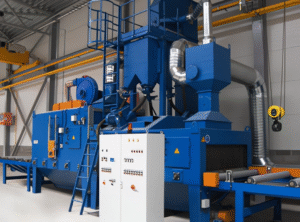
Chong Jen Machinery’s design experts recommend conducting a thorough workflow audit to align requirements with practical needs—our team works with buyers to document every detail, from workpiece CAD models to production targets, ensuring the robotic shot blasting workstation integrates seamlessly with existing shot blasting machine and production lines. This initial step reduces design errors by 40% and ensures the final setup delivers maximum ROI.
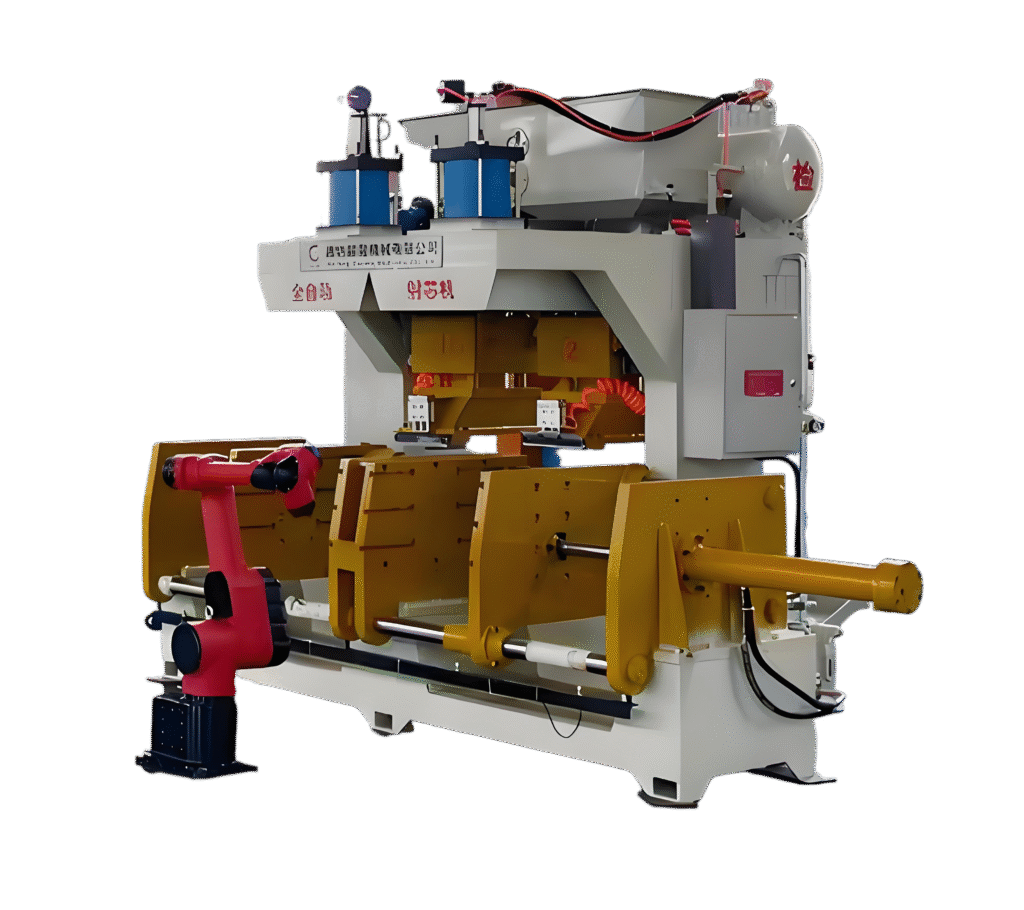
Select Suitable Industrial Robot for Robotic Shot Blasting Workstation
The industrial robot is the core of the robotic shot blasting workstation, as its performance directly impacts precision, efficiency, and versatility.
- Choosing the right industrial robot requires matching its specifications to the workstation’s core requirements, avoiding overcapacity or underperformance. Key factors to consider include degrees of freedom (DOF), payload capacity, repeatability, and reach. For complex workpieces (e.g., turbine blades, gearboxes), a 6-axis industrial robot with ±0.03mm repeatability is ideal, as it can navigate intricate contours and hard-to-reach areas .
- Payload capacity should accommodate the shot blasting nozzle or wheelblast equipment attachment—most robotic shot blasting workstations use industrial robots with 12-50kg payloads, while heavy-duty applications may require 100kg+ models.
Additionally, the industrial robot should be compatible with offline programming software, allowing operators to import workpiece CAD models and generate optimal paths without disrupting production . Chong Jen Machinery specializes in integrating industrial robots from leading brands (e.g., Fanuc, ABB) into custom robotic shot blasting workstations, ensuring seamless compatibility with wheelblast equipment and shot blasting machine. Our experts select robots based on your specific workpiece and production needs, balancing precision and cost to deliver a solution that maximizes efficiency.
Integrate Wheelblast Equipment and Shot Blasting Machine into the Workstation
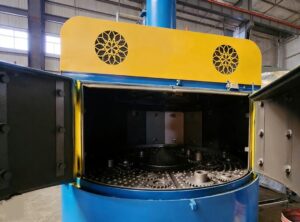
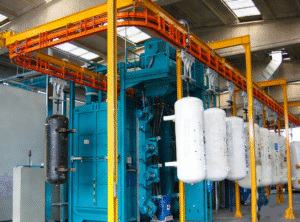
Integrating high-quality wheelblast equipment and shot blasting machine is critical to the robotic shot blasting workstation’s performance, as these components determine the quality of surface treatment and overall efficiency.
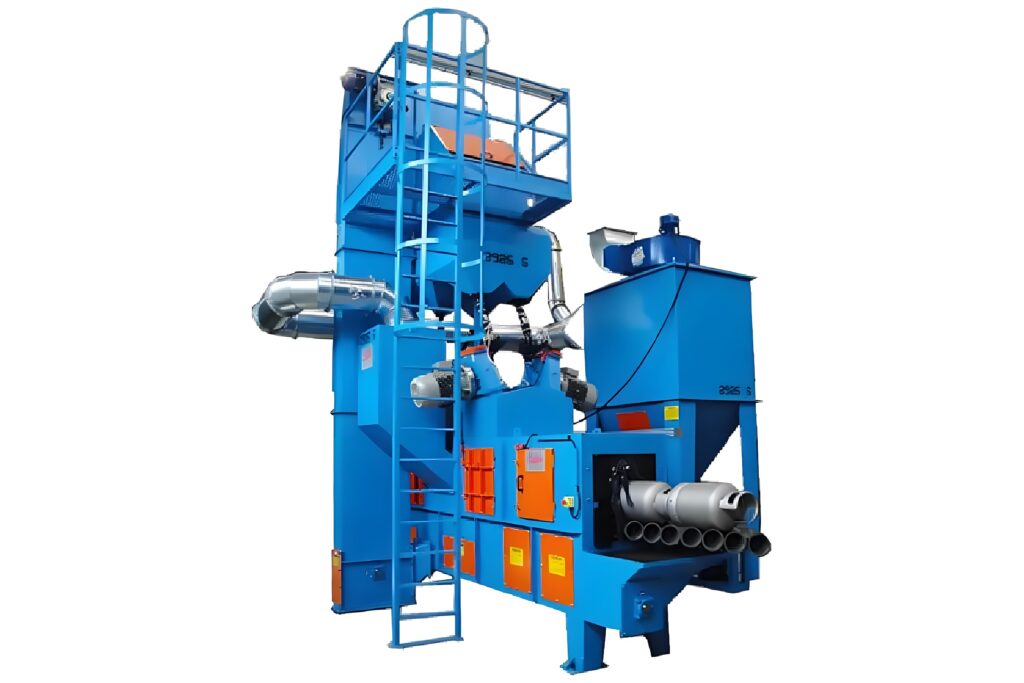
- Wheelblast equipment is preferred for high-volume, heavy-duty applications, as it uses centrifugal force to propel abrasives, delivering consistent, powerful cleaning . When integrating wheelblast equipment, consider factors like blast wheel speed, abrasive type (steel shot, garnet), and recovery systems.
- For precision applications, pairing wheelblast equipment with a shot blasting machine that has adjustable abrasive flow rates ensures controlled, uniform surface treatment. The workstation should also include an efficient abrasive recovery system—Chong Jen Machinery’s custom designs integrate cyclone separators and cartridge filters that recycle 95%+ of abrasives, reducing waste and operational costs .
Additionally, the shot blasting machine and wheelblast equipment must be aligned with the industrial robot’s movement range, ensuring the robot can position the workpiece (or nozzle) for full coverage. The table below compares different wheelblast equipment configurations for robotic shot blasting workstations, based on real-world performance data:
| Wheelblast Equipment Configuration | Abrasive Recovery Efficiency | Surface Treatment Uniformity | Suitable Workpiece Type |
| Single External Blast Wheel | 90-92% | 85-90% | Small to Medium Precision Parts |
| Dual Blast Wheels (Custom Chong Jen) | 95%+ | 95%+ | Large/Complex Components |
| Integrated Wheelblast + Shot Blasting Machine | 93-95% | 90-95% | Mixed Production Lines |
Design Custom Workstation Layout for Efficiency and Safety
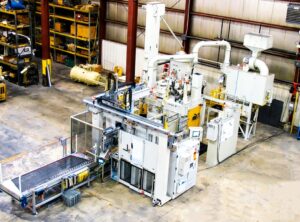
A custom workstation layout is essential to maximize efficiency, ensure safety, and accommodate the industrial robot, wheelblast equipment, and shot blasting machine. Poor layout leads to bottlenecks, safety hazards, and reduced productivity—Chong Jen Machinery’s design team prioritizes a layout that minimizes workpiece movement, optimizes robot reach, and complies with safety standards. Key layout considerations include:
- First, the industrial robot’s placement to ensure full coverage of the shot blasting area without collision with wheelblast equipment or shot blasting machine.
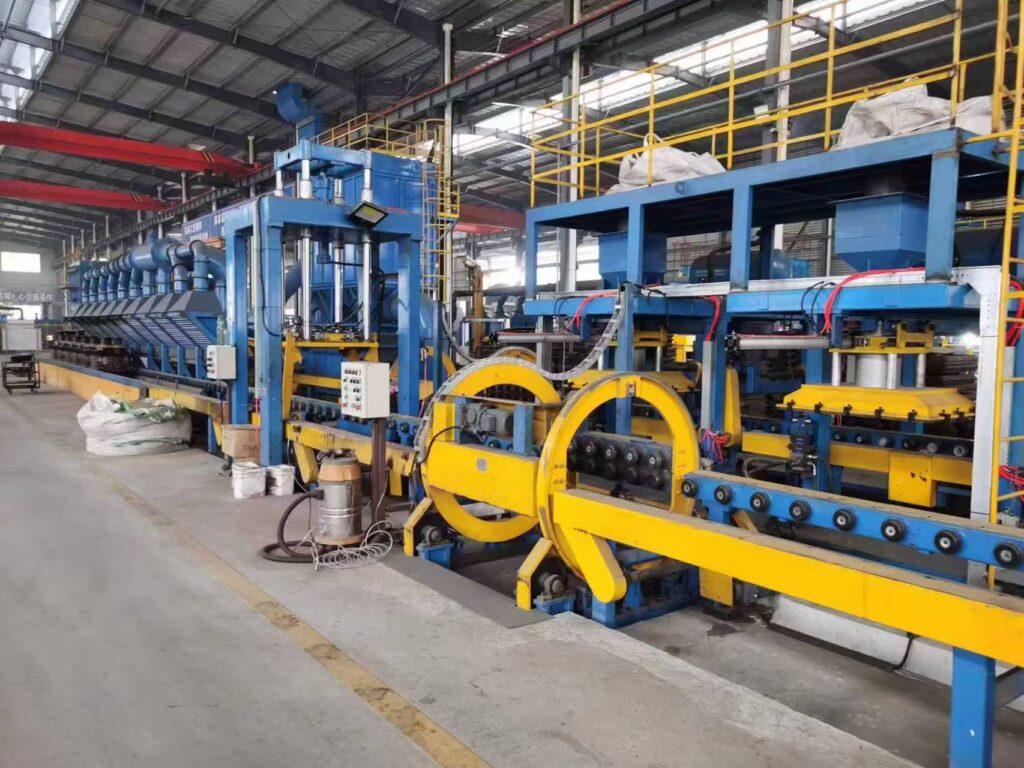
- Second, integrating a conveyor system (or custom fixture table) to transport workpieces in and out of the workstation, reducing manual handling and increasing throughput. For dynamic production lines, AGV integration allows for flexible workpiece transport, adapting to changing production needs .
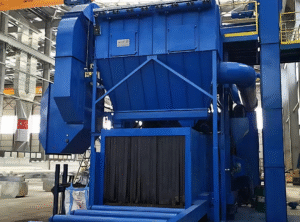
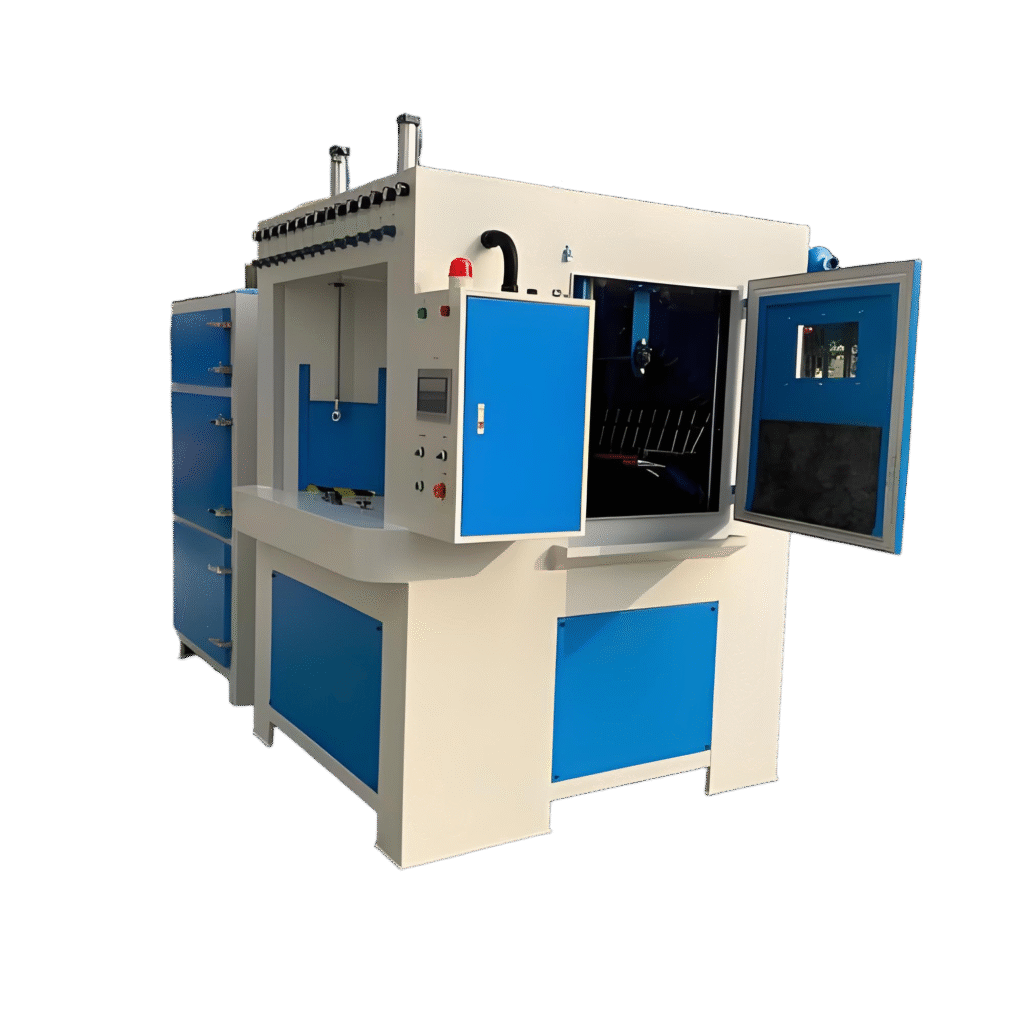
- Third, designing a sealed enclosure to contain abrasives and dust, protecting workers and preventing contamination—this is especially critical when integrating wheelblast equipment, which generates high levels of dust. The enclosure should include access doors for maintenance and emergency stops for safety.
Chong Jen Machinery’s custom layouts also incorporate ergonomic maintenance areas, with external-mounted wheelblast equipment for easy access, reducing downtime for repairs and cleaning. By tailoring the layout to your production space and workflow, we ensure the robotic shot blasting workstation operates seamlessly with minimal waste.
Implement Custom Control Systems and Automation Integration
Custom control systems are the “brain” of the robotic shot blasting workstation, enabling seamless coordination between the industrial robot, wheelblast equipment, shot blasting machine, and other components.
- A well-designed control system reduces human error, improves repeatability, and allows for real-time monitoring of performance. Key features of a custom control system include offline programming (OLP) software, which lets operators program the industrial robot using workpiece CAD models, reducing setup time from hours to minutes .
- The system should also integrate real-time data monitoring, tracking metrics like abrasive consumption, robot performance, and surface treatment quality—this data helps identify inefficiencies and predict maintenance needs. Chong Jen Machinery’s custom control systems are designed to integrate with existing MES/PLM systems, enabling end-to-end production traceability and process optimization .
Additionally, the control system should include safety interlocks (e.g., emergency stops, door sensors) to shut down operations if hazards are detected. For multi-robot workstations, the control system coordinates robot movements to avoid collisions and maximize throughput. Our experts also implement adaptive control features, where the industrial robot adjusts its path based on real-time feedback from sensors, ensuring uniform surface treatment even for workpieces with minor variations. This level of custom automation reduces unplanned downtime by 40% and improves overall production efficiency.
Address Safety and Maintenance Considerations in Design
Safety and maintenance are non-negotiable in robotic shot blasting workstation design, as they protect workers, extend equipment lifespan, and reduce downtime.
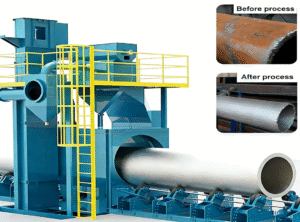
- Neglecting these factors leads to safety violations, costly repairs, and reduced productivity. For safety, the workstation must include a sealed enclosure with dust collection systems (ATEX-certified filters for hazardous dust), emergency stop buttons at multiple locations, and safety guards for moving parts .
- The industrial robot should be equipped with collision detection sensors to prevent accidents, and operators should have access to remote control capabilities to operate the workstation from a safe distance. For maintenance, the design should include easy access to key components—Chong Jen Machinery’s custom workstations feature external-mounted wheelblast equipment, removable panels for shot blasting machine maintenance, and tool-less access to robot end-effectors.
Additionally, the workstation should include an automated abrasive cleaning and recovery system, reducing manual maintenance and ensuring consistent performance of the wheelblast equipment. We also integrate predictive maintenance features into the control system, which alerts operators to potential issues (e.g., worn blast wheel blades, low abrasive levels) before they cause downtime. By prioritizing safety and maintenance in the design, we help B2B buyers reduce accidents by 70% and extend equipment lifespan by 30%.
Optimize Workpiece Fixturing for Precision in Robotic Shot Blasting
Workpiece fixturing is a critical yet often overlooked aspect of robotic shot blasting workstation design, as poor fixturing leads to inaccurate surface treatment, workpiece damage, and reduced efficiency.
- Custom fixturing is essential to accommodate different workpiece shapes and sizes, ensuring the industrial robot can position the workpiece optimally for the wheelblast equipment or shot blasting machine.
- Key considerations for fixturing design include: ensuring the fixture holds the workpiece securely without damaging it, providing unobstructed access to all surfaces that require shot blasting, and being compatible with the industrial robot’s gripper. For complex workpieces (e.g., aerospace engine casings), Chong Jen Machinery designs custom fixtures with adjustable clamps and 3D-printed adapters, ensuring precise positioning with ±0.05mm accuracy .
Additionally, the fixture should be easy to change for different workpiece types—our quick-change fixturing systems reduce changeover time from 4 hours to 15 minutes, ideal for small-batch, multi-variety production . The fixturing system should also integrate with the control system, allowing the industrial robot to automatically recognize the fixture and adjust its path accordingly. By optimizing fixturing, we ensure uniform surface treatment, reduce workpiece waste by 25%, and improve the overall efficiency of the robotic shot blasting workstation.
Test and Optimize the Robotic Shot Blasting Workstation Design
Testing and optimization are final, critical steps in robotic shot blasting workstation design, ensuring the setup meets all requirements and delivers optimal performance.
- Before full-scale deployment, Chong Jen Machinery conducts comprehensive testing, including dry runs with dummy workpieces to verify industrial robot movement, wheelblast equipment performance, and control system functionality. We measure key metrics like surface treatment uniformity, cycle time, and abrasive consumption, comparing results to the initial requirements.
- If adjustments are needed—such as optimizing the industrial robot’s path, adjusting wheelblast equipment parameters, or modifying fixturing—our team implements custom tweaks to improve performance. For example, if surface treatment uniformity is below target, we may adjust the industrial robot’s speed or reposition the wheelblast equipment to ensure full coverage. Post-deployment, we conduct ongoing optimization, using real-time data from the control system to identify bottlenecks and refine the design.
Our experts also provide operator training to ensure the workstation is used to its full potential, maximizing efficiency and reducing human error. This testing and optimization phase reduces post-deployment issues by 50% and ensures the robotic shot blasting workstation delivers consistent, high-quality results.
Conclusion
Design custom robotic shot blasting workstation with industrial robot and wheelblast equipment.
Contact Chong Jen Machinery
For custom robotic shot blasting workstation design, integrating industrial robot, wheelblast equipment and shot blasting machine,
email Chong Jen Machinery: [email protected].
Our experts will tailor a solution to your production needs, delivering efficiency, precision, and long-term value.
 English
  Russian
  Spanish
  Portuguese
  French
  Indonesian
  Thai
Thai