
Wrong selection of shot blasting equipment damages steel structures; master key points to choose suitable blast equipment.
This guide summarizes key selection points for steel structure shot blasting equipment, helping you choose appropriate wheelblast equipment and blast equipment for stable operation.
Explore key selection points for shot blasting equipment and wheelblast equipment below.
Key Point 1: Match Shot Blasting Equipment with Steel Structure Specifications
The primary key point for selecting steel structure shot blasting equipment is to match the equipment with the specifications of the steel structures to be processed, which is also a core principle for choosing wheelblast equipment and blast equipment.
- Steel structures vary in size, weight, and shape—from small angle steel and steel plates to large H-beams, box girders, and trusses—and each requires corresponding shot blasting equipment. For small to medium-sized steel structures, compact shot blasting equipment with moderate power is sufficient, while large steel structures need heavy-duty wheelblast equipment with a larger processing chamber and higher shot throwing capacity.
- The wheelblast equipment used for steel structures must have a processing chamber that can accommodate the maximum size of the workpiece, with a reserved distance of at least 300mm between the workpiece and the shot blaster to avoid collisions and ensure uniform shot blasting.
Additionally, blast equipment must match the weight of the steel structure; for heavy workpieces, blast equipment with a high-load-bearing conveyor system is required to prevent equipment damage or workpiece jamming.Choosing shot blasting equipment that matches steel structure specifications ensures efficient processing, avoids equipment overload, and extends the service life of shot blasting equipment, wheelblast equipment, and blast equipment.
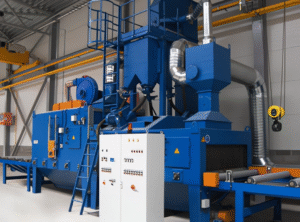
Key Point 2: Focus on Core Performance of Wheelblast Equipment for Steel Structures
The core performance of wheelblast equipment directly determines the shot blasting effect and efficiency of steel structures, making it a key selection point for shot blasting equipment and blast equipment.
- The shot blaster, as the core component of wheelblast equipment, should have stable power output and adjustable shot throwing speed—preferably with an impeller speed of no less than 2000r/min to ensure the initial projectile velocity is at least 60m/s, avoiding rust residue.
- The shot recycling system of wheelblast equipment is also crucial; a combination of screw conveyor and bucket elevator can ensure a shot circulation cycle of no more than 30 seconds, preventing idling wear of the shot blaster. For steel structure shot blasting, shot blasting equipment must have uniform shot coverage to eliminate cleaning blind spots—large steel structures may require 6-8 shot blasters arranged at multiple angles.
Additionally, the durability of blast equipment is essential; key components such as shot blaster blades and chamber liners should be made of high-wear-resistant materials like high-chromium cast iron to extend service life. Focusing on the core performance of wheelblast equipment ensures that the selected shot blasting equipment can meet the surface treatment requirements of steel structures and operate stably for a long time.
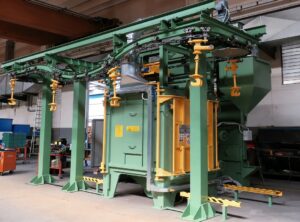
Key Point 3: Consider Environmental Protection and Safety of Blast Equipment
When selecting steel structure shot blasting equipment, it is crucial to consider the environmental protection and safety performance of blast equipment, which is also an important criterion for evaluating shot blasting equipment and wheelblast equipment.
- Steel structure shot blasting produces a large amount of dust and noise, so blast equipment must be equipped with an efficient dust removal system—preferably a pulse backblow bag filter with an air volume of no less than 150m³/(kW·h) per shot blaster, ensuring the emission concentration is no more than 30mg/m³. The overall noise of shot blasting equipment should be controlled below 85dB, which can be achieved by adding sound insulation covers and shock-absorbing pads.
- In terms of safety, blast equipment must be equipped with emergency stop buttons, door safety interlocks (which automatically cut off power when the chamber door is opened), and overload protection sensors, complying with relevant safety standards. Wheelblast equipment should also have a protective structure to prevent projectile splashing and ensure operator safety.
Choosing blast equipment with excellent environmental protection and safety performance not only meets national environmental protection requirements but also protects the health of operators and avoids safety accidents.
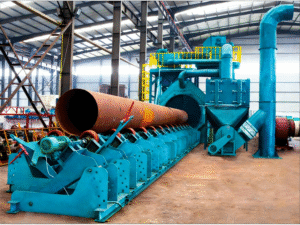
Key Point 4: Balance Cost-Effectiveness of Shot Blasting Equipment
Balancing cost-effectiveness is a practical key point for selecting steel structure shot blasting equipment, as it involves the long-term operation cost of shot blasting equipment, wheelblast equipment, and blast equipment.
- Many users blindly pursue low prices and ignore the quality of blast equipment, leading to frequent failures, high maintenance costs, and reduced production efficiency. High-quality shot blasting equipment may have a higher initial investment, but it has stable performance, low failure rates, and long service life, reducing long-term maintenance and replacement costs.
- When selecting, it is necessary to compare the cost-performance ratio of different shot blasting equipment, considering not only the purchase price but also factors such as energy consumption, maintenance difficulty, and the service life of wearing parts. Wheelblast equipment with energy-saving design can reduce power consumption, while blast equipment with easy-to-replace wearing parts can reduce maintenance time and costs.
Additionally, choosing shot blasting equipment with a complete after-sales service system ensures timely maintenance and technical support, avoiding production interruptions. Balancing cost-effectiveness ensures that the selected shot blasting equipment can meet production needs while minimizing operational costs.
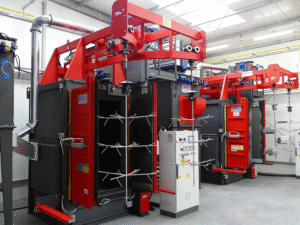
Key Point 5: Ensure Compatibility of Shot Blasting Equipment with Production Scenarios
The compatibility of shot blasting equipment with actual production scenarios is another key selection point, which directly affects the efficiency of steel structure shot blasting.
- Different production scenarios have different requirements for shot blasting equipment: continuous large-scale production requires shot blasting equipment with high automation and continuous operation capabilities, such as assembly line-type wheelblast equipment that can realize automatic feeding, shot blasting, and unloading.
- For small-batch, multi-specification steel structure processing, blast equipment with flexible adjustment capabilities is more suitable, allowing for quick parameter adjustment to adapt to different workpieces.
Additionally, the installation space of the workshop should be considered when selecting shot blasting equipment; compact blast equipment is suitable for workshops with limited space, while large wheelblast equipment requires sufficient installation and maintenance space. The shot blasting equipment should also be compatible with the subsequent processing procedures of steel structures, such as coating and welding, ensuring a seamless connection between processes. Ensuring the compatibility of shot blasting equipment with production scenarios maximizes the role of wheelblast equipment and blast equipment, improving overall production efficiency.
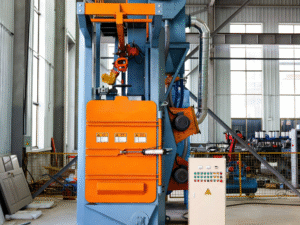
Common Selection Pitfalls of Steel Structure Shot Blasting Equipment and Avoidance Methods
When selecting steel structure shot blasting equipment, many users fall into common pitfalls, which affect the use effect of shot blasting equipment, wheelblast equipment, and blast equipment.
- One common pitfall is ignoring the matching between shot blasting equipment and steel structure specifications, leading to insufficient processing capacity or equipment waste. To avoid this, clearly clarify the maximum size, weight, and processing volume of steel structures before selection, and select corresponding shot blasting equipment.
- Another pitfall is neglecting the quality of core components of wheelblast equipment, such as using shot blasters with low power density, which leads to unstable projectile velocity and accelerated wear. The solution is to check the power density, impeller dynamic balance level, and material of key components when selecting, and require manufacturers to provide relevant detection reports.
- A third pitfall is ignoring the after-sales service of blast equipment, leading to difficult maintenance and long downtime when failures occur. To avoid this, choose manufacturers with rich experience and perfect after-sales service, and confirm the warranty period and maintenance response time. Avoiding these pitfalls ensures that the selected shot blasting equipment is practical, stable, and cost-effective.
Conclusion
Master key points to select suitable shot blasting, wheelblast and blast equipment for steel structures.
For steel structure shot blasting equipment, wheelblast equipment and blast equipment solutions,
email: [email protected]
 English
  Russian
  Spanish
  Portuguese
  French
  Indonesian
  Thai
Thai