Improper mobile shot blasting machine operation causes inefficiency; this guide ensures safe, smooth machine shot.
This practical guide details the full operation process of mobile shot blasting machines, covering shot blast preparation, operation, and maintenance for efficient shot blasting.
Explore step-by-step operation tips and key precautions for mobile shot blasting machines below.
How to Prepare for Mobile Shot Blasting Machine Operation?
Adequate preparation is the foundation for safe and efficient operation of mobile shot blasting machines, avoiding faults and accidents during shot blast.
- Check the equipment comprehensively: inspect the mobile shot blasting machine’s impeller head, nozzle, abrasive hopper, and transmission system for wear, looseness, or blockage. Ensure the impeller blades and shot wheel are intact, the nozzle is free of damage, and the abrasive pipeline is unobstructed. Check the engine, air compressor, and electrical system of the mobile equipment to ensure normal start-up and operation.
- Prepare abrasives and workpieces: select abrasives suitable for the workpiece material (such as steel shot for metal workpieces, glass beads for precision parts) with uniform particle size (0.8-2.0mm), and add them to the hopper after filtering out impurities. Clean the workpiece surface to remove oil, rust, and debris, which will affect shot blasting effect. Mark the shot blast area to avoid missing or overlapping processing.
- Prepare protective equipment: operators must wear professional protective gear, including goggles, dust masks, protective clothing, and anti-slip gloves, to prevent injury from abrasive splashing, dust inhalation, or equipment operation.
- Conduct a test run: start the mobile shot blasting machine, run it idly for 3-5 minutes, check for abnormal noise, vibration, or leakage, and adjust the machine shot parameters (speed, flow rate) to the appropriate range before formal shot blasting. Full preparation can reduce equipment faults by 40% and ensure smooth operation.
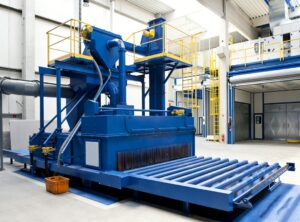
What Are the Step-by-Step Operations for Mobile Shot Blasting Machines?
Following standard step-by-step operations ensures uniform shot blasting effect and extends the service life of the mobile shot blasting machine.
- Start the equipment in sequence: turn on the power switch, start the air compressor, wait for the air pressure to reach 0.6-0.8MPa, then start the engine of the mobile shot blasting machine, and finally start the impeller head and abrasive feeding system. Avoid starting all components at the same time to prevent overload.
- Adjust operation parameters: according to the workpiece material, surface requirements, and shot blast area, adjust the impeller speed (1500-2000rpm), abrasive flow rate (200-300kg/min), and shot blast distance (50-100mm). Maintain a 45-60° nozzle angle to ensure uniform impact on the workpiece surface. For large-area workpieces (such as floors, steel plates), move the mobile shot blasting machine at a uniform speed (5-10cm/s), overlapping each shot blast area by 10-15% to avoid missing.
- Monitor operation in real time: during shot blasting, observe the equipment’s operation status, including abrasive supply, noise, and vibration, and check the workpiece surface effect regularly. If uneven shot blasting, equipment jamming, or other abnormalities occur, stop the machine immediately for inspection and handling.
- Shut down the equipment in sequence: after completing shot blast, first stop the abrasive feeding system, then run the impeller head idly for 1-2 minutes to clear residual abrasives in the pipeline, then turn off the impeller head, engine, and air compressor, and finally cut off the power. Standard step-by-step operations ensure efficient and safe shot blasting.
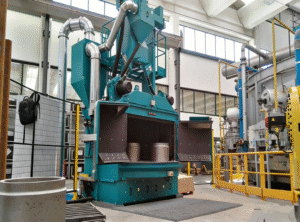
How to Adjust Parameters for Different Workpieces in Mobile Shot Blasting?
Mobile shot blasting machines are widely used for various workpieces, and adjusting parameters according to workpiece types is key to ensuring shot blasting quality.
- Metal workpieces (such as steel plates, steel structures): select spherical steel shot with a particle size of 1.0-2.0mm, set the impeller speed to 1800-2000rpm, air pressure to 0.7-0.8MPa, and abrasive flow rate to 250-300kg/min. The shot blast distance is 50-70mm, and the moving speed is 5-8cm/s, ensuring thorough derusting and surface strengthening.
- Orecision hardware workpieces (such as screws, nuts): use fine glass beads or aluminum oxide (0.3-0.8mm), reduce the impeller speed to 1200-1500rpm, air pressure to 0.4-0.6MPa, and flow rate to 150-200kg/min. Increase the shot blast distance to 70-100mm, move at 8-10cm/s, avoiding damage to the workpiece surface.
- Concrete workpieces (such as floors, bridges): select angular steel grit (1.5-2.5mm), set the impeller speed to 2000-2200rpm, air pressure to 0.8MPa, and flow rate to 300kg/min. The moving speed is 3-5cm/s, ensuring the concrete surface is roughened evenly for subsequent bonding.
- Castings: use steel shot (0.8-1.5mm), adjust the impeller speed to 1500-1800rpm, air pressure to 0.6-0.7MPa, and flow rate to 200-250kg/min, removing sand and burrs while controlling surface roughness. Reasonable parameter adjustment ensures that each workpiece meets the required shot blasting effect.
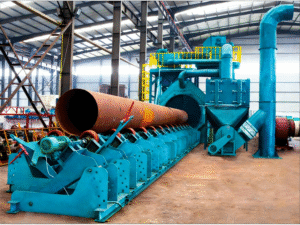
What Are the Safety Precautions for Mobile Shot Blasting Machine Operation?
Safety is the top priority in mobile shot blasting machine operation, and mastering key precautions can avoid accidents and protect operators and equipment.
- Operator requirements: only trained and qualified operators can operate the equipment; no untrained personnel are allowed to start or touch the mobile shot blasting machine. Operators must wear full protective equipment during operation and are not allowed to take off protective gear midway.
- On-site safety: the shot blast area must be isolated with warning signs, and no unrelated personnel are allowed to enter to prevent abrasive splashing injury. Avoid operating the equipment in rainy, windy, or high-temperature environments—rainwater may damage electrical components, and strong winds may affect shot blasting uniformity.
- Equipment safety: do not overload the mobile shot blasting machine, and avoid idling for a long time (no more than 10 minutes) to prevent excessive wear of the impeller and motor. Do not open the abrasive hopper or pipeline during operation to avoid abrasive leakage. If the equipment fails, stop the machine immediately, cut off the power, and perform maintenance after the machine cools down—do not repair while the machine is running.
- Emergency handling: prepare fire extinguishers and first-aid kits on-site. If an electrical fault or fire occurs, cut off the power immediately and use a dry powder fire extinguisher to put out the fire. If an operator is injured by abrasive splashing, stop the operation and provide first aid promptly. Strictly following safety precautions ensures zero accidents during shot blasting.
How to Maintain Mobile Shot Blasting Machines Daily?
Regular daily maintenance extends the service life of mobile shot blasting machines, ensuring stable performance and consistent shot blasting effect.
- Daily maintenance after operation: clean the equipment thoroughly, remove residual abrasives, dust, and debris from the impeller head, nozzle, pipeline, and hopper to avoid blockage and corrosion. Inspect the nozzle, impeller blades, and shot wheel for wear—replace them if the wear exceeds 3mm. Check the tightness of fasteners (bolts, nuts) and tighten them in time. Lubricate the moving parts (motor bearings, impeller shaft) with high-temperature resistant grease to reduce friction.
- Weekly maintenance: inspect the air compressor, engine, and electrical system, check for oil, gas, or power leakage, and add oil or repair as needed. Clean the abrasive filter and recovery system, ensuring normal abrasive recycling. Calibrate the parameter gauges (pressure gauge, flow meter, speed meter) to ensure accurate measurement.
- Monthly maintenance: disassemble the impeller head and nozzle for thorough cleaning and inspection, replace worn seals and gaskets. Check the abrasive storage hopper for corrosion and repair or paint if necessary. Test the overall performance of the mobile shot blasting machine, adjust parameters, and ensure it operates normally.
Additionally, store the equipment in a dry, ventilated place when not in use, cover it with a dust cover to avoid dust and moisture. Proper daily maintenance can extend the equipment’s service life by 50% and reduce maintenance costs.
Conclusion
Follow preparation, operation, parameter adjustment and maintenance for safe mobile shot blasting.
For professional guidance on mobile shot blasting machine operation and maintenance,
contact us via email: [email protected]
 English
  Russian
  Spanish
  Portuguese
  French
  Indonesian
  Thai
Thai