
Improper mobile shot blasting machine operation causes inefficiency; this guide ensures safe, smooth machine shot.
This practical guide details the full operation process of mobile shot blasting machines, covering shot blast preparation, operation, and maintenance for efficient shot blasting.
Explore step-by-step operation tips and key precautions for mobile shot blasting machines below.
How to Prepare for Mobile Shot Blasting Machine Operation?
Adequate preparation is the foundation for safe and efficient operation of mobile shot blasting machines, avoiding faults and accidents during shot blast.
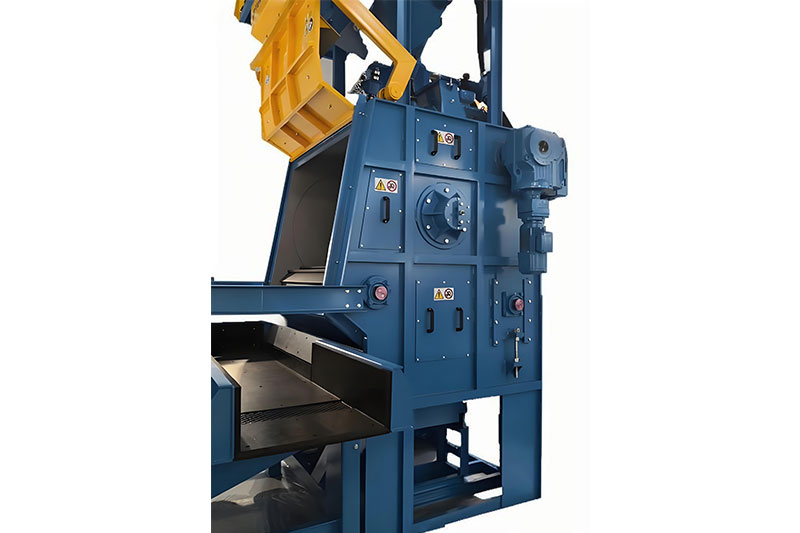
- Check the equipment comprehensively: inspect the mobile máquina de chorro de arena’s impeller head, nozzle, abrasive hopper, and transmission system for wear, looseness, or blockage. Ensure the impeller blades and shot wheel are intact, the nozzle is free of damage, and the abrasive pipeline is unobstructed. Check the engine, air compressor, and electrical system of the mobile equipment to ensure normal start-up and operation.
- Prepare abrasives and workpieces: select abrasives suitable for the workpiece material (such as steel shot for metal workpieces, glass beads for precision parts) with uniform particle size (0.8-2.0mm), and add them to the hopper after filtering out impurities. Clean the workpiece surface to remove oil, rust, and debris, which will affect shot blasting effect. Mark the shot blast area to avoid missing or overlapping processing.
- Prepare protective equipment: operators must wear professional protective gear, including goggles, dust masks, protective clothing, and anti-slip gloves, to prevent injury from abrasive splashing, dust inhalation, or equipment operation.
- Conduct a test run: start the mobile máquina de chorro de arena, run it idly for 3-5 minutes, check for abnormal noise, vibration, or leakage, and adjust the machine shot parameters (speed, flow rate) to the appropriate range before formal shot blasting. Full preparation can reduce equipment faults by 40% and ensure smooth operation.
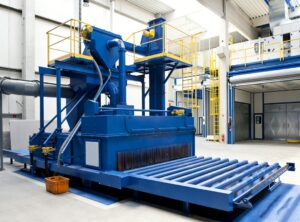
What Are the Step-by-Step Operations for Mobile Shot Blasting Machines?
Following standard step-by-step operations ensures uniform shot blasting effect and extends the service life of the mobile shot blasting machine.
- Start the equipment in sequence: turn on the power switch, start the air compressor, wait for the air pressure to reach 0.6-0.8MPa, then start the engine of the mobile shot blasting machine, and finally start the impeller head and abrasive feeding system. Avoid starting all components at the same time to prevent overload.
- Ajustar los parámetros de operación: de acuerdo con el material de la pieza de trabajo, los requisitos de superficie y el área de chorro, ajustar la velocidad del impulsor (1500-2000rpm), la tasa de flujo de abrasivo (200-300kg/min) y operación de granallado la distancia (50-100mm). Mantener un ángulo de boquilla de 45-60° para asegurar un impacto uniforme en la superficie de la pieza de trabajo. Para piezas de trabajo de gran área (como pisos, placas de acero), mover la máquina de chorro móvil a una velocidad uniforme (5-10cm/s), superponiendo cada área de chorro en un 10-15% para evitar omisiones.
- Monitorear la operación en tiempo real: durante el chorro, observar el estado de operación del equipo, incluyendo el suministro de abrasivo, ruido y vibración, y verificar regularmente el efecto en la superficie de la pieza de trabajo. Si ocurre un chorro desigual, atascos de equipo u otras anomalías, detener la máquina inmediatamente para inspección y manejo.
- Apagar el equipo en secuencia: después de completar operación de granallado, primero detener el sistema de alimentación de abrasivo, luego hacer funcionar el cabezal del impulsor en vacío durante 1-2 minutos para limpiar los abrasivos residuales en la tubería, luego apagar el cabezal del impulsor, el motor y el compresor de aire, y finalmente cortar la energía. Las operaciones estándar paso a paso garantizan un chorro eficiente y seguro.
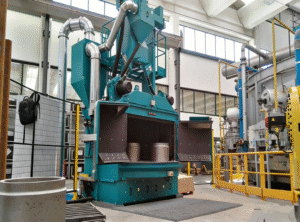
¿Cómo ajustar parámetros para diferentes piezas de trabajo en el chorro móvil?
Las máquinas de chorro móvil se utilizan ampliamente para diversas piezas de trabajo, y ajustar los parámetros de acuerdo con los tipos de piezas de trabajo es clave para garantizar la calidad del chorro.
- Piezas de trabajo metálicas (como placas de acero, estructuras de acero): seleccionar gránulos de acero esféricos con un tamaño de partícula de 1.0-2.0mm, establecer la velocidad del impulsor en 1800-2000rpm, la presión de aire en 0.7-0.8MPa, y la tasa de flujo abrasivo en 250-300kg/min. La operación de granallado distancia es de 50-70mm, y la velocidad de movimiento es de 5-8cm/s, asegurando un desoxidado exhaustivo y un fortalecimiento de la superficie.
- Piezas de trabajo de hardware de precisión (como tornillos, tuercas): usar perlas de vidrio finas u óxido de aluminio (0.3-0.8mm), reducir la velocidad del impulsor a 1200-1500rpm, la presión de aire a 0.4-0.6MPa, y la tasa de flujo a 150-200kg/min. Aumentar la distancia de chorro a 70-100mm, mover a 8-10cm/s, evitando daños en la superficie de la pieza de trabajo.
- Piezas de trabajo de concreto (como pisos, puentes): seleccionar granalla de acero angular (1.5-2.5mm), establecer la velocidad del impulsor en 2000-2200rpm, la presión de aire en 0.8MPa, y la tasa de flujo en 300kg/min. La velocidad de movimiento es de 3-5cm/s, asegurando que la superficie del concreto esté rugosa uniformemente para un posterior enlace.
- Fundiciones: usar bolas de acero (0.8-1.5mm), ajustar la velocidad del impulsor a 1500-1800rpm, la presión de aire a 0.6-0.7MPa, y la tasa de flujo a 200-250kg/min, eliminando arena y rebabas mientras se controla la rugosidad de la superficie. Un ajuste razonable de parámetros asegura que cada pieza de trabajo cumpla con el calidad del granallado efecto requerido.
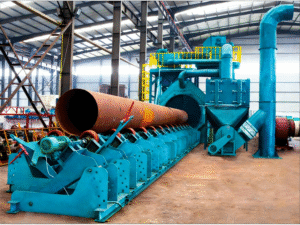
What Are the Safety Precautions for Mobile Shot Blasting Machine Operation?
Safety is the top priority in mobile shot blasting machine operation, and mastering key precautions can avoid accidents and protect operators and equipment.
- Operator requirements: only trained and qualified operators can operate the equipment; no untrained personnel are allowed to start or touch the mobile shot blasting machine. Operators must wear full protective equipment during operation and are not allowed to take off protective gear midway.
- On-site safety: the shot blast area must be isolated with warning signs, and no unrelated personnel are allowed to enter to prevent abrasive splashing injury. Avoid operating the equipment in rainy, windy, or high-temperature environments—rainwater may damage electrical components, and strong winds may affect shot blasting uniformity.
- Equipment safety: do not overload the mobile máquina de chorro de arena, and avoid idling for a long time (no more than 10 minutes) to prevent excessive wear of the impeller and motor. Do not open the abrasive hopper or pipeline during operation to avoid abrasive leakage. If the equipment fails, stop the machine immediately, cut off the power, and perform maintenance after the machine cools down—do not repair while the machine is running.
- Emergency handling: prepare fire extinguishers and first-aid kits on-site. If an electrical fault or fire occurs, cut off the power immediately and use a dry powder fire extinguisher to put out the fire. If an operator is injured by abrasive splashing, stop the operation and provide first aid promptly. Strictly following safety precautions ensures zero accidents during calidad del granallado.
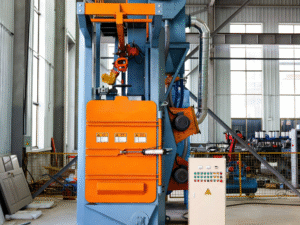
How to Maintain Mobile Shot Blasting Machines Daily?
Regular daily maintenance extends the service life of mobile shot blasting machines, ensuring stable performance and consistent shot blasting effect.
- Daily maintenance after operation: clean the equipment thoroughly, remove residual abrasives, dust, and debris from the impeller head, nozzle, pipeline, and hopper to avoid blockage and corrosion. Inspect the nozzle, impeller blades, and shot wheel for wear—replace them if the wear exceeds 3mm. Check the tightness of fasteners (bolts, nuts) and tighten them in time. Lubricate the moving parts (motor bearings, impeller shaft) with high-temperature resistant grease to reduce friction.
- Weekly maintenance: inspect the air compressor, engine, and electrical system, check for oil, gas, or power leakage, and add oil or repair as needed. Clean the abrasive filter and recovery system, ensuring normal abrasive recycling. Calibrate the parameter gauges (pressure gauge, flow meter, speed meter) to ensure accurate measurement.
- Monthly maintenance: disassemble the impeller head and nozzle for thorough cleaning and inspection, replace worn seals and gaskets. Check the abrasive storage hopper for corrosion and repair or paint if necessary. Test the overall performance of the mobile shot blasting machine, adjust parameters, and ensure it operates normally.
Adicionalmente, almacene el equipo en un lugar seco y ventilado cuando no esté en uso, cúbralo con una funda contra el polvo para evitar el polvo y la humedad. Un mantenimiento diario adecuado puede extender la vida útil del equipo en un 50% y reducir los costos de mantenimiento.
Conclusión
Siga la preparación, operación, ajuste de parámetros y mantenimiento para un chorro de arena móvil seguro.
Para obtener orientación profesional sobre la operación y el mantenimiento de la máquina de chorro de arena móvil,
contáctenos por correo electrónico: [email protected]
 Spanish
  English
  Russian
  Portuguese
  French
  Indonesian
  Thai
Thai