
Are Outdated Blast Wheel Designs Increasing Maintenance Risk?
Many foundries and fabricators still evaluate a Blast Wheel mainly by purchase price, wear-part cost, or basic operating capacity. However, difficult access, unsafe servicing, and inaccurate reassembly can create longer shutdowns, inconsistent cleaning, and avoidable media loss. Without practical design upgrades, maintenance workload and quality risk continue increasing throughout the shot blasting machine lifecycle.
The most effective Blast Wheel upgrades combine modular quick release, external angle adjustment, split-housing access, easy blade replacement, assembly fault tolerance, and repeatable positioning. Our Manufacturer and Supplier provides Customizable OEM and ODM shot blaster solutions designed to improve operational safety, reduce maintenance time, and maintain consistent blasting quality.
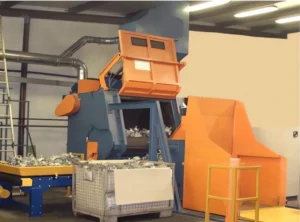
Move Beyond Traditional Maintenance Strategies
Blast Wheel procurement traditionally follows three approaches. The first focuses on cost and wear, comparing blade prices, expected service life, and abrasive consumption. The second emphasizes operating condition customization, matching wheel capacity to casting type, shot specification, production pace, and chamber layout. The third concentrates on disassembly and maintenance, assessing how technicians inspect and replace worn components.
Each approach remains relevant, but none is sufficient alone. A low-cost wheel can become expensive if maintenance access is poor. A highly customized design can still create safety risks if operators must work in restricted spaces. A serviceable wheel may not deliver consistent quality if components cannot be reassembled with repeatable precision. Modern design upgrades should connect these three perspectives while placing greater emphasis on safe operation, predictable servicing, and stable surface treatment.
Procurement criteria for a lifecycle-focused wheel
- Total maintenance time over the expected equipment life
- Operator exposure during inspection and component replacement
- Accuracy of disassembly and reassembly procedures
- Accessibility of blades, sleeves, liners, and fasteners
- Consistency of abrasive projection after servicing
- Suitability for frequent part replacement and changing production schedules
- Availability of technical documentation, spare parts, and service support
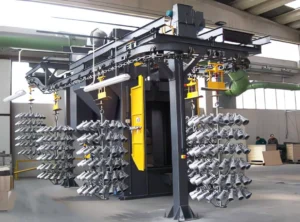
Upgrade Access with Modular Quick Release and Split Housing
A modular quick-release structure allows technicians to remove the relevant wheel assembly or access module without dismantling unrelated sections of the shot blasting machine. This shortens preparation time and limits the number of components exposed to abrasive dust. It is especially useful for foundries and finishing lines where wear parts require frequent inspection.
A split-housing design provides a wider and more direct service opening. Operators can inspect blade edges, the control cage, directional components, internal liners, and abrasive accumulation without relying on narrow access points. The housing should include secure locking features, clear lifting points, and protected interfaces so that faster access does not compromise operational safety.
| Design upgrade | Maintenance improvement | Operational result |
| Modular quick release | Faster removal of service modules | Shorter planned shutdowns |
| Split housing | Broader access to internal components | Quicker inspection and fault diagnosis |
| Protected locking points | Safer and more reliable closure | Lower risk of vibration or abrasive leakage |
| External service access | Less surrounding equipment removal | Reduced operational workload |
Improve Blade Replacement and Assembly Fault Tolerance
Blade replacement is one of the most frequent maintenance tasks on a Blast Wheel. A practical design should enable one trained operator to complete routine replacement safely, using manageable components and commonly available tools. Clear replacement sequences, accessible fasteners, and suitable handling points reduce labor demand and limit the time that the shot blaster remains offline.
Assembly fault tolerance is equally important. Locating pins, guided interfaces, standardized fasteners, and positive locking mechanisms help prevent reversed blades, incorrect clearances, loose covers, and misaligned components. These features reduce dependence on individual technician experience and make correct servicing more repeatable across shifts, sites, and maintenance teams.
Features that support safer single-person servicing
- Clearly accessible blade fasteners
- Component weights suitable for controlled manual handling
- Mechanical stops that prevent incorrect installation
- Marked installation positions and replacement sequences
- Captive or standardized fasteners where practical
- Inspection openings that reduce unnecessary entry into the equipment
- Maintenance instructions with torque, clearance, and alignment requirements
Single-person maintenance should not mean unsafe lifting or unsupported work. The Manufacturer should define safe handling limits and provide lifting aids when wheel modules exceed practical manual weight. Good design reduces the number of operators required while preserving lockout, guarding, lifting, and verification procedures.
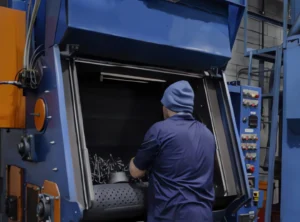
Maintain Consistent Disassembly and Assembly Precision
Repeated servicing can change wheel alignment if components depend only on manual positioning. Even small installation errors may alter abrasive projection, increase vibration, accelerate bearing wear, or create uneven cleaning. Consistent disassembly and assembly precision therefore protects both equipment reliability and workpiece quality.
External angle adjustment is a valuable upgrade because technicians can correct projection direction without repeatedly opening the complete housing. Adjustment scales, fixed reference points, locking devices, and calibrated settings allow operators to return the wheel to a known position after inspection or product changeover. This reduces trial runs, media waste, and quality variation.
Recommended precision controls
- Locating pins or tapered alignment interfaces
- Reference marks for wheel and housing position
- Positive stops for directional sleeve adjustment
- Repeatable blade seating and controlled clearances
- Fastener specifications for critical joints
- Post-maintenance vibration and projection checks
Reduce Maintenance Time in Frequent-Replacement Scenarios
Some production environments replace blades, sleeves, liners, or other wear parts frequently because of abrasive material, high throughput, heavy castings, or extended operating hours. In these conditions, maintenance design has a direct effect on available production capacity. The best solution is not simply a more wear-resistant component, but a wheel that makes inspection and replacement quick, safe, and predictable.
| Operating scenario | Priority upgrade | Reason for selection |
| High-volume continuous production | Quick-release modules and durable alignment features | Minimizes recurring service interruptions |
| Frequent product changeover | External angle adjustment and repeatable settings | Reduces setup and trial time |
| Heavy abrasive loading | Accessible split housing and protected service points | Speeds inspection and controls dust exposure |
| Multiple maintenance shifts | Fault-tolerant assembly and clear documentation | Improves consistency between operators |
- Record the current duration and staffing required for each maintenance task.
- Identify components that require the most frequent replacement.
- Measure quality variation before and after servicing.
- Review operator exposure, lifting requirements, and lockout procedures.
- Request a wheel design with modular access, repeatable alignment, and external adjustment.
- Validate the proposed configuration through representative production trials.
Our company supports Customizable OEM and ODM projects for new installations, replacement upgrades, and existing shot blasting machine modifications. As a professional Supplier, we assess casting type, production rhythm, wear patterns, safety requirements, and maintenance procedures before recommending a structure. The objective is reduced maintenance time, lower operational workload, and stable quality after every service cycle.
Conclusion
Key Blast Wheel upgrades should improve safety, access, replacement speed, and assembly precision rather than focus only on price or wear. Contact our Manufacturer and Supplier for a lifecycle assessment and Customizable OEM or ODM shot blaster proposal tailored to your maintenance and production needs.
 English
  Russian
  Spanish
  Portuguese
  French
  Indonesian
  Thai
Thai