
Improper blast sand use causes poor finishing and high waste; standardized usage boosts efficiency and cuts costs.
Master correct blast sand usage rules for sand blasting room and blast Room equipment to improve finishing quality and reduce abrasive consumption.
Learn professional abrasive usage skills to optimize your blast room operations easily.
How to Select the Right Blast Sand for Sand Blasting Room Operations
Correct blast sand selection is the foundation of standardized operation for any sand blasting room and blast Room equipment, directly determining surface finishing quality, processing efficiency, and abrasive consumption. Different workpiece materials and surface treatment requirements demand matched abrasive types and particle sizes, and mismatched blast sand will lead to insufficient cleaning, excessive surface roughness, or workpiece damage.
- For heavy-duty rust removal and oxide layer cleaning on steel workpieces, high-hardness abrasives like brown alumina and steel grit are ideal, featuring strong cutting force and high recyclability. For precision finishing on aluminum, stainless steel, or thin-wall parts, fine glass beads or white alumina are preferred to avoid scratching the base material.
- In terms of particle size, coarse 20–40 mesh blast sand suits thick coating removal, medium 60–80 mesh fits conventional cleaning tasks, and fine 100+ mesh abrasives are perfect for precise surface matting. Using unspecified blast sand not only ruins workpiece quality but also accelerates wear on blast room equipment nozzles and pipelines.
With years of practical experience, Chong Jen Machinery recommends customized abrasive selection solutions for different sand blasting room scenarios, helping clients match the most cost-effective blast sand to balance quality and consumption.
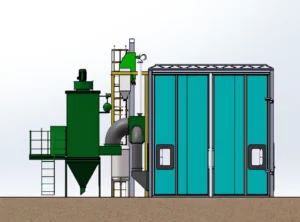
What Standard Operating Methods for Blast Sand Reduce Waste in Blast Room Equipment
Standardized blast sand operation procedures effectively reduce unnecessary waste and maximize the service life of abrasives in a sand blasting room and blast Room equipment. Many factories suffer 30% higher abrasive loss due to irregular operations, such as unstable air pressure, improper blasting angles, and unregulated sand replenishment.
- The standard working air pressure for most blast room equipment ranges from 0.4MPa to 0.7MPa; excessive pressure breaks blast sand into fine dust that cannot be recycled, while insufficient pressure reduces cleaning efficiency and requires repeated blasting.
- The optimal blasting angle is 45 to 90 degrees, and keeping a 100–300mm distance between the nozzle and workpiece avoids local over-blasting and abrasive waste.
Besides, regular screening and classification are essential. Operators need to remove fine dust and oversized impurities from recycled blast sand via standard screens to maintain consistent particle size. The table below shows how standardized operations reduce blast sand waste:
| Operation Status | Abrasive Waste Rate | Recycling Rate |
| Irregular Operation | 28–35% | 60% |
| Standardized Operation | 10–15% | 85%+ |
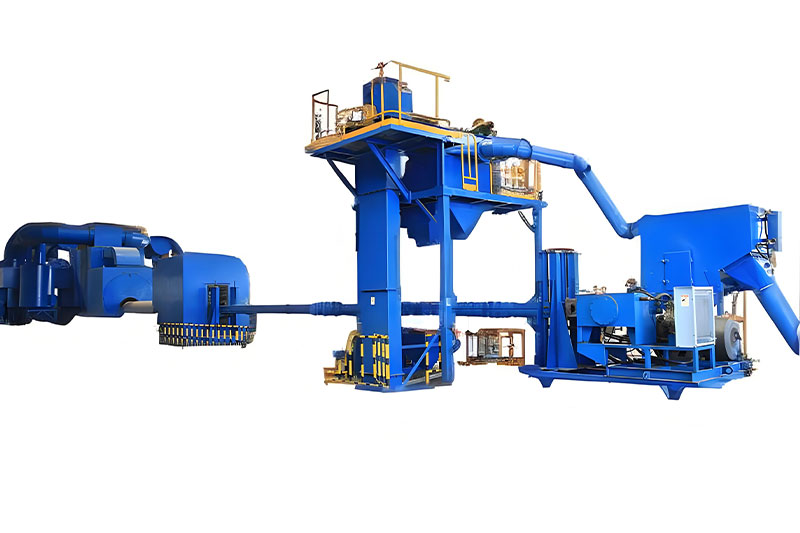
Chong Jen Machinery’s optimized blast Room equipment is equipped with precision abrasive recovery and screening systems, which assist users in standardizing blast sand usage, lowering long-term operational costs significantly.
How to Maintain and Recycle Blast Sand for Long-Term Sand Blasting Room Stability
Scientific maintenance and recycling of blast sand are key to stable and low-cost operation of a sand blasting room. After long-term circulation, blast sand will mix with metal dust, oxide debris, and broken fine particles.
- If not cleaned in time, these impurities will reduce blasting uniformity, cause surface pitting defects, and block blast room equipment pipelines and dust filtration systems. Factories need to conduct daily impurity removal and weekly particle size screening to eliminate invalid fine powder and retain qualified blast sand.
- Meanwhile, keep the blast sand dry and sealed; moist abrasives will agglomerate, leading to nozzle clogging and intermittent equipment shutdowns.
- Reasonable new sand replenishment is also critical: adding 10–15% new blast sand per week ensures overall abrasive activity and consistent blasting effects. Effective recycling management can extend blast sand service life by more than twice, greatly reducing consumable costs for batch production. Professional maintenance habits also reduce failure rates of sand blasting room auxiliary systems, ensuring continuous and stable daily production.
Conclusion
Standardize blast sand selection, operation and recycling to optimize blast room performance.
Contact Chong Jen Machinery
For professional sand blasting room optimization and blast Room equipment matching solutions, consult Chong Jen Machinery for tailored guidance,
email us:[email protected]
 English
  Russian
  Spanish
  Portuguese
  French
  Indonesian
  Thai
Thai