Sandblasting booth noise disturbs workers and violates standards; use practical methods to reduce it effectively.
This guide shares actionable noise reduction methods for sandblasting booth, helping B2B buyers lower noise to safe levels while maintaining operational efficiency.
Discover easy, cost-effective ways to reduce sandblasting booth noise below.
Method 1: Optimize Sandblasting Booth Sealing to Block Noise Leakage
Poor sealing is one of the main causes of excessive sandblasting booth noise, as gaps in the booth body allow noise to escape and amplify.
- Most sandblasting booths generate 85-95dB of noise during operation, and unsealed gaps can increase this by 5-10dB, exceeding the industrial safety limit of 85dB. To fix this, inspect the sandblasting booth’s doors, windows, and ventilation ports for gaps, then seal them with high-density sound-insulating rubber strips.
- Additionally, line the inner walls of the sandblasting booth with 50mm thick sound-absorbing cotton, which absorbs 60-70% of internal noise and prevents it from transmitting outward.Chong Jen Machinery designs sandblasting booth with integrated sealing structures, ensuring no gaps in the booth body and built-in sound-absorbing linings, which reduce initial noise by 10-12dB without affecting sandblasting operations. This simple optimization is low-cost and easy to implement, making it ideal for existing sandblasting booth upgrades.
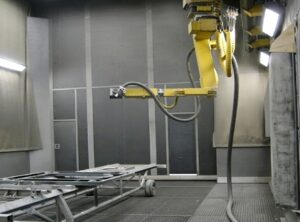
Method 2: Improve Sandblasting Booth Internal Components to Reduce Vibration Noise
Vibration from internal components is another major noise source of sandblasting booth, especially from the blast gun, air compressor, and abrasive delivery system.
- When the blast gun vibrates excessively, it creates loud, continuous noise that reverberates inside the sandblasting booth. To reduce this, install shock-absorbing brackets for the blast gun and air compressor, which dampen vibration and cut noise by 8-10dB.
- Replace worn blast gun nozzles with anti-vibration ceramic nozzles, as they reduce airflow turbulence and vibration during operation.
Regularly lubricate the sandblasting booth’s abrasive conveyor and air pipes to minimize friction-induced noise. The table below shows noise reduction effects of these improvements for a standard sandblasting booth:
| Improvement Measure | Noise Reduction Effect | Sandblasting Booth Noise After Improvement |
| Shock-Absorbing Brackets | 8-10dB | 80-85dB |
| Anti-Vibration Nozzles | 6-8dB | 82-87dB |
| Sound-Absorbing Linings | 10-12dB | 78-83dB |
Method 3: Upgrade Sandblasting Booth Ventilation System for Quiet Operation
The ventilation system of a sandblasting booth often generates loud noise due to high airflow speed, which adds to the overall noise level.
- To address this, replace the sandblasting booth’s ventilation fan with a low-noise, high-efficiency model, which reduces fan noise by 10-15dB while maintaining sufficient air circulation. Install a muffler on the ventilation inlet and outlet of the sandblasting booth to dampen airflow noise.
- Additionally, adjust the ventilation speed to the minimum required for dust removal—excessive airflow not only increases noise but also wastes energy. Chong Jen Machinery’s custom sandblasting booth is equipped with optimized ventilation systems, combining low-noise fans and mufflers to ensure the sandblasting booth operates quietly while meeting environmental and safety standards, helping B2B buyers avoid noise violations and protect worker health.
Conclusion
Optimize sealing, components and ventilation to reduce sandblasting booth noise.
Contact Chong Jen Machinery
For low-noise sandblasting booth solutions and professional advice,
email Chong Jen Machinery: email: [email protected]
 English
  Russian
  Spanish
  Portuguese
  French
  Indonesian
  Thai
Thai