
Traditional sandblasting causes wheel damage, low efficiency and high costs for alloy wheel processing.
Professional wheel blasting machine solutions deliver precise, efficient alloy wheel finishing; wheel blast technology outperforms sandblasting for quality, safety and long-term value.
Discover why modern blasting machine upgrades replace outdated sandblasting workflows.
The Hidden Drawbacks of Traditional Sandblasting for Alloy Wheel Processing
Alloy wheels are high-precision, lightweight automotive components that demand strict surface treatment standards for roughness uniformity, surface flatness and finish smoothness. Traditional sandblasting has long been adopted for alloy wheel rust removal, paint stripping and surface polishing, but it carries inherent flaws that restrict high-quality mass production.
- Conventional sandblasting relies on compressed air to spray quartz sand and other fine abrasives, which produces uneven impact force and easily causes micro-scratches, pitting and surface warping on soft alloy materials.
- In addition, sandblasting generates massive fine dust, leading to severe workshop pollution, environmental assessment risks and potential health hazards for operators. The disposable use of sand abrasives also results in huge material waste and high recurring production costs.
- Most importantly, sandblasting cannot guarantee consistent surface roughness for batch alloy wheels, resulting in unstable painting adhesion and high product rework rates.For professional alloy wheel manufacturers, these drawbacks make traditional sandblasting unable to meet modern high-standard and large-scale production demands, requiring upgraded wheel blast technology and professional wheel blasting machine equipment.
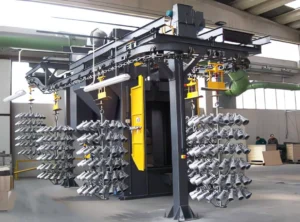
Core Working Advantages of Alloy Wheel Blasting Machine
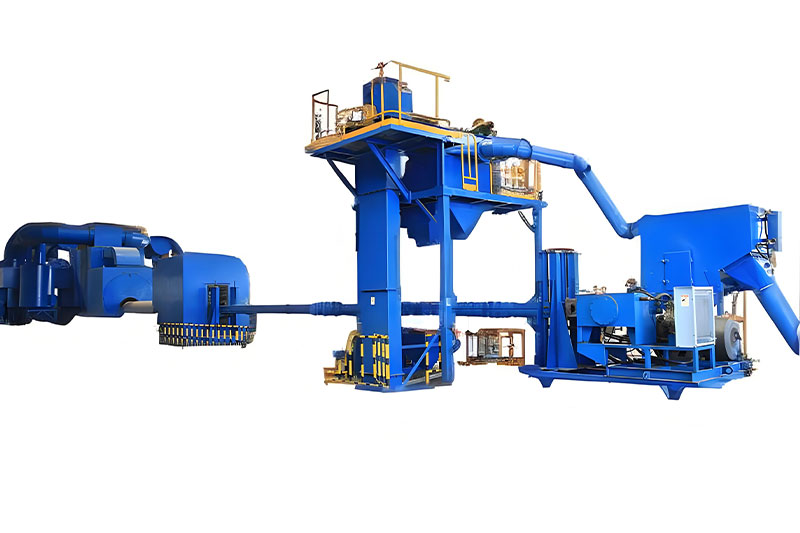
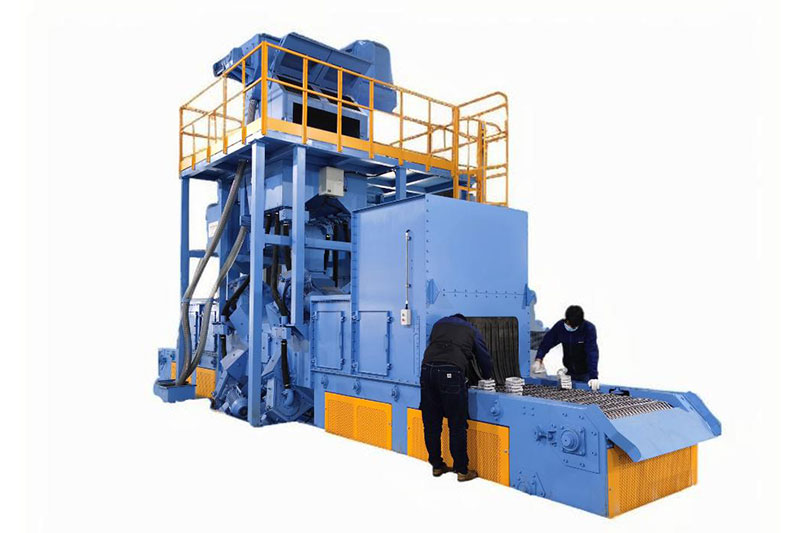
A professional alloy wheel blasting machine is a customized high-precision blasting machine designed exclusively for aluminum alloy wheel surface treatment, adopting advanced wheel blast centrifugal acceleration technology different from air-driven sandblasting.
- The core working principle is to use high-speed rotating blast wheels to generate stable centrifugal force, uniformly accelerating steel shot abrasives to form dense and orderly impact streams. This mechanical blasting method achieves precise and controllable surface treatment without damaging the alloy wheel base material.
- Compared with scattered and uncontrollable sandblasting impact, wheel blast machine features adjustable blasting intensity, uniform coverage and zero dead-angle processing, perfectly adapting to complex curved surfaces, spoke gaps and groove structures of alloy wheels. The whole wheel blasting machine system supports closed-cycle abrasive recycling, greatly reducing material waste and dust pollution.
Meanwhile, the standardized mechanical operation eliminates manual operation errors, ensuring 100% batch consistency of alloy wheel surface roughness and finish, laying a solid foundation for subsequent high-gloss painting and electroplating processes.
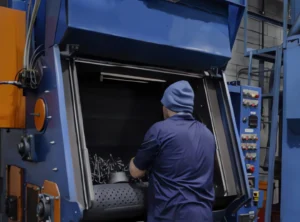
Performance Comparison: Wheel Blast Machine vs Traditional Sandblasting
The comprehensive performance gap between wheel blast technology and traditional sandblasting is obvious in alloy wheel processing, covering processing quality, production efficiency, operational cost and environmental compliance. Professional wheel blasting machine equipment achieves precise roughness control within a fixed range, effectively improving coating adhesion and finished product durability.
- In terms of efficiency, automatic wheel blast processing supports continuous batch production, with single-wheel processing efficiency more than three times higher than traditional sandblasting.
- In terms of cost, the recyclable abrasives of the blasting machine reduce long-term consumable investment, while sandblasting requires continuous replacement of disposable sand materials with high waste costs.
Environmentally, closed wheel blast systems produce almost no floating dust, fully meeting industrial environmental protection standards. The following data table intuitively shows the performance gap between the two processing methods:
| Processing Index | Traditional Sandblasting | Alloy Wheel Wheel Blasting Machine |
| Batch Surface Uniformity | Unstable, easy pitting | Highly consistent, zero defects |
| Processing Efficiency | Low, manual dependent | 300% higher, automatic operation |
| Dust Pollution Level | Severe, non-compliant | Low, environmentally friendly |
| Long-Term Consumable Cost | High disposable waste | Low cyclic reuse cost |
Chong Jen Machinery specializes in customized alloy wheel wheel blasting machine solutions. We optimize wheel blast parameters and structural configurations for different alloy wheel models, helping manufacturers completely replace traditional sandblasting and upgrade production lines efficiently.
Quality and Durability Upgrade for Alloy Wheel Finishing
Surface treatment quality directly determines the appearance grade and service life of alloy wheels, and wheel blast technology brings qualitative upgrades to finished product quality.
- Traditional sandblasting easily leaves irregular scratches and residual sand dust on alloy surfaces, leading to bubbles, peeling and cracking of subsequent paint layers, which seriously affects product appearance and anti-corrosion performance. The precision wheel blast mode of the professional blasting machine removes surface oxide layers, oil stains and old paint uniformly without damaging the alloy base material, forming a neat and orderly textured surface.
- This standardized surface structure greatly enhances the adhesion between the alloy wheel base and coating, effectively avoiding paint falling problems in long-term use. In addition, wheel blasting machine processing can eliminate internal stress of alloy wheels, improving material fatigue resistance and overall structural stability. For high-end automotive alloy wheel manufacturing, this precise and stable finishing effect is an irreplaceable core advantage compared with traditional sandblasting processes.
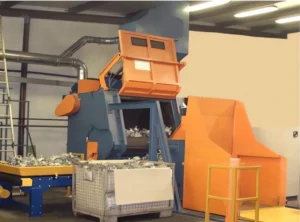
Cost and Environmental Advantages of Upgrading to Wheel Blast Equipment
Upgrading from sandblasting to a professional wheel blasting machine brings sustainable cost-saving and environmental benefits for alloy wheel factories.
- In terms of economic costs, wheel blast equipment adopts fully recyclable steel shot abrasives with a recycling rate of over 95%, eliminating the continuous consumable investment of disposable sand materials. The high automation of the blasting machine reduces on-site operating personnel, greatly cutting labor costs. Stable processing quality reduces rework rates and waste product losses, further improving economic benefits.
- In terms of environmental protection, the fully closed design of the wheel blasting machine supports matched dust removal systems, realizing zero floating dust emission and completely solving the environmental compliance problems of traditional sandblasting.
Moreover, the low-energy and high-efficiency operating mode of modern wheel blast equipment reduces unit product energy consumption, meeting the green manufacturing development trend of the automotive industry and helping factories pass environmental inspections stably.
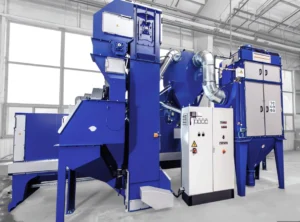
Application Value and Market Competitiveness for Wheel Manufacturers
In the increasingly competitive automotive alloy wheel market, surface finishing quality and production efficiency have become core competitive indicators.
- Traditional sandblasting processes can no longer meet customers’ high requirements for wheel appearance and durability, resulting in low-end product positioning and limited profit margins. Adopting professional wheel blasting machine and advanced wheel blast technology helps manufacturers achieve standardized, high-efficiency and high-quality batch production. Uniform and high-grade surface finishing improves product appearance grade and market recognition, supporting enterprises to undertake high-end customized orders.
- The automated blasting machine production mode also improves production line operation efficiency, shortens delivery cycles, and enhances customer trust and satisfaction. Upgrading processing equipment is not only a technical iteration but also an important strategy for alloy wheel manufacturers to optimize product quality, reduce comprehensive costs and enhance long-term market competitiveness.
Conclusion
Wheel blasting machine outperforms sandblasting in quality, cost and efficiency for alloy wheels.
Contact Chong Jen Machinery
For premium alloy wheel wheel blasting machine and customized wheel blast production solutions, consult Chong Jen Machinery :[email protected].
 English
  Russian
  Spanish
  Portuguese
  French
  Indonesian
  Thai
Thai