
Many shot blasting projects leave residual rust, causing rework, delays and increased operational costs.
Poor shot blasting rust removal results mainly stem from incorrect parameter settings, worn parts and improper abrasive selection for your shot blasting machine.
Explore key causes and professional fixes to perfect your shot blasting quality.
Incorrect Abrasive Selection and Degraded Abrasive Conditions
Abrasive condition is one of the top factors affecting shot blasting rust removal performance, yet it is frequently overlooked by equipment operators.
- Many factories use mismatched abrasives or continuously recycle severely worn, broken particles, which directly weaken shot blasting cleaning force. Large, high-hardness abrasives are required for heavy rust and thick oxide layers, while fine and soft media cannot generate enough impact force to strip stubborn rust.
- In addition, long-term recycled abrasives accumulate fine dust and metal debris, reducing overall density and kinetic energy. Using contaminated abrasives leads to superficial cleaning, where rust residues remain in workpiece crevices and uneven surfaces.
Even with a high-performance shot blasting machine, incorrect abrasive matching will result in inconsistent cleaning quality and low pass rates. Regular abrasive screening and replacement are essential to maintain stable shot blasting results.
Worn Components and Unstable Shot Blasting Machine Operation
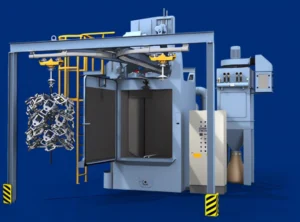
Mechanical wear and equipment failure are core hardware reasons for poor rust removal. Key components of a shot blasting machine, including blast wheel blades, nozzles and distribution sleeves, gradually wear down after long working hours. Worn blades lose uniform acceleration capability, causing uneven shot projection and insufficient local impact force.
Damaged nozzles scatter abrasive streams, forming cleaning dead zones on workpiece surfaces. Moreover, unstable motor speed and inconsistent air pressure lead to fluctuating shot blasting intensity, leaving partial rust and scale uncleaned. The following data shows how component wear affects cleaning efficiency:
| Machine Condition | Rust Removal Completion Rate | Rework Probability |
| New & Calibrated Components | 99%+ | 2% |
| Severely Worn Components | 82%–88% | 28% |
Chong Jen Machinery recommends regular component inspection and professional calibration for all shot blasting machine models. Our technical team provides targeted maintenance solutions to help factories maintain stable shot blasting performance and avoid recurring rust removal failures.
Improper Operation Parameters and Unreasonable Workpiece Placement
Unreasonable operational settings are common human-induced causes of unsatisfactory shot blasting rust removal.
- Many operators adopt fixed blasting time and pressure for all workpieces without adjusting parameters according to rust thickness and material hardness. Insufficient blasting time and low pressure cannot completely strip thick rust layers, while unreasonable shooting angles create blind spots.
- In addition, unreasonable workpiece stacking and shielding block abrasive streams, resulting in local residual rust. Standardized parameter adjustment and flexible placement strategies can fully release the performance of the shot blasting machine, ensuring comprehensive and uniform rust removal for every workpiece surface.
Conclusion
Fix abrasives, machine wear and operation errors to perfect shot blasting results.
Contact Chong Jen Machinery
For professional shot blasting optimization and high-efficiency shot blasting machine equipment,
contact us:[email protected]
 English
  Russian
  Spanish
  Portuguese
  French
  Indonesian
  Thai
Thai