
Uncontrolled casting roughness after shot blasting affects quality; scientific methods ensure stable machine shot results.
This guide details practical methods to control casting roughness during shot blasting, optimizing shot blaster operations and ensuring casting quality.
Explore key techniques and precautions for precise casting roughness control in shot blast below.
Why Is Casting Roughness Control Critical in Shot Blasting?
Controlling casting roughness during shot blasting is a core link in casting processing, directly determining the quality, performance, and subsequent processing efficiency of castings.
- Excessively high roughness after shot blast will increase the difficulty of subsequent processes such as painting, electroplating, and assembly, leading to poor adhesion of coatings, uneven stress distribution, and reduced service life of castings.
- On the contrary, excessively low roughness will reduce the bonding force between the casting surface and the coating or mating parts, affecting the overall structural stability. For different types of castings (such as automotive castings, engineering machinery castings, and precision castings), the required roughness range varies significantly—precise control ensures that castings meet design standards.
Additionally, stable casting roughness reduces rework rates, lowers production costs, and improves the competitiveness of products. In shot blasting operations, the shot blaster’s performance, machine shot parameters, and abrasive selection all affect casting roughness, so mastering scientific control methods is essential for high-quality shot blasting.
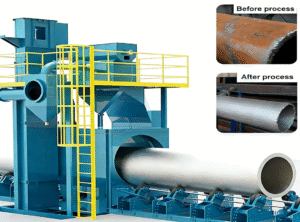
How to Select Suitable Abrasives to Control Casting Roughness?
Abrasive selection is the foundation of casting roughness control during shot blasting, as the type, particle size, and hardness of abrasives directly affect the impact effect of machine shot on castings.
- Choose the right abrasive type: for castings that require moderate roughness (Ra 1.6-6.3μm), spherical steel shot is preferred, as it has a smooth surface and uniform impact force, resulting in a consistent casting surface. For castings that need slightly higher roughness (Ra 6.3-12.5μm), angular steel grit can be used, as its sharp edges can create deeper surface textures. Avoid using mixed abrasives with inconsistent shapes, as they will cause uneven roughness.
- Control abrasive particle size precisely: ขนาดของอนุภาคที่มีขัดมากขึ้น จะทำให้ความหยาบของการหล่อมากขึ้น; ขนาดอนุภาคที่เล็กลง จะทำให้ความหยาบน้อยลง ตามความหยาบที่ต้องการ ให้เลือกใช้วัสดุขัดที่มีช่วงขนาดอนุภาค 0.5-2.0 มม. และใช้ตะแกรงหลายชั้นเพื่อกรองสิ่งเจือปนและอนุภาคที่ไม่สม่ำเสมอก่อนที่จะเพิ่มลงในเครื่องยิงยิง.
- จับคู่ความแข็งของวัสดุขัดกับวัสดุการหล่อ: ความแข็งของวัสดุขัดควรจะสูงกว่าความแข็งของการหล่อ 10-20TP3T - ถ้าความแข็งของวัสดุขัดสูงเกินไปจะทำให้เกิดความหยาบมากเกินไป ขณะที่ถ้าความแข็งต่ำเกินไปจะไม่สามารถตอบสนองความต้องการในการทำความสะอาดและความหยาบได้ การเลือกวัสดุขัดอย่างถูกต้องสามารถสร้างพื้นฐานที่มั่นคงสำหรับการควบคุมความหยาบที่แม่นยำใน การยิงระเบิด.
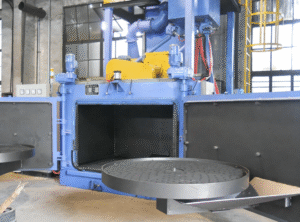
วิธีปรับพารามิเตอร์ของเครื่องยิงเพื่อควบคุมความหยาบในการหล่อ?
การปรับพารามิเตอร์ของเครื่องยิงเป็นวิธีที่ตรงที่สุดและมีประสิทธิภาพในการควบคุมความหยาบในการหล่อระหว่างการยิง โดยพารามิเตอร์เช่น ความเร็วของการยิง เครื่อง, อัตราการไหล และระยะทาง จะกำหนดความเข้มของการกระทบต่อการหล่อ.
- ควบคุมความเร็วของกระสุน: ความเร็วของกระสุนที่สูงขึ้น จะทำให้แรงกระทบมากขึ้น และความหยาบในการหล่อสูงขึ้น ติดตั้งตัวขับความถี่ตัวแปร (VFD) บนเครื่องยิงเพื่อตั้งค่าความเร็วของใบพัดแบบไม่พึ่งพาการเก็บค่าที่สอดคล้อง - สำหรับการหล่อที่ต้องการความหยาบต่ำ ให้ตั้งที่ 1200-1500 รอบต่อนาที; สำหรับความหยาบปานกลางให้ตั้งที่ 1500-1800 รอบต่อนาที; สำหรับความหยาบสูงให้ตั้งที่ 1800-2000 รอบต่อนาที ควรปรับความเร็วเป็นประจำเพื่อให้แน่ใจว่าสมบูรณ์.
- ปรับอัตราการไหลของวัสดุขัด: อัตราการไหลที่มากเกินไปจะทำให้เกิดการกระทบที่ซ้อนกันบนพื้นผิวการหล่อ เพิ่มความหยาบ; อัตราการไหลที่ไม่เพียงพอจะทำให้เกิดความหยาบไม่สม่ำเสมอ ปรับอัตราการไหลให้เป็น 70-80TP3T ของ ความจุที่ ระบุของเครื่องยิงและใช้เครื่องวัดการไหลเพื่อติดตามในเวลาเรียลไทม์ เพื่อให้แน่ใจว่าการป้อนอย่างสม่ำเสมอ.
- ควบคุมระยะทางและมุมของการยิง: ระยะห่างระหว่างปากของเครื่องยิงและการหล่อควรอยู่ที่ 50-100 มม. หากใกล้เกินไปจะทำให้ความหยาบเพิ่มขึ้น ขณะที่ห่างเกินไปจะทำให้ประสิทธิภาพการกระทบลดลง รักษามุมการกระทบ 45-60° เพื่อให้แน่ใจว่าการบำบัดพื้นผิวสม่ำเสมอ การปรับพารามิเตอร์เหล่านี้อย่างเหมาะสมสามารถทำให้ควบคุมความหยาบของการหล่อได้อย่างแม่นยำ.
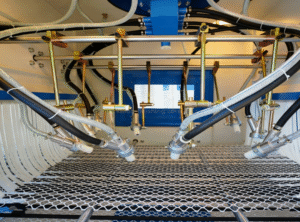
วิธีการปรับปรุงกระบวนการทำงานของการยิงเพื่อควบคุมความหยาบ?
การปรับปรุงกระบวนการทำงานของการยิงเป็นสิ่งสำคัญในการทำให้ความหยาบในการหล่อเป็นไปอย่างสม่ำเสมอหลีกเลี่ยงการผันผวนของคุณภาพที่เกิดจากการทำงานที่ไม่ถูกต้อง.
- เตรียมการหล่อก่อนการยิง: ขจัดน้ำมัน, สนิม และทรายหลวม ๆ บนพื้นผิวการหล่อ เนื่องจากสิ่งเจือปนเหล่านี้อาจส่งผลต่อผลกระทบของการยิงเครื่องและทำให้เกิดความหยาบไม่สม่ำเสมอ ใช้สารทำความสะอาดหรืออากาศแรงดันสูงในการทำความสะอาดการหล่อ เพื่อให้แน่ใจว่าพื้นผิวสะอาดก่อน การยิง.
- จัดการหล่ออย่างสมเหตุสมผล: place castings in the shot blaster evenly, avoiding overlapping or shielding, ensuring that all surfaces are fully exposed to shot blast. For complex-shaped castings, adjust the placement angle or use a rotating fixture to ensure uniform impact.
- Control shot blasting time: the longer the shot blasting time, the higher the roughness—set the time according to the required roughness and casting material. For example, cast iron castings require 30-60 seconds, while steel castings require 60-90 seconds. Avoid over-blasting or under-blasting.
- Conduct post-shot blast inspection: use a roughness tester to detect the casting surface after การพ่นวัสดุ, record the data, and adjust shot blaster parameters or operation methods in time if the roughness exceeds the standard. Optimizing the operation process can reduce roughness fluctuations and ensure stable quality.
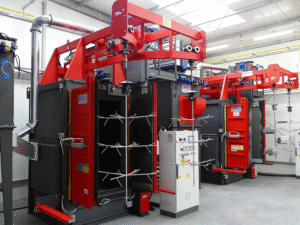
How to Maintain Shot Blaster to Ensure Stable Roughness Control?
Regular maintenance of the shot blaster is essential to maintain its performance, ensuring stable casting roughness control during long-term shot blasting operations.
- จัดตั้งกิจวัตรการบำรุงรักษาในแต่ละวัน: หลังจากแต่ละ shot blast operation, clean the shot blaster’s impeller, nozzle, pipeline, and hopper to remove residual abrasives and debris, which may cause uneven abrasive flow and affect roughness. Inspect the nozzle for wear—worn nozzles will change the shot blast direction and intensity, leading to uneven roughness. Replace worn nozzles in time.
- Conduct weekly maintenance: lubricate the shot blaster’s motor, bearings, and other moving parts to ensure smooth operation. Check the impeller blades and shot wheel for wear, and replace them if necessary, as uneven wear will cause unstable projectile speed.
- ทำบำรุงรักษารายเดือน: calibrate the shot blaster’s speed, flow rate, and pressure gauges to ensure accurate parameters. Inspect the abrasive recovery system to ensure normal operation, avoiding abrasive waste and uneven feeding.
Additionally, train operators to master the correct operation and maintenance skills, enabling them to identify early signs of equipment abnormalities and take timely measures. Proper maintenance ensures that the shot blaster operates stably, providing a guarantee for precise casting roughness control.
บทสรุป
Abrasive selection, parameter adjustment and maintenance ensure precise casting shot blasting roughness control.
For professional guidance on casting shot blasting roughness control and shot blaster optimization,
ติดต่อเราผ่านทางอีเมล: [email protected]
 Thai
Thai  English
  Russian
  Spanish
  Portuguese
  French
  Indonesian