
Are Automatic Shot Blasting Machines Creating Hidden Injury Risks?
Automatic operation improves consistency and throughput, but it does not eliminate mechanical hazards. Operators may still face steel shot splatter, entrapment, unexpected startup, crushing points, and unsafe access during loading, inspection, or maintenance. When safety is added only after installation, protection gaps can remain expensive, difficult to verify, and dangerous.
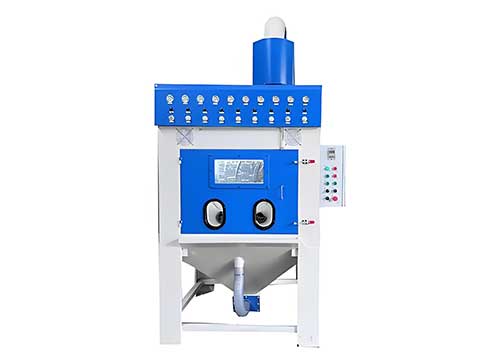
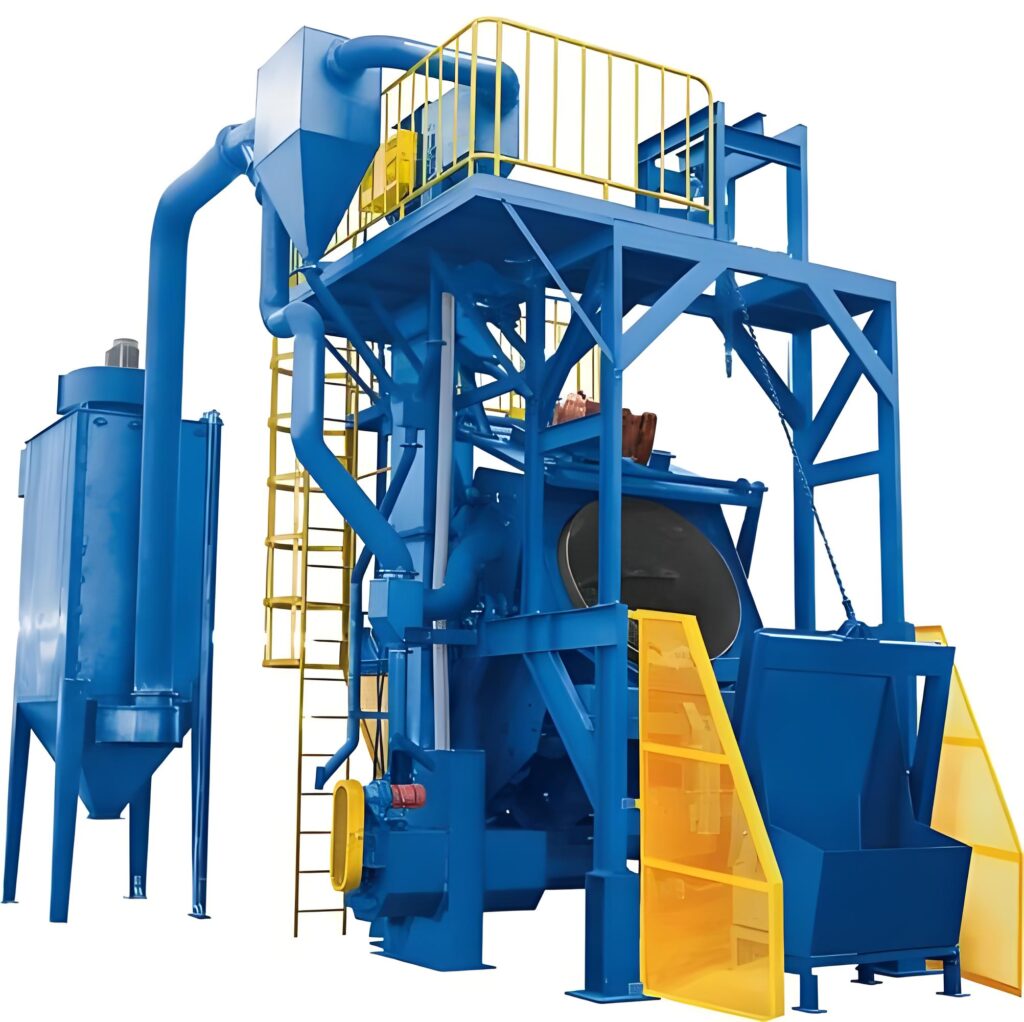
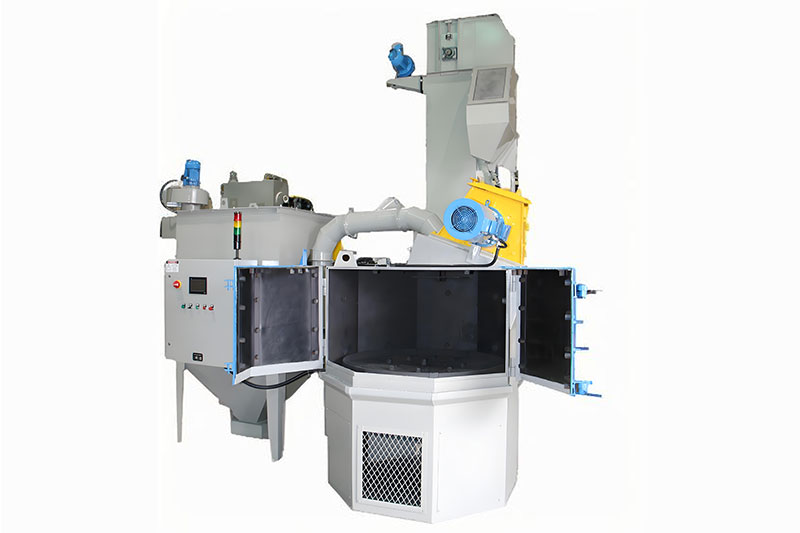
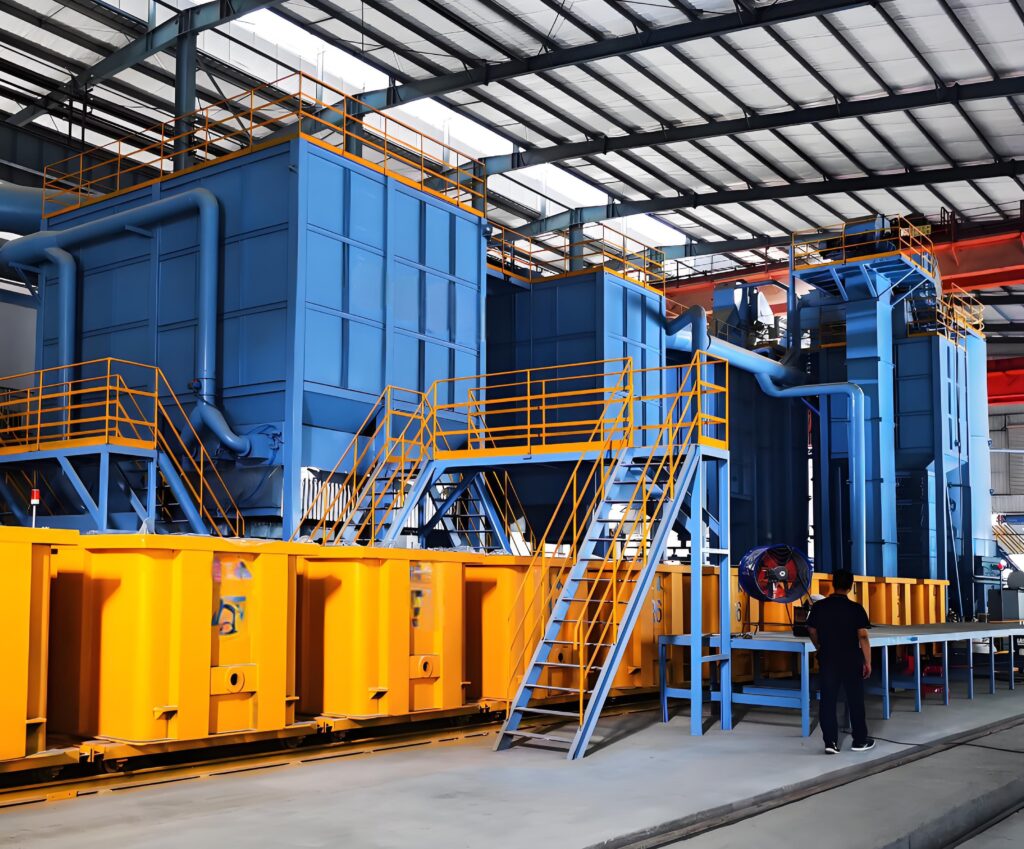
Choose a Shot Blasting Machine with enclosed abrasive zones, reliable safety interlocks, emergency stops, anti-pinch protection, controlled access, and documented risk assessments. Our company provides Customizable OEM and ODM Wheelblast Equipment, helping each Manufacturer and Supplier integrate operator protection into the original design instead of relying on unsafe retrofits.
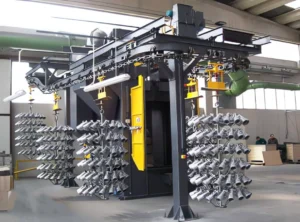
Select Protective Structures Before Approving the Machine
Protective structures should prevent operators from reaching hazardous areas and contain steel shot under normal and abnormal operating conditions. Procurement teams should evaluate the complete machine boundary, including the blasting chamber, loading system, conveyors, transfer points, abrasive recovery system, and maintenance access.
- Use a fully enclosed blasting chamber suitable for the specified abrasive velocity and workpiece size.
- Specify impact-resistant liners, curtains, seals, and protected inspection windows.
- Prevent steel shot from escaping through loading openings, discharge points, doors, and conveyor interfaces.
- Install fixed guards around blast wheels, shafts, belts, chains, elevators, rollers, and other moving parts.
- Provide safe platforms, stairs, handrails, lighting, and maintenance clearances.
- Ensure guards cannot be removed without tools where access is not required during normal operation.
- Define the expected service life and replacement method for seals, curtains, liners, and guarding components.
Protective structures must match the process. A track-type machine may require special attention to tumbling parts and discharge openings, while a roller-conveyor system may create hazards at transfer points and between moving rollers. Automatic loading systems also require guarded interfaces between robots, fixtures, conveyors, and the blasting chamber.
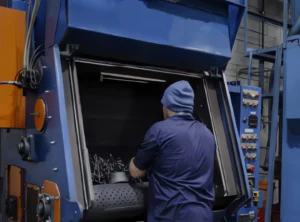
Questions for the equipment Supplier
- What workpiece dimensions and abrasive conditions were used to verify containment?
- Which access points are protected by fixed guards, movable guards, or interlocked doors?
- How are worn seals and curtains inspected and replaced?
- What prevents operators from entering the machine during automatic operation?
- Are safety boundaries shown on the approved layout and machine drawings?
- Which protective components are included in the quoted scope and which are optional?
Specify Reliable Interlock Doors and Emergency Stops
Safety doors and emergency-stop systems are critical controls, not standard accessories. A door interlock should prevent hazardous motion and abrasive projection while the door is open. The system should also prevent automatic restart when the door is closed or power returns after an interruption.
Interlock requirements
- Access doors should remain locked until hazardous movement and abrasive flow have stopped.
- Opening a protected door should initiate a controlled stop appropriate to the machine risk.
- Closing or resetting the door should not automatically restart the equipment.
- Interlock status should be visible through the control system and operator interface.
- Bypassing or defeating an interlock should require authorized maintenance controls.
- Door switches, locks, cables, and mounting points should withstand vibration, dust, and repeated operation.
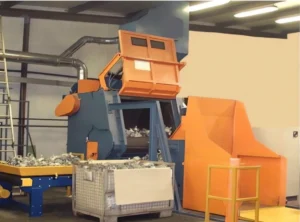
Emergency-stop requirements
Emergency-stop devices should be positioned where operators can reach them quickly from normal workstations, loading areas, unloading areas, inspection points, and maintenance access routes. The emergency function should stop hazardous movement and abrasive projection in a predictable sequence without creating additional risks.
- Map all normal operator and maintenance positions.
- Place emergency stops within practical reach of each position.
- Identify which drives, conveyors, blast wheels, elevators, and abrasive feeds stop after activation.
- Prevent automatic restart after emergency-stop reset.
- Test every emergency stop during factory and site acceptance.
- Record test results, response times, faults, and corrective actions.
Request the safety circuit diagram, interlock list, emergency-stop logic, functional test procedure, and maintenance instructions before final approval. A professional Manufacturer should explain how each safety function is verified and what happens when a sensor or communication signal fails.
Prevent Crushing and Pinching During Automatic Handling
Automatic loading and unloading mechanisms can create hazards even when the blasting chamber is fully enclosed. Robots, hooks, turntables, roller conveyors, lifting devices, clamps, doors, and transfer systems may produce crushing, shearing, or trapping points.
- Use guarded loading and unloading zones with clearly defined safety boundaries.
- Install presence sensors, safety scanners, light curtains, or pressure-sensitive devices where personnel could enter a moving area.
- Use anti-pinch edges and controlled closing speeds on powered doors and covers.
- Prevent movement when a workpiece is incorrectly positioned or a fixture is not locked.
- Use mechanical stops and position monitoring to prevent overtravel.
- Provide manual release or safe recovery procedures after power loss.
- Separate automatic material flow from pedestrian routes wherever possible.
Safety sensors must be selected for the environment. Dust, abrasive particles, vibration, oil, temperature changes, misalignment, damaged cables, and poor cleaning can cause false signals or failure to detect a person. Sensors should be protected from direct impact and positioned so their status can be inspected without entering the danger zone.
Common causes of safety sensor failure
| Failure cause | Potential result | Procurement and maintenance control |
| Dust or abrasive contamination | False trips or missed detection | Use suitable protection, cleaning procedures, and inspection intervals |
| Vibration and misalignment | Unreliable door or position signals | Use robust mounting and verify alignment during commissioning |
| Damaged cables or connectors | Intermittent safety circuit faults | Protect routing and maintain approved replacement parts |
| Unauthorized bypassing | Loss of intended operator protection | Use controlled access, tamper-resistant arrangements, and audits |
| Incorrect reset logic | Unexpected restart or incomplete shutdown | Test the complete safety sequence during acceptance and maintenance |
Separate Human-Machine Interaction Zones
Safety isolation is most effective when the layout prevents people and moving equipment from occupying the same space. Physical separation should be supported by control logic, visual signs, floor markings, and standardized access procedures.
- Define restricted zones around the blasting chamber, loading system, conveyors, and abrasive recovery equipment.
- Use fixed barriers or guarded enclosures instead of relying only on warning signs.
- Provide dedicated operator stations outside the automatic movement envelope.
- Separate forklift routes, pedestrian walkways, inspection points, and maintenance areas.
- Install access gates with interlocks at locations where entry is unavoidable.
- Provide safe viewing methods so operators do not open doors to check process status.
- Use status lights, audible warnings, and clear operating modes for automatic, manual, setup, and maintenance conditions.
The safety design should cover abnormal situations such as a jammed workpiece, broken hook, blocked abrasive return, sensor fault, or incomplete unloading cycle. Operators should have a defined recovery procedure that does not require reaching into a moving or contaminated zone.
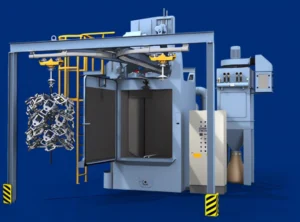
Integrate Training With Standard Operating Procedures
Safety features are effective only when operators understand their purpose and use them correctly. Training should be based on the delivered Shot Blasting Machine configuration, not on a generic presentation.
- Explain the machine hazards, restricted areas, and permitted operating conditions.
- Demonstrate automatic, manual, setup, inspection, and maintenance modes.
- Train operators to check guards, interlocks, emergency stops, sensors, seals, and warning devices.
- Define loading, unloading, fixture verification, and workpiece recovery procedures.
- Provide lockout and isolation training for authorized maintenance personnel.
- Explain how to report abnormal noise, vibration, leakage, sensor faults, and damaged guards.
- Verify competency through practical demonstrations and documented assessments.
- Review procedures after modifications, incidents, near misses, or changes in production.
Standard operating procedures should include daily inspection checklists and clear stop-work criteria. Training records, inspection logs, safety-test results, and corrective-action reports also support occupational health reviews, customer audits, and insurance assessments.
Understand Retrofit Limitations and Insurance Consequences
Retrofitting safety components onto older equipment can improve protection, but it may not provide the same result as integrated design. Limited space, outdated control systems, weak machine frames, inaccessible wiring, and incompatible emergency-stop logic can make modifications difficult to validate.
- Retrofitted guards may interfere with loading, inspection, or maintenance access.
- New sensors may not communicate reliably with older controllers.
- Emergency-stop additions may stop one drive while leaving another hazard active.
- Old structures may lack suitable mounting points for barriers or interlocked doors.
- Modifications can create new pinch points or obstruct safe escape routes.
- Documentation may not reflect the final configuration after several changes.
Insurance assessments may differ according to the quality and completeness of the safety configuration. A machine with documented risk assessment, tested interlocks, guarded access, training records, and preventive maintenance evidence is easier to evaluate than one relying on informal controls or undocumented retrofits. Poor safety evidence may influence premiums, exclusions, claim reviews, or required corrective actions.
Ask the Manufacturer to define responsibility for risk assessment, guarding, commissioning, training, documentation, and future modifications. Include safety acceptance criteria in the purchase contract and require a documented handover package.
Prevent Injuries Through Safety-First Procurement
Select automatic shot blasting equipment by evaluating containment, interlocks, anti-pinch protection, isolation zones, sensor reliability, training, retrofit limitations, and insurance documentation. Contact our team for a Customizable OEM or ODM Wheelblast Equipment solution designed to protect operators while maintaining stable production output.
 English
 Russian
 Spanish
 Portuguese
 French
 Indonesian
 Thai