
Is a Low-Priced Blast Wheel Increasing Your Total Operating Cost?
Many purchasers compare shot blasting machine quotations by total unit price while overlooking Blast Wheel structure. Poor design can accelerate blade wear, scatter steel shot, increase energy consumption, and force unplanned shutdowns. These hidden losses reduce output and raise maintenance costs, especially in heavy-duty applications where stable, continuous operation is essential.
The best Blast Wheel is selected by evaluating projection efficiency, blade life, dynamic balance, directional sleeve precision, sealing, energy use, and maintenance access. Our company, an experienced Manufacturer and Supplier, provides Customizable OEM and ODM shot blasting machine solutions designed for reliable long-term operation and controlled lifecycle cost.
Why Blast Wheel Structural Design Matters
A Blast Wheel converts motor power into controlled steel shot velocity and coverage. Its impeller, blades, control cage, directional sleeve, hub, housing, and sealing system must work as one balanced assembly. A lower purchase price may conceal weak components, inefficient shot distribution, difficult maintenance, or limited suitability for demanding production conditions.
Procurement teams should evaluate how the complete wheel design affects cleaning performance, abrasive consumption, wear-part replacement, and equipment availability. The objective is not simply to purchase a powerful wheel, but to achieve the required surface preparation with consistent projection and minimum interruption.
Key structural features to examine
- Blade geometry and installation accuracy
- Impeller and hub strength under continuous impact
- Wear-resistant blade materials and heat treatment
- Directional sleeve precision and shot-flow control
- Housing protection against abrasive erosion
- Leak-proof sealing around rotating and abrasive-exposed areas
- Accessibility for inspection and replacement
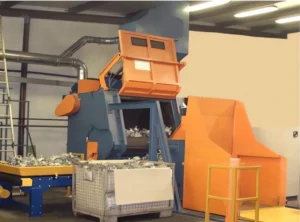
Control Wear, Projection Efficiency, and Energy Consumption
Wear-resistant blade materials directly influence replacement cycles and blasting consistency. Blades exposed to high-velocity steel shot require suitable alloy composition, hardness, toughness, and surface quality. Excessively brittle material may crack, while insufficient hardness can produce rapid edge erosion and changing projection patterns.
The directional sleeve is equally important. Its position determines when and where abrasive enters the wheel. Poor precision can cause shot deviation, uneven coverage, reduced cleaning efficiency, and unnecessary impact on internal components. Correct alignment helps direct more usable abrasive toward the workpiece instead of wasting energy inside the chamber.
| Design factor | Potential problem with poor design | Procurement benefit of verified design |
| Blade material | Rapid wear, cracking, and inconsistent shot velocity | Longer replacement cycles and stable cleaning |
| Directional sleeve | Shot deviation and uneven surface treatment | Improved projection efficiency and coverage |
| Wheel balance | Vibration, bearing stress, and noise | Lower mechanical wear and smoother operation |
| Internal sealing | Abrasive leakage and contamination of nearby components | Cleaner equipment and reduced maintenance exposure |
| Wheel geometry | High energy use with limited useful output | Better energy control per processed workpiece |
Energy consumption should be measured against useful blasting output rather than motor rating alone. An inefficient Blast Wheel may require longer cycle times or higher abrasive flow to achieve the same result. A properly designed wheel can improve steel shot projection efficiency, helping control electricity and abrasive costs while maintaining the required cleaning standard.
Verify Dynamic Balancing and Mechanical Reliability
Dynamic balancing is a critical part of Blast Wheel manufacturing. The rotating assembly must be balanced under operating conditions to limit vibration and protect bearings, shafts, motors, housings, and connected components. Poor balancing may not be obvious during a short demonstration, but its effects become expensive during continuous production.
Ask the Supplier for evidence
- Dynamic balancing procedures and inspection records
- Material specifications for blades, impellers, hubs, and sleeves
- Dimensional tolerances for key rotating components
- Factory testing under representative operating conditions
- Recommended inspection intervals and vibration limits
- Documented replacement procedures for wear parts
A reliable Supplier should explain how the wheel is assembled, aligned, tested, and serviced. Procurement should also confirm whether replacement blades can be installed without removing excessive surrounding equipment. Easy maintenance reduces labor time and limits downtime losses when wear parts reach the end of their service cycle.
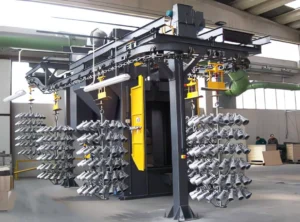
Calculate Downtime and Lifecycle Cost
Wear-part price is only one part of maintenance cost. The financial impact also includes production stoppage, technician labor, emergency freight, rejected workpieces, delayed shipments, and possible damage to adjacent equipment. For high-volume foundries and fabricators, a short unplanned shutdown may cost more than the price difference between two competing wheels.
- Record current blade replacement frequency and average service hours.
- Calculate the output lost during each shutdown and changeover.
- Include abrasive leakage, bearing failures, vibration-related repairs, and energy use.
- Compare expected wheel life under the actual steel shot size and operating schedule.
- Review spare-part availability and local technical support.
- Use total cost of ownership instead of purchase price as the approval standard.
| Lifecycle cost item | Questions for purchasing teams |
| Wear parts | What are the expected service intervals for blades, sleeves, and liners? |
| Downtime | How long does a standard replacement and inspection require? |
| Energy | What useful output is achieved per unit of electrical consumption? |
| Quality losses | Can shot deviation cause rework, scrap, or coating problems? |
| Support | Are critical components stocked and serviceable locally? |
Select the Design for the Application
Heavy-duty applications require more than a high motor rating. Continuous steel plate, structural fabrication, foundry, or large casting production demands robust wheel components, effective sealing, wear protection, stable balancing, and straightforward service access. A wheel designed for intermittent light-duty work may not deliver long-term stable operation in abrasive, high-throughput conditions.
Workpiece size, steel shot specification, cleaning standard, cycle time, chamber layout, and operating hours should guide selection. A Customizable shot blasting machine may require different wheel capacity, blade material, control settings, liner protection, or abrasive recovery arrangements depending on the factory process.
Recommended procurement process
- Define workpiece material, dimensions, production volume, and cleaning requirements.
- Specify steel shot type, size, flow rate, and expected operating hours.
- Request wheel drawings, component materials, balancing documentation, and test data.
- Conduct a workpiece trial using representative production parts.
- Compare energy use, wear-part life, service access, and projected downtime.
- Confirm warranty terms, spare-part supply, installation support, and training.
Our company can provide OEM and ODM cooperation for manufacturers requiring special layouts, controls, wheel configurations, or replacement compatibility. As an experienced Manufacturer and Supplier, we assess the complete shot blasting machine rather than promoting a wheel based only on its initial price.
Conclusion and Procurement Action
Blast Wheel design directly affects cleaning quality, energy use, wear-part life, and downtime. Request a technical evaluation, component specification review, and workpiece trial from our team to select a Customizable solution that delivers reliable performance and lower long-term operating cost.
 English
  Russian
  Spanish
  Portuguese
  French
  Indonesian
  Thai
Thai