
Many users misuse blast rooms, causing poor finishes, dust leaks and frequent equipment faults.
Sandblasting chambers and blast rooms use compressed air and abrasive recycling to clean workpiece surfaces, delivering consistent, safe industrial surface treatment results.
Understand its core workflow to operate your blast room efficiently and correctly.
Basic Working Principle of a Standard Sand Blasting Room
A sandblasting chamber, commonly known as a blast room, is a closed industrial workspace designed for standardized surface cleaning, rust removal, paint stripping and texturing.
- Its core working principle relies on compressed air power to accelerate abrasive media, which impacts workpiece surfaces to strip oxide layers, welding slag and stubborn contaminants physically.
- Different from open blasting tools, a professional sand blasting room forms a fully enclosed working space with matched dust removal and abrasive recycling systems. During operation, compressed air pushes abrasives through specialized nozzles to form high-speed particle streams, completing uniform surface treatment.
After blasting, falling abrasives and dust waste are automatically separated and recycled. This closed-loop working mode ensures stable blasting quality, zero dust pollution and low abrasive consumption, making the blast room ideal for large workpieces and batch industrial processing scenarios.
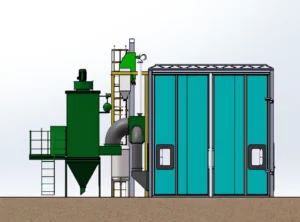
Core System Components That Drive Blast Room Operation
A complete sandblasting chamber consists of four key functional systems that jointly ensure stable and efficient operation.
- The blasting power system includes air compressors and blasting guns, providing stable air pressure and abrasive acceleration power. The enclosed chamber body isolates internal blasting operations to prevent external dust overflow and ensure operational safety.
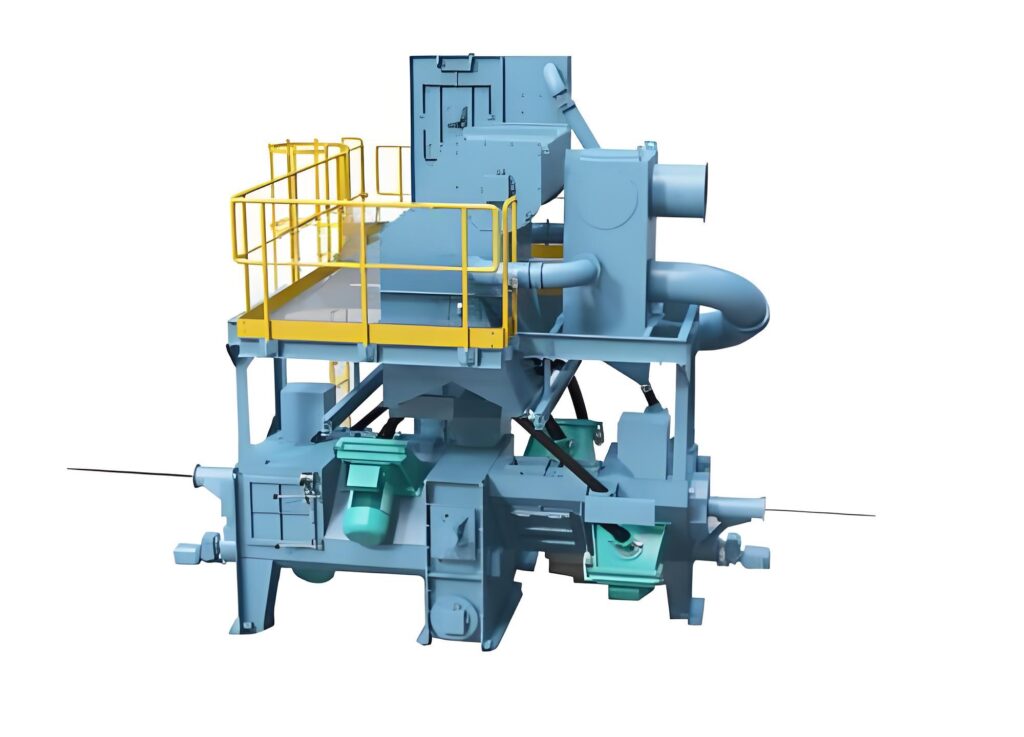
- The abrasive recycling system collects scattered abrasives, screens and purifies qualified media for cyclic reuse, greatly reducing material waste. The supporting dust removal system absorbs and filters floating dust generated during blasting, meeting environmental protection emission standards. The following table shows core component functions and operational impacts:
| Core Component | Key Function | Operational Impact |
| Air Compression System | Provide stable blasting pressure | Determines cleaning strength and efficiency |
| Abrasive Recycling System | Recycle and purify abrasives | Reduces long-term material costs |
| Dust Removal System | Filter floating dust and impurities | Ensures environmental compliance and safety |
Chong Jen Machinery optimizes integrated system matching for every custom blast room. We calibrate air pressure, recycling and dust removal systems to keep your sandblasting chamber running stably with minimal consumption.
Standard Step-by-Step Workflow of Sandblasting Chamber Operation
Professional blast room operation follows a fixed cyclic workflow to guarantee consistent finishing quality.
- Before startup, operators inspect chamber sealing, air pressure stability and dust system status, then place workpieces reasonably to avoid blasting dead zones. After starting the equipment, the dust removal system operates in advance to form negative pressure inside the sandblasting chamber and prevent dust overflow. Operators hold blasting guns to spray abrasives evenly on workpiece surfaces at a standard distance and angle.
- After blasting completes, the abrasive recycling system collects scattered media for screening and reuse, while the dust system continues running to clean residual floating dust. This complete closed-loop workflow standardizes every blasting process, eliminates quality fluctuations, and extends the service life of the entire blast room equipment.
Conclusion
Blast rooms rely on closed-loop systems for safe, efficient and uniform blasting.
Contact Chong Jen Machinery
For high-performance sandblasting chamber and customized blast room solutions, consult Chong Jen Machinery :[email protected].
 English
  Russian
  Spanish
  Portuguese
  French
  Indonesian
  Thai
Thai