
Manual horizontal molding suffers low output and high errors; automation reform solves core foundry bottlenecks efficiently.
Discover how automation reform optimizes horizontal molding performance, improves automatic sand molding machine and molding machine efficiency, and delivers stable high-volume foundry production.
Learn systematic automation upgrade strategies to renovate traditional molding lines.
What Are the Limitations of Traditional Manual Moulage horizontal Production?
Traditional horizontal molding production relying on manual operation and semi-automatic equipment faces obvious limitations that restrict the profitability and scalability of modern foundry factories.
- Most old-fashioned molding machine units operate with manual sand filling, manual mold calibration, and human-assisted demolding, leading to unstable cycle times and inconsistent product quality. Workers’ operating proficiency, fatigue, and subjective judgment directly affect molding precision, resulting in frequent dimensional deviations, sand inclusion defects, and high scrap rates.
- Meanwhile, traditional production modes require large labor teams to complete sand preparation, mold setting, and line coordination, bringing high labor costs and difficult personnel management. The matching old sand processing equipment cannot synchronize material supply speed with molding rhythm, causing frequent line standby and idle time. Statistics show that traditional semi-manual horizontal molding lines only achieve an OEE (Overall Equipment Effectiveness) of 55% to 62%, with up to 40% of production time wasted on manual errors, equipment waiting, and rework.
These long-standing problems make it difficult for small and medium foundries to meet large-order delivery requirements and standardized quality standards, gradually losing market competitiveness in the precision casting industry.
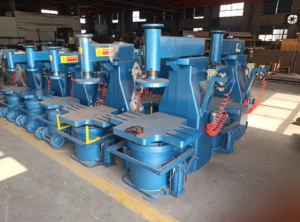
How Does Automation Reform Reshape Horizontal Molding Line Efficiency?
Automation reform completely overturns the operation logic of traditional horizontal molding, realizing standardized, high-speed, and low-defect production through intelligent equipment linkage and program control.
- The core of the reform is to replace manual intervention with automatic program logic, covering sand preparation, mold compaction, mold opening, core setting, and mold conveying. After automation upgrading, the entire horizontal molding process no longer relies on manual adjustment, and each production link is executed according to fixed program parameters, ensuring consistent cycle time and unified molding precision.
- The upgraded automatic sand molding machine can realize real-time sand proportioning, moisture adjustment, and impurity removal, providing high-standard molding sand continuously and stably for the main molding machine. Synchronous automatic conveying lines eliminate manual handling waiting time, greatly improving line operation continuity. The following data table clearly reflects the efficiency changes brought by automation reform:
| Production Mode | Cycle de moulage unique | OEE de la ligne | Taux de Rebuts |
| Traditional Manual Molding | 35–45s | 58% | 7–9% |
| Automated Horizontal Molding | 24–30s | 84% | 1–2% |
Chong Jen Machinery focuses on practical automation reform solutions for horizontal molding lines. We optimize program logic for automatic sand molding machine and molding machine linkage, realizing zero-delay material supply and synchronous operation, helping customers increase comprehensive production capacity by 30% to 40%.
Core Automatic Equipment Configuration for Horizontal Molding Automation Upgrades
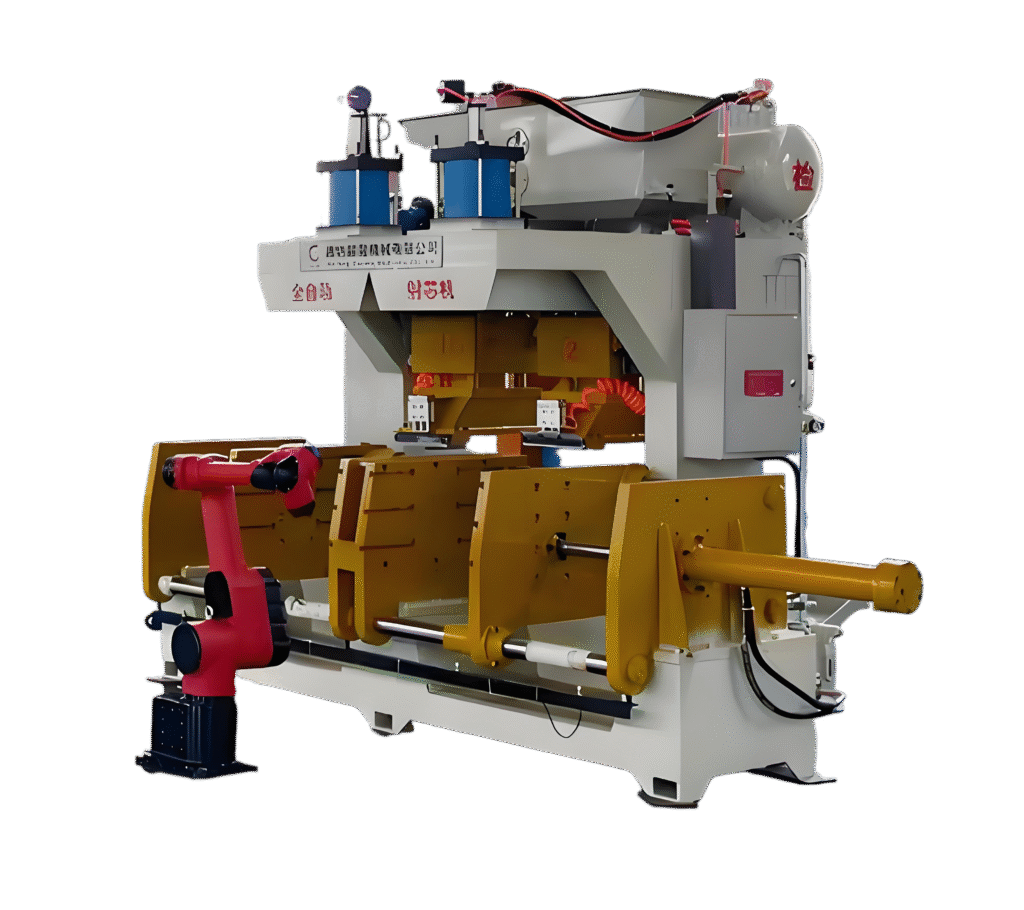
Successful horizontal molding automation reform relies on scientific matching of core automatic equipment, with the automatic sand molding machine and intelligent molding machine serving as the two core modules of the entire upgraded line.
- The automatic sand molding machine is responsible for standardized sand treatment, including automatic feeding, stirring, moisture detection, and screening. Different from traditional manual sand mixing equipment, the automatic model can precisely control sand moisture within ±1% error, ensuring uniform sand density and stable molding quality for each batch. The upgraded intelligent molding machine adopts PLC full-program control, realizing automatic mold closing, constant-pressure compaction, precise mold opening, and automatic demolding, effectively eliminating human-induced precision errors.
- In addition, supporting automatic modules such as automatic core-setting robots, intelligent conveying systems, and real-time monitoring sensors form a closed-loop automatic production system. All equipment operates synchronously through a central control system, avoiding mismatched rhythm and line stagnation. For different workshop scales and product types, targeted equipment configuration can maximize automation benefits and avoid over-investment in redundant functions.
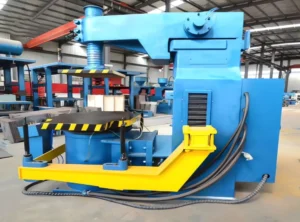
What Custom Automation Solutions Suit Different Foundry Production Scenarios?
Not all foundry factories are suitable for unified full-automatic transformation; custom automation reform schemes are the key to balancing cost and efficiency for horizontal molding upgrades. Factories engaged in small-batch and multi-variety customized casting production do not need full-automatic unmanned lines.
- Semi-automatic customized schemes with flexible manual intervention stations can save investment while improving efficiency. For large-scale mass production of standard castings, full-automatic linkage transformation of automatic sand molding machine and molding machine is recommended to realize unmanned continuous production.
- In addition, for old workshop renovation with limited space, compact customized automation modules can be adopted to avoid overall line reconstruction and save workshop transformation costs. Customized parameter programming can also be performed according to product specifications to adapt to different molding sizes and process requirements.
Chong Jen Machinery provides one-on-one custom automation reform services for horizontal molding lines. We formulate targeted upgrade schemes according to customer production scale, product types, and workshop conditions, ensuring every transformation achieves the best cost-performance and practical production improvement effects.
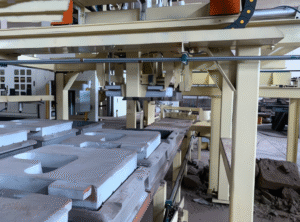
How Automation Reform Reduces Long-Term Operational Costs of Molding Lines
In addition to improving production efficiency, horizontal molding automation reform significantly reduces long-term comprehensive operational costs for foundry enterprises, bringing sustainable profit growth.
- First, automated lines greatly reduce labor dependence. The original manual positions such as sand mixing, mold calibration, and workpiece handling can be replaced by automatic equipment, cutting labor costs by more than 60%.
- Second, precise automatic parameter control reduces material waste. Le machine à moulage de sable automatique accurately controls sand usage and avoids excessive sand waste caused by manual operation; meanwhile, the low defective rate reduces raw material loss and rework costs.
- Third, standardized automatic operation reduces equipment wear and failure frequency. The intelligent molding machine runs stably according to preset programs, avoiding equipment impact and damage caused by irregular manual operation, extending equipment service life and reducing maintenance costs.
In the long run, automation reform can help foundries recover transformation costs within one to two years and form stable high-efficiency and low-consumption production advantages.
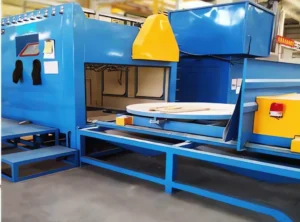
Common Mistakes in Horizontal Molding Automation Transformation
Many foundries encounter low transformation benefits due to blind automation upgrades, which is a common problem in horizontal molding automation reform.
- The first typical mistake is pursuing full automation blindly regardless of production demand. Small-batch customized production adopting full-automatic unmanned lines will lead to low equipment utilization and wasted investment.
- The second mistake is mismatched equipment linkage. Simply replacing a single machine à moulage de sable automatique or molding machine without overall program debugging will cause asynchronous operation of each link and form new production bottlenecks.
- The third mistake is ignoring post-transformation operation training. Automated equipment has higher operation logic requirements; untrained operators cannot give full play to equipment performance, resulting in insufficient upgrade effects.
- The fourth mistake is neglecting reserved upgrade space. Les schémas de transformation à court terme ne peuvent pas s'adapter aux itérations ultérieures des produits et à l'expansion de la capacité, entraînant des coûts de reconstruction secondaires.
Éviter ces erreurs est le prérequis d'une réforme de l'automatisation réussie. L'équipe d'ingénierie professionnelle de Chong Jen Machinery résume une riche expérience de transformation sur site, aidant les clients à éviter divers risques de transformation et à garantir un retour sur investissement stable.
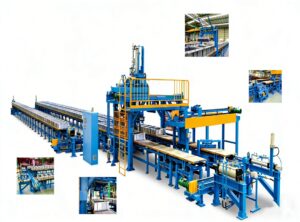
Tendances de développement futures de la production automatisée de moulage horizontal
Avec l'amélioration continue de l'industrie de la fonderie, le moulage horizontal automatisé se développe vers l'intelligence, la numérisation et une grande flexibilité.
- Machine de moulage future et automatique sand molding machine réalisera la surveillance des données cloud, permettant de visualiser à distance l'état de fonctionnement de la ligne, les données de production et le taux de défauts en temps réel. Les fonctions intelligentes d'autodiagnostic identifieront automatiquement les anomalies de l'équipement et prédiront les cycles de maintenance, réduisant ainsi davantage les temps d'arrêt non planifiés.
- De plus, la transformation automatique flexible deviendra la norme, permettant à l'équipement de changer rapidement les paramètres pour s'adapter à différents besoins de production de produits et résoudre le point faible de la faible flexibilité des lignes automatiques traditionnelles.
L'optimisation de l'automatisation verte et à faible consommation sera également une direction de développement importante, optimisant la consommation d'énergie de fonctionnement de l'équipement et réduisant la pollution par la poussière et le bruit tout en garantissant une haute efficacité, aidant les fonderies à respecter les normes de protection de l'environnement et à atteindre un développement durable.
Conclusion
La réforme scientifique de l'automatisation améliore considérablement l'efficacité du moulage horizontal et réduit les coûts d'usine.
Contact Chong Jen Machinery
Pour une réforme professionnelle de l'automatisation du moulage horizontal sur mesure et des solutions de machine à mouler et de machine à mouler automatique haute performance,
contactez Chong Jen Machinery par e-mail : :[email protected]
 French
  English
  Russian
  Spanish
  Portuguese
  Indonesian
  Thai
Thai