
Why the Lowest Molding Equipment Quote Can Become Your Highest-Cost Decision
Overseas foundries often select a Manufacturer by comparing only the bare-machine price. That approach creates a serious procurement risk: hidden sand waste, excessive electricity use, labor dependency, scrap, repairs, and downtime can exceed the original savings. Without a full lifetime-cost review, a seemingly affordable Molding Equipment purchase may weaken margins for years.
The best selection standard is total cost of ownership, not purchase price. Our company evaluates equipment purchase, shipping, consumables, energy, labor, yield, maintenance, downtime, and residual value over three to five years, then recommends a Customizable OEM or ODM solution matched to your castings, production capacity, operating conditions, and facility.
Start with the Complete TCO Calculation
A professional procurement review separates initial CAPEX from recurring OPEX and production-risk costs. Use the following formula before approving any molding line:
Three to five-year TCO = equipment price + container shipping and installation + sand and resin waste + electricity + labor + maintenance and spare parts + scrap and rework losses + downtime losses + tooling and layout modifications.
- Record the equipment purchase price, auxiliary systems, tooling, commissioning, training, and factory modifications.
- Add logistics costs, including export packing, container shipping, insurance, inland transport, customs, and installation.
- Calculate annual OPEX from sand or resin consumption, electricity for hydraulic motors and the complete machine, labor, lubrication, and consumables.
- Estimate quality-related losses from scrap, rework, dimensional variation, poor mold strength, and inconsistent compaction.
- Calculate downtime losses by multiplying unavailable production hours by contribution margin per hour.
- Compare the total cost against expected casting output, yield rate, machine life, and resale or upgrade value.
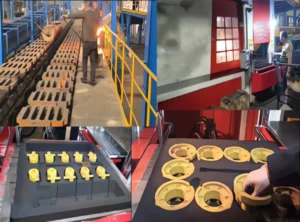
Why Low-Cost Equipment Can Be Expensive
Simple vibration-compaction molding machines may require a lower one-time CAPEX, but the apparent saving often disappears during operation. High manual intervention can increase labor costs, while uneven compaction may create more defects. Excessive sand consumption, repeated mold preparation, and frequent adjustments also raise hidden loss costs.
- Higher sand waste from inaccurate filling and mold handling.
- Higher scrap and rework rates caused by unstable mold quality.
- Greater electricity consumption per acceptable casting.
- More labor for loading, alignment, inspection, and correction.
- Frequent breakdowns that reduce production capacity and delivery reliability.
A semi-automatic molding line can improve consistency, yet it still depends heavily on operator performance. The correct production capacity matching solution should consider casting dimensions, alloy, mold size, hourly demand, shift pattern, available labor, and future expansion rather than relying on a catalogue specification alone.
Three-to-Five-Year Cost Comparison by Molding Line
The following indicative comparison shows why procurement teams should evaluate cost per acceptable casting. Actual results vary with casting weight, labor rates, energy prices, sand quality, utilization, and maintenance practices.
| Molding line | Initial CAPEX | Operating profile | Typical long-term cost position |
| Vibration-compaction machine | Low | High labor, sand waste, variable yield | Often highest cost per good casting |
| Semi-automatic line | Medium | Moderate labor and improved consistency | Balanced for limited production |
| Fully automatic boxless line | Medium to high | Low labor, stable cycle time, high yield | Lower TCO at regular volume |
| V-process or vacuum molding line | High | Low sand waste, precise molds, specialized application | Highly competitive for suitable castings |
| Shell molding line | Medium to high | Strong surface finish, resin and energy considerations | Best when quality justifies process cost |
What Automated Lines Add to the Business Case
Our automated horizontal and vertical boxless molding lines, together with vacuum molding solutions, are designed to reduce lifetime expenses rather than simply minimize the invoice. Higher precision supports consistent mold dimensions and casting quality. Controlled sand handling reduces waste, efficient drives reduce electricity use, and lower failure rates protect scheduled output.
- Reduced labor requirements through automated molding, transfer, and handling.
- Lower sand consumption through accurate dosing, recovery, and mold control.
- Lower electricity use through efficient hydraulic systems and optimized machine cycles.
- Higher casting yield rates with stable compaction and repeatable process parameters.
- Reduced downtime through robust design, diagnostics, preventive maintenance, and accessible spare parts.
- Improved scalability through modular equipment and Customizable production configurations.
From Machine Selection to Full-Line Planning
A reliable Supplier should provide more than a standalone machine. Our company can develop end-to-end foundry line design, free factory layout planning, material flow analysis, sand handling integration, molding, pouring, cooling, shakeout, reclamation, inspection, and automation interfaces. As an experienced OEM and ODM partner, we can configure the line around your existing building and expansion plan.
| Operating input | Procurement decision it influences |
| Casting size, weight, and alloy | Molding method, flask or boxless dimensions, and compaction requirements |
| Required good castings per hour | Cycle time, number of molding stations, and automation level |
| Local labor and electricity costs | Automation payback and OPEX reduction |
| Sand type and reclamation capability | Consumable usage, recovery equipment, and environmental performance |
| Factory footprint and utilities | Layout, installation scope, and infrastructure CAPEX |
Request a Customized Lifetime-Cost Review
Do not approve a Molding Equipment purchase from a bare-machine quote alone. Send our company your casting drawings, annual volume, target cycle time, labor costs, energy prices, sand data, and factory dimensions. We will provide a free customized cost calculation, compare suitable models over three to five years, and recommend the optimal full-line solution.
 English
  Russian
  Spanish
  Portuguese
  French
  Indonesian
  Thai
Thai