
Poor wheel blast knowledge causes inconsistent finishes, wasted output and frequent blasting machine failures.
Mastering wheel blast basics helps operators optimize wheel blasting machine performance, stabilize surface prep quality, and extend blasting machine service life for industrial production.
Learn core wheel blast fundamentals to refine your surface preparation workflows.
What Is Wheel Blast: Core Definition and Fundamental Working Principle
Wheel blast is a mechanical surface preparation technology that serves as the foundation of modern industrial surface treatment, widely replacing traditional manual grinding and air blasting processes.
- Unlike air-powered blasting equipment that relies on compressed air, a professional wheel blasting machine uses high-speed rotating blast wheels to generate powerful centrifugal force, accelerating steel shot, steel grit and other metallic abrasives to impact workpiece surfaces evenly. This physical impact strips rust, oxide scales, welding slag, old paint layers and surface contaminants without chemical pollution or material damage.
- The core advantage of wheel blast technology lies in its controllable impact force, uniform coverage and high operational efficiency, making it the most reliable solution for standardized mass surface preparation. A complete wheel blast cycle includes abrasive acceleration, surface impact, debris separation, and abrasive recycling.
Understanding these basic working principles allows factory operators to avoid improper parameter settings that lead to incomplete cleaning, uneven roughness and unnecessary wear on the blasting machine. For all industrial surface prep projects, mastering wheel blast fundamentals is the first step to stable and high-quality production.
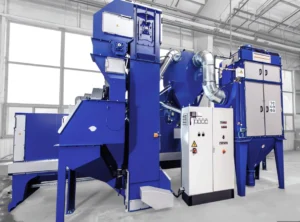
Key Components That Make Up a Functional Wheel Blasting Machine
A high-performance wheel blasting machine consists of multiple coordinated core components, and each part directly affects the overall operating effect of the wheel blast system.
- The blast wheel assembly is the heart of the blasting machine, including blades, impellers, control cages and wheel housings, which determine abrasive acceleration speed and coverage range. The abrasive circulation system collects used abrasives, separates broken particles and qualified media, and realizes cyclic reuse to reduce production costs.
- The dust removal system filters floating dust and fine debris generated during wheel blast processing to ensure workshop environmental compliance and prevent internal component blockage.
Additionally, automated feeding systems, sealing structures and electrical control systems ensure continuous and stable equipment operation. Damaged or aging components are the leading cause of degraded wheel blast quality and frequent equipment downtime. Many factories overlook routine component inspection, resulting in gradually reduced blasting machine efficiency and increased defect rates. Maintaining intact core components is essential for consistent long-term wheel blast performance.
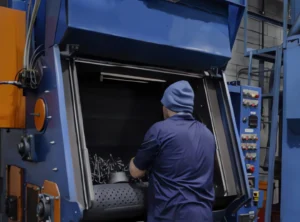
Critical Differences Between Wheel Blast and Traditional Surface Prep Methods
Most surface preparation quality and efficiency gaps stem from choosing the wrong processing technology.
- Traditional methods including manual grinding and air sandblasting have obvious limitations in batch production and precision control, while standardized wheel blast processes solve these pain points comprehensively. Manual grinding relies on human operation, resulting in uneven surface roughness, low efficiency and high labor costs.
- Air sandblasting produces massive dust pollution, consumes large amounts ofdisposable abrasives, and cannot guarantee batch consistency. In contrast, a professional wheel blasting machine delivers adjustable, repeatable and uniform surface treatment results.
- Wheel blast equipment features automated operation, low abrasive waste and environmentally friendly processing, perfectly matching modern industrial standardized production needs. The following data table clearly compares the performance differences between mainstream surface preparation methods:
| Surface Prep Method | Batch Consistency | Operational Efficiency | Environmental Impact |
| Manual Grinding | Poor, uneven finish | Very low, labor-intensive | Low dust, high labor waste |
| Air Sandblasting | Moderate inconsistency | Medium efficiency | High dust pollution |
| Wheel Blast (Blasting Machine) | Excellent full-batch uniformity | 2-3x higher efficiency | Closed, low-emission design |
Chong Jen Machinery focuses on optimized wheel blasting machine design and process debugging. We help factories replace inefficient traditional processes with stable wheel blast solutions, improving surface prep quality while cutting long-term operational costs.
Core Industrial Applications for Standard Wheel Blast Processes
Wheel blast technology is widely applicable to almost all metal surface preparation scenarios, becoming an indispensable process in foundry, steel structure, automotive, hardware and aerospace industries.
- In foundry production, wheel blast processing removes residual sand, burrs and oxidation layers from castings and forgings, improving surface smoothness and product qualification rates. For steel structure manufacturing, a wheel blasting machine cleans rust and scale from steel plates, profiles and pipes, creating standardized roughness for subsequent anti-corrosion painting and coating adhesion.
- The automotive industry uses professional wheel blast equipment to treat chassis parts, wheel hubs and structural components, enhancing surface fatigue resistance and coating durability. Hardware and mechanical factories rely on automated wheel blast systems for batch deburring and surface strengthening.
Different workpieces and production scales require targeted wheel blast parameter adjustment and equipment configuration. Reasonable matching of blasting machine models and process parameters ensures optimal surface preparation results for diverse industrial products.
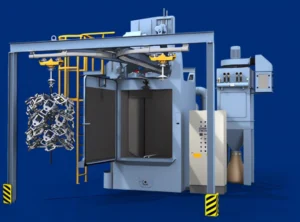
Standard Parameter Settings for Stable Wheel Blast Surface Preparation
Scientific parameter calibration is the key to maximizing wheel blasting machine performance and avoiding surface prep defects.
- Core adjustable wheel blast parameters include blast wheel rotating speed, abrasive particle size, feeding speed and blasting coverage range. High rotating speed generates strong impact force, suitable for removing thick rust and heavy oxide layers, while low-speed operation adapts to precision workpieces to avoid surface deformation and excessive material loss.
- Matching abrasive specifications according to workpiece hardness ensures uniform surface roughness without micro-damage. Unreasonable parameter settings are the main cause of common defects such as incomplete cleaning, over-blasting and uneven texture.
Many factory operators use fixed parameters for all workpieces, leading to unstable product quality and wasted equipment performance. Mastering basic parameter matching rules enables flexible adjustment of blasting machine operation modes, adapting to different surface preparation standards and greatly improving production qualification rates.
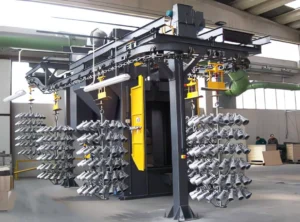
Basic Maintenance Practices to Preserve Blasting Machine Performance
Long-term stable wheel blast performance depends on standardized daily maintenance, which effectively extends the service life of the wheel blasting machine and reduces failure rates.
- Daily maintenance includes inspecting blade wear, cleaning blocked circulation pipelines, checking sealing tightness and removing accumulated dust inside the blasting machine. Worn blades cause unbalanced rotation, uneven abrasive spraying and severe equipment vibration, which directly degrade wheel blast quality.
- Regular screening and replacement of deteriorated abrasives ensure consistent impact force and avoid finish defects. Weekly lubrication of transmission parts and calibration of electrical control systems prevent operational stalling and parameter drift. Simple and regular maintenance can reduce blasting machine failure rates by more than 80%, maintaining stable wheel blast surface preparation effects for long-term batch production and minimizing unplanned downtime losses.
Conclusion
Master wheel blast basics to optimize blasting machine efficiency and surface prep quality.
Contact Chong Jen Machinery
For customized wheel blasting machine solutions and professional wheel blast process optimization,
consult Chong Jen Machinery:[email protected].
 English
  Russian
  Spanish
  Portuguese
  French
  Indonesian
  Thai
Thai