
How Select a Hook Shot Blaster for Balanced Capacity & Workshop Space?
Are you a plant manager, procurement officer, or workshop planner struggling to balance production capacity with limited floor space when selecting a hook shot blaster ? Poor machine choice leads to cramped workflows, reduced throughput, maintenance bottlenecks, and higher total cost of ownership. This guide explains spatial layouts, capacity trade-offs, compact design strategies, and supplier selection (OEM/ODM and customizable options) to optimize both throughput and workshop efficiency.
Match hook shot blaster capacity to available workshop space by evaluating chamber layout, hook spacing, and conveyor footprint; choose customizable or OEM/ODM solutions from a trusted manufacturer / supplier offering low MOQ and a 24-month warranty for risk-free deployment.
Read on for practical layout rules, a single vs double hook capacity comparison, compact design tips (with our strengths), recommended sourcing cities in China, and a data-driven supplier comparison to help wholesaler and direct buyers choose the right Shot Blasting Machine .
How does chamber layout impact workshop space usage?
- Linear vs. Modular Layout:Linear chambers require more floor length but simplify material flow; modular chambers reduce footprint by stacking operations in a compact cell.
- Hook Spacing & Pitch:Wider hook pitch increases machine capacity but consumes aisle space; optimize pitch for average part dimensions to avoid wasted real estate.
- Loading/Unloading Zones:Dedicated end zones or side-loading stations reduce congestion—consider lift-assist or overhead crane clearances that affect ceiling height requirements.
- Maintenance Access:Provide clearance for door swing, abrasive replacement, and wheel service; tight layouts increase downtime if service access is compromised.
- Vertical Integration:Use elevated conveyors, mezzanines, or stacked cells to multiply capacity per square meter—suitable for multi-shift operations in the Construction Machinery Industry .
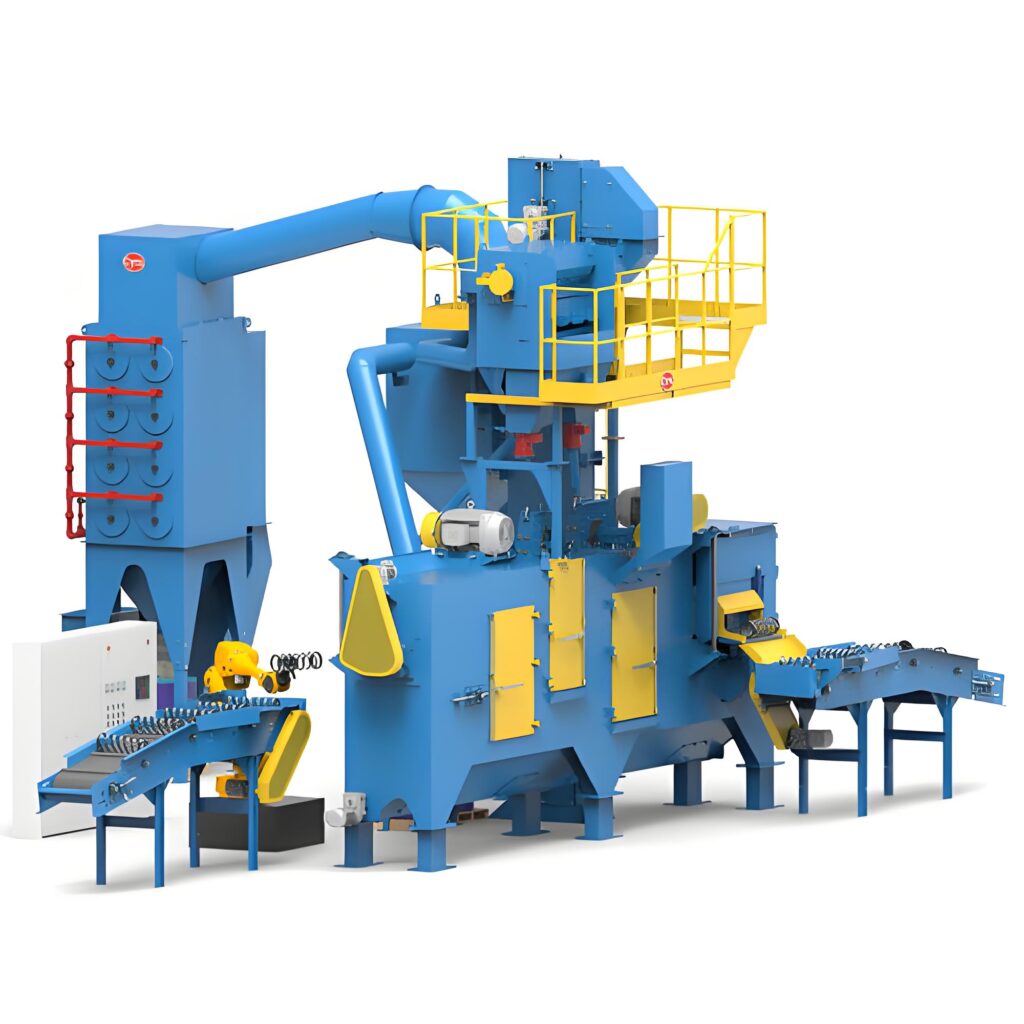
- Footprint Optimization:Select machines with compact wheel housings or remote dust collectors to free floor space; customizable configurations allow tailoring to existing workshop constraints.
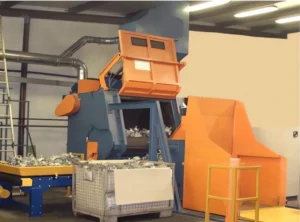
Single vs. Double Hook Blaster Capacity Comparison
Choosing between single and double hook shot blasters hinges on part mix, cycle time, and space. Single-hook machines typically have a smaller footprint and suit lighter throughput demands; double-hook machines alternate hooks to increase effective throughput without duplicating blast chambers.
Capacity and Throughput
Double-hook systems can approach nearly double the output of a single-hook unit if cycle times and loading/unloading are balanced—useful when line automation is present. However, actual gain depends on hook pitch, conveyor speed, and blast exposure time required for the part finish.
Space & Workflow Considerations
Double-hook designs often require additional horizontal or vertical clearance for the alternation mechanism, slightly increasing footprint. For restricted floorspace, a single-hook with faster indexing or increased abrasive velocity (Wheel Blast options) may be more efficient.
Cost & Maintenance
Double-hook machines typically have higher upfront cost and slightly more complex maintenance (additional hooks, controls). Single-hook units are simpler, easier to retrofit, and often better for small-batch wholesaler orders or low MOQ procurement strategies.
When to choose which
Choose double-hook if steady high-volume runs justify the space and capital; choose single-hook with OEM/ODM customizable upgrades for smaller factories or mixed-part workloads common in the Construction Machinery Industry .
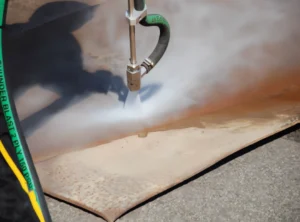
How to design a compact blaster for small factories?
Designing compact shot blasters requires both engineering choices and supplier cooperation. Our company helps small factories with pragmatic, space-saving solutions and after-sales support. Key compact design features we provide include:
- Shortened chamber footprint:Optimized wheel placement and tapered blast patterns to maintain coverage in reduced length.
- Vertical stacking:Multi-level infeed/outfeed options to maximize use of headroom rather than floor area.
- Integrated dust collection:External or rooftop collectors minimize machine width and allow easier maintenance aisles.
- Retractable or foldable platforms:Service platforms that stow to save space during production runs.
- Control & automation compactness:PLC cabinets and HMI mounted externally or in slimline racks to reduce footprint.
- OEM/ODM & Customizable options:We offer tailored layouts, modular designs, and customizable jigs for small-batch or multi-part workflows—ideal for wholesaler clients and small manufacturers.
Our strengths: on-site layout consultation, low MOQ for pilot machines, fast OEM/ODM turnaround, and a 24-month warranty that lowers adoption risk for small factories upgrading to industrial shot blasters.
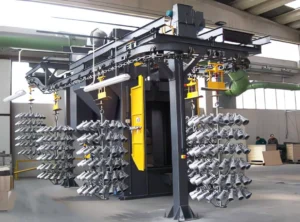
Which city in China is best for shot blasting machine manufacturers and suppliers?
Several Chinese cities host strong clusters of Shot Blasting Machine production, each with distinct strengths:
Wuxi
Specializes in heavy industrial machines with robust fabrication capabilities—ideal for large Wheel Blast systems used in construction machinery.
Guangzhou
Excels in export logistics and rapid OEM/ODM assembly—best for suppliers targeting overseas wholesaler networks and tight delivery schedules.
Hangzhou / Ningbo
Known for automation, control integration, and compact designs—good for small-to-medium enterprises in the Construction Machinery Industry seeking customizable solutions.
Why our locations matter: Our factories are located in these hubs, enabling low minimum order quantities (low MOQ) for sample and pilot orders, flexible OEM / ODM production, and a standard 24-month warranty on core components. That combination reduces buying risk and speeds deployment for both manufacturers and suppliers .
Why choose us as your shot blasting machine supplier in China?
We combine flexible manufacturing, export readiness, and warranty-backed reliability tailored for wholesale , manufacturer, and direct supplier customers. Below is a concise market-position table demonstrating our competitive stance.
| Supplier | Estimated Global Market Share | Core Strengths | MOQ | Warranty |
| Our Company | 6% | OEM/ODM, customizable designs, compact solutions, fast lead times | Low (samples & pilot runs) | 24 months |
| Global Leader A | 20% | Large-scale production, broad product range | High | 12–18 months |
| Regional Supplier B | 4% | Niche machines, localized service | Medium | 12 months |
Data-driven rationale
Market estimates indicate that agile suppliers offering OEM , ODM and customizable options gain share among small-to-mid-size buyers. Our moderate 6% share reflects targeted growth in compact and export-ready shot blaster configurations for the Construction Machinery Industry and general manufacturing sectors. Low MOQ and a 24-month warranty are proven purchase drivers for wholesaler networks and procurement teams.
Summary
Balance capacity and space by optimizing chamber layout, choosing single vs double hook strategically, and selecting a Manufacturer/Supplier offering OEM/ODM, customizable designs, low MOQ, and a 24-month warranty for reliable, space-efficient shot blasting solutions.
 English
  Russian
  Spanish
  Portuguese
  French
  Indonesian
  Thai
Thai