
How to Calculate Real Cost per Cleaned Casting for a Hook Shot Blasting Machine — stop hidden margin erosion
P Unknown abrasive consumption, reblasts, and cycle variability hide true per-piece costs. Procurement and production face margin loss when wheel blast settings or supplier changes cause scrap. A structured, Customizable costing method ties coating specs, abrasive mix, and conveyor timing to accurate cost per cleaned casting.
Use coating supplier data sheet anchor profile targets, measured QA records, and Supplier/Manufacturer abrasive consumption to build a standardized cost-per-piece model; our company provides OEM/ODM-ready templates and validation checklists.
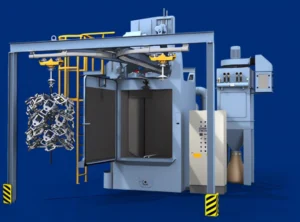
How coating systems, abrasive mixes, and blast parameters interact
Coating requirements set the anchor profile and cleanliness level; abrasive selection and machine settings deliver those outcomes. A hook shot blasting machine or wheel blast line must be tuned so abrasive energy and exposure time meet coating supplier limits without excess consumption or reblasts.
Key inputs from coating supplier data sheet
- Target anchor profile (µm or mil) and acceptable range
- Required cleanliness grade (e.g., Sa 2.5) and contamination limits
- Surface prep method recommendations and tolerances
- Handling and flash-rust windows that affect throughput
Anchor profile measurement and QA records
Consistent measurement and QA logging are essential to link process to cost:
- Use standardized instruments and locations; record operator and time.
- Maintain QA records: profile values, sample size, reblast events, scrap counts.
- Trigger reblasts when profiles fall outside supplier tolerance or visual contamination is detected.
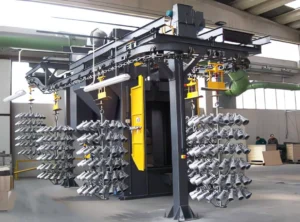
Abrasive choice: steel shot vs. grit and blast parameter effects
Selecting steel shot or grit changes consumption, profile shape, and waste; wheel speed and conveyor speed adjust exposure and throughput. Work with Manufacturer and Supplier to optimize a Customizable mix for your parts and coating.
| Steel Shot vs. Grit — Operational Tradeoffs | ||
| Attribute | Steel Shot | Grit |
| Profile type | Rounded, shallower peaks | Sharper, deeper anchor |
| Consumption | Lower (recyclable) | Higher (consumable) |
| Dust/Waste | Less dust, easier recycling | More dust, higher disposal cost |
| Best use | Peening, high-volume cleaning | Heavy profile for thick coatings |
Wheel speed, conveyor speed, and reblast triggers
- Establish baseline: run trials varying wheel speed and conveyor speed; log profile and throughput.
- Define numerical reblast triggers from QA records: e.g., profile < target – tolerance or visual residue > threshold.
- Quantify average reblast time, abrasive used, and scrap per event to include in cost model.
Step-by-step cost-per-cleaned-casting calculation
- Gather inputs: coating supplier data sheet, Manufacturer machine wear rates, Supplier abrasive prices, energy rates, operator wages.
- Measure variable hourly costs: abrasive kg/hr, energy at selected wheel speed, filter/disposal fees, spare wear parts.
- Record effective throughput: nominal conveyor rate minus time lost to reblasts and rejects (from QA records).
- Compute per-piece variable cost = hourly variable costs ÷ effective pieces/hr.
- Compute per-piece fixed cost = (operator+overhead+depreciation per shift) ÷ effective pieces/shift.
- Add average reblast cost per piece = (reblast events/hr × reblast cost) ÷ effective pieces/hr.
- Total cost per cleaned casting = per-piece variable + per-piece fixed + reblast allocation.
| Illustrative Cost Model | ||
| Item | Hourly Value | Notes |
| Abrasive cost | $20/hr | Supplier price for grit; adjust for recycling rate |
| Energy & wear | $12/hr | OEM wheel speed 1400 rpm baseline |
| Operator & overhead | $30/hr | Includes QA sampling |
| Effective throughput | 60 pieces/hr | After reblasts |
| Total cost per piece | $1.03 | Sum of allocated hourly costs divided by throughput |
Process governance and supplier collaboration
- Keep QA records traceable to Supplier lot and Manufacturer machine serial for root-cause analysis.
- Use Customizable SOPs shared with OEM/ODM partners to reduce variability and reblasts.
- Negotiate Supplier contracts that include abrasive performance metrics and waste disposal terms.
Ready to quantify savings? Request our Customizable costing template and supplier-validated parameter set to calculate your hook shot blasting machine cost per cleaned casting; contact procurement for an OEM/ODM consultation.
 English
  Russian
  Spanish
  Portuguese
  French
  Indonesian
  Thai
Thai