
Incorrect blast room pressure causes poor finishing and waste; precise adjustment greatly improves blasting quality.
Learn how to accurately adjust pressure for sand blast room and standard blast rooms, plus custom pressure settings for different workpiece materials and scenarios.
Master professional pressure tuning skills to avoid defective blasting results.
Why Sand Blast Room Pressure Determines Overall Blasting Effect
Air pressure is the core factor that controls abrasive velocity, cleaning force, and surface uniformity in all blast rooms. Improper pressure adjustment is the leading cause of inconsistent surface finishing, residual oxide layers, excessive workpiece roughness, and even substrate damage during sand blast room operations.
- Too low pressure fails to provide enough kinetic energy for blast abrasives, resulting in incomplete rust removal, uneven matting, and repeated rework.
- In contrast, excessively high pressure causes abrasive over-impact, scratching thin workpieces, increasing abrasive consumption, and raising equipment wear speed. Industry data shows that inaccurate pressure control can increase operational costs by 20% due to wasted abrasives and reduced productivity. Every sand blast room requires differentiated pressure parameters based on workpiece material, thickness, and surface treatment standards.
Many generic blast rooms lack precise pressure control structures, leading to unstable output. Chong Jen Machinery optimizes pressure control valves and pressure sensing systems for our standard and custom blast rooms, ensuring stable and adjustable pressure output to fit diverse production needs.
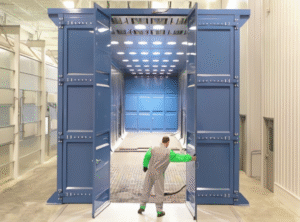
How to Correctly Adjust Working Pressure in Standard Blast Rooms
Professional pressure adjustment for a sand blast room follows standardized step-by-step procedures to ensure stable and repeatable blasting results.
- First, operators must confirm the tightness of blast room pipelines, nozzles, and seals to avoid air leakage that causes pressure loss.
- Second, adjust the main air regulator valve to set the basic pressure range; most conventional blasting tasks maintain a working pressure between 0.4MPa and 0.7MPa. Fine cleaning and thin metal treatment require 0.4–0.5MPa, while heavy rust and scale removal need 0.6–0.7MPa.
- Third, perform trial blasting on scrap workpieces to observe surface effects and fine-tune pressure values.
- Fourth, lock the pressure valve to prevent pressure drift during long-hour continuous operation. The following table shows practical pressure parameters for common sand blast room applications:
| Workpiece Type | Optimal Pressure (MPa) | Blasting Effect |
| Aluminum & Thin Sheet | 0.40–0.50 | Smooth matting without substrate damage |
| Steel & Thick Casting | 0.60–0.70 | Complete rust and scale removal |
Chong Jen Machinery equips our blast rooms with high-precision digital pressure gauges and stable regulating valves, allowing operators to achieve accurate pressure adjustment in one step and avoid repeated debugging.
Why Custom Pressure Settings Are Essential for Specialized Blast Room Projects
Standard fixed pressure settings cannot meet all industrial blasting demands, making custom pressure configuration indispensable for complex sand blast room projects. Special workpieces such as high-precision alloy parts, antique restoration components, and thin-walled stainless steel require ultra-fine pressure control that standard blast rooms cannot provide.
- Custom pressure systems support segmented pressure adjustment, low-pressure fine blasting mode, and delayed pressure stabilization functions, effectively protecting high-value workpieces while ensuring cleaning quality. Custom pressure tuning also adapts to different abrasive types, including glass beads, steel grit, and walnut sand, matching different kinetic energy requirements.
- For factories with diversified product lines, custom pressure solutions greatly reduce defective rates and expand the application range of blast rooms. Chong Jen Machinery provides full custom parameter configuration for sand blast room equipment, tailoring exclusive pressure schemes according to customer workpiece specifications and production standards to maximize blasting efficiency and quality stability.
Conclusion
Precise pressure adjustment optimizes sand blast room effect and reduces production costs.
Contact Chong Jen Machinery
For professional sand blast room pressure optimization and custom blast room solutions,
feel free to contact Chong Jen Machinery via email:[email protected]
 English
  Russian
  Spanish
  Portuguese
  French
  Indonesian
  Thai
Thai