
Poor surface purification causes coating failure; shot blasting equipment ensures thorough, efficient cleaning.
This guide explains how shot blasting machines achieve workpiece surface purification, covering shot blasting, shot blasting equipment, and wheelblast equipment for buyers.
Learn the core mechanisms and key factors of shot blasting surface purification.
What Is the Core Principle of Shot Blasting for Workpiece Surface Purification?
The core principle of workpiece surface purification using shot blasting equipment lies in the physical impact of high-velocity abrasives, a process at the heart of shot blasting technology. Shot blasting machines—including wheelblast equipment—utilize centrifugal force from rotating impellers to accelerate abrasives (such as steel shot or grit) to speeds of 60-100 m/s, propelling them onto the workpiece surface with controlled force . This high-velocity impact generates two key effects:
- First, it mechanically strips away surface contaminants like rust, oxide scale, weld slag, and oil, which are common causes of coating failure and reduced workpiece durability .
- Second, it creates a uniform surface profile (anchor pattern) that enhances the adhesion of subsequent coatings or treatments. Unlike chemical cleaning, shot blasting is an environmentally friendly physical process that avoids corrosive chemical residues and meets strict environmental standards. Wheelblast equipment, a specialized type of shot blasting equipment, uses centrifugal blast wheels to deliver abrasives more efficiently, making it ideal for high-volume purification tasks.
Chong Jen Machinery’s shot blasting equipment and wheelblast equipment are engineered to optimize this impact principle, with precision impeller designs that ensure consistent abrasive velocity and coverage, achieving Sa2.5 or higher surface cleanliness—the industry standard for reliable surface purification .
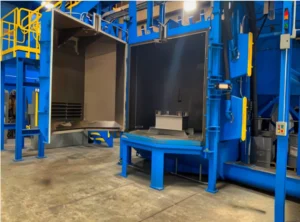
How Do Key Components of Shot Blasting Equipment Support Surface Purification?
Shot blasting equipment and wheelblast equipment rely on coordinated key components to achieve effective workpiece surface purification, each playing a critical role in the shot blasting process.
- The blast wheel (the core of wheelblast equipment) is responsible for accelerating abrasives, with adjustable rotational speeds (2000-3500 rpm) to control impact force for different workpiece materials . The abrasive recovery system ensures that usable abrasives are recycled, maintaining consistent purification quality while reducing waste—Chong Jen Machinery’s equipment features advanced separation systems that remove debris from used abrasives, keeping the abrasive stream clean and effective .
- The dust collection system is another essential component, removing dust generated during shot blasting to protect workers and prevent recontamination of the purified surface; our equipment integrates multi-stage dust collection, achieving 99.8% dust removal efficiency and meeting global environmental standards .
Additionally, the workpiece handling system (e.g., conveyors, turntables) ensures uniform exposure to abrasives, eliminating cleaning blind spots. The table below outlines key components and their roles in surface purification:
| Component | Role in Surface Purification | Key Advantage |
| Blast Wheel (Wheelblast Equipment) | Accelerates abrasives for impact cleaning | High efficiency, adjustable impact force |
| Abrasive Recovery System | Recycles usable abrasives, maintains consistency | Reduces waste, lowers operational costs |
| Dust Collection System | Removes dust, prevents recontamination | Eco-friendly, protects workpiece quality |
What Parameters Affect the Surface Purification Effect of Shot Blasting Equipment?
Several key parameters directly influence the surface purification effect of shot blasting equipment, wheelblast equipment, and shot blasting processes, and optimizing these parameters is critical for achieving consistent, high-quality results. Abrasive selection is fundamental: the hardness, size, and shape of abrasives must match the workpiece material—for example, harder steel grit is ideal for heavy rust removal, while softer glass beads suit precision parts .
- Abrasive velocity, controlled by the blast wheel speed, determines cleaning efficiency: higher speeds (up to 100 m/s) remove tough contaminants faster but require careful adjustment to avoid workpiece damage. Projection angle is another key parameter: a 90° angle delivers maximum impact for flat surfaces, while 45-60° angles are optimal for complex or irregular workpieces to eliminate blind spots . Shot blasting time also matters—over-processing wastes abrasives and may damage the workpiece, while under-processing leaves contaminants.
- Chong Jen Machinery’s experts provide personalized parameter optimization guidance, tailoring abrasive type, velocity, and angle to each client’s workpiece requirements, ensuring that our shot blasting equipment and wheelblast equipment deliver consistent, thorough surface purification with minimal waste.
Conclusion
Shot blasting equipment uses high-velocity abrasives to achieve efficient workpiece surface purification.
Contact Chong Jen Machinery
For high-performance shot blasting equipment, wheelblast equipment, and professional shot blasting guidance,
email Chong Jen Machinery: [email protected].
 English
  Russian
  Spanish
  Portuguese
  French
  Indonesian
  Thai
Thai