
Can a Generic Blast Wheel Damage Castings and Increase Foundry Costs?
Choosing a generic Blast Wheel for every casting can create serious production problems. Excessive impact may penetrate thin walls, weak coverage can leave unevenly cleaned areas, and unsuitable wear-resistant parts may fail prematurely. These issues lead to rework, scrap, downtime, and unstable coating preparation. Foundries need wheel structures matched to casting geometry and line speed.
The best Blast Wheel is selected according to casting type, wall thickness, weight, surface geometry, production rhythm, shot specification, projection angle, and required impact intensity. Our company, an experienced Manufacturer and Supplier, provides Customizable OEM and ODM shot blasting machine solutions for specific foundry conditions.
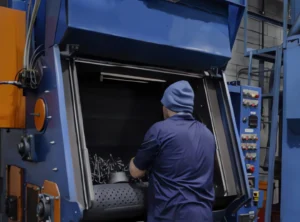
Match Blast Wheel Design to Casting Categories
Different castings require different abrasive projection patterns. A wheel suitable for heavy ductile iron components may be unsuitable for thin aluminum housings or precision investment castings. Generic polishing wheel designs often ignore differences in material strength, recessed areas, gates, ribs, and fragile edges.
Scenario-based compatibility
- Thin-walled aluminum and magnesium castings require controlled impact, reduced shot concentration, and protection against penetration or distortion.
- Small precision castings need even coverage around cavities, ribs, and complex contours without excessive surface roughening.
- Medium iron and steel castings require balanced projection to remove sand, scale, flash, and residual molding material.
- Heavy castings need high-impact construction, durable liners, and stable abrasive delivery during long operating cycles.
- Castings with deep recesses require carefully positioned wheels and suitable projection angles to prevent shadowed or insufficiently cleaned zones.
Simply installing a high-output wheel may increase cleaning speed in one application but reduce quality in another. The correct design must balance impact energy, coverage, abrasive flow, and exposure time according to the complete casting category.
Distinguish Intermittent and Mass Production Conditions
Intermittent foundry production usually involves frequent product changes, variable batch sizes, and flexible operating schedules. In this environment, the Blast Wheel should support quick adjustment, accessible maintenance, and stable performance across multiple casting specifications. A universal configuration may be practical, but projection intensity and abrasive flow must remain adjustable.
Mass production requires a different priority. Continuous lines process large volumes at a fixed pace, so wheel durability, thermal stability, balanced rotation, and predictable wear are essential. A wheel that performs well during short trials may experience rapid component erosion or vibration when operated continuously at high throughput.
| Production condition | Important design priorities | Typical procurement focus |
| Intermittent batches | Adjustment flexibility and quick maintenance | Changeover time, control range, and multi-product compatibility |
| Mass production | Durability and consistent abrasive delivery | Service life, balancing, cooling, and spare-part availability |
| High-mix production | Adaptable projection and controlled impact | Variable wheel settings and customized programs |
| Heavy continuous casting | High impact resistance and structural strength | Blade material, liners, bearings, and maintenance intervals |
Control Projection Angle and Force Intensity
Projection angle determines how effectively abrasive reaches the casting surface. An unsuitable angle can cause overspray onto thin-walled sections, excessive impact on edges, or inadequate cleaning in recessed areas. The control cage, directional sleeve, wheel position, and blade configuration should be coordinated to produce the required coverage rather than simply maximizing shot velocity.
Design adjustments for casting protection
- Use a controlled projection angle for fragile walls, fins, and narrow ribs.
- Reduce abrasive concentration where overspray could cause penetration or deformation.
- Increase useful impact on thick sections, riser areas, and heavily contaminated surfaces.
- Adjust wheel placement to reduce shadow zones around cavities and internal corners.
- Coordinate shot size and flow rate with wheel speed and casting material.
Force intensity can be adjusted through wheel speed, abrasive flow, shot size, projection distance, and exposure time. A professional Supplier should evaluate these variables together. Excessive force may damage the workpiece, while insufficient force leaves sand or scale behind and increases cycle time.
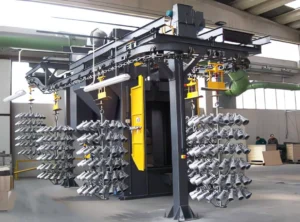
Use High-Impact Structures for Heavy Castings
Heavy castings place greater mechanical and abrasive stress on the shot blasting machine. Their surfaces may contain thick molding sand, stubborn scale, flash, or uneven contamination. These applications require a robust Blast Wheel with wear-resistant blades, reinforced hubs, protected housings, reliable bearings, and durable internal liners.
High-impact design should not mean uncontrolled impact. The wheel must deliver force consistently across the target area while maintaining dynamic balance. Poor balance creates vibration, accelerates bearing damage, and can loosen structural connections. For mass production, these failures create costly interruptions and quality instability.
Why Customized Wheel Modifications Improve Results
Our company designs wheel structures according to casting type, production line pace, chamber arrangement, abrasive specification, and cleaning standard. Customizable modifications may include blade geometry, directional sleeve position, wheel diameter, rotational speed, projection angle, abrasive flow control, liner protection, and wheel placement.
- Review casting drawings, material, weight, wall thickness, and contamination.
- Classify the process as intermittent, high-mix, or continuous mass production.
- Identify fragile areas, heavy sections, cavities, and required surface profile.
- Define target cycle time, shot type, abrasive flow, and cleaning standard.
- Test a proposed wheel configuration using representative castings.
- Confirm wear-part life, maintenance access, spare-part supply, and expansion needs.
OEM and ODM cooperation can support new foundry lines, replacement projects, and upgrades to existing equipment. Instead of adapting a generic polishing wheel and accepting uneven cleaning or premature wear, customers can request a solution engineered around their actual operating conditions.
Conclusion
Blast Wheel design should follow casting geometry, material, impact requirements, and production rhythm. Contact our Manufacturer and Supplier for a casting assessment, wheel recommendation, and Customizable OEM or ODM shot blasting machine proposal tailored to your foundry.
 English
  Russian
  Spanish
  Portuguese
  French
  Indonesian
  Thai
Thai