
Could Non-Compliant Blast Room Design Delay Approval and Stop Production?
Choosing Blast Room size, airflow, or dust collection from experience alone can create failed acceptance inspections, excessive emissions, unsafe negative pressure, or costly redesigns. Inadequate explosion protection and environmental controls may also delay an environmental impact assessment. A compliance-first design protects workers, project schedules, operating permits, and long-term procurement value.
The best Blast Room meets applicable occupational safety, fire protection, environmental, electrical, and dust-emission requirements before equipment is selected. Our company provides Customizable OEM and ODM solutions, including compliant room dimensions, ventilation, dust collection, monitoring, and safety systems for different workpieces, production rates, and workshop conditions.
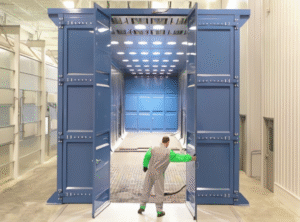
Establish the Compliance Baseline Before Designing the Room
Blast room design specifications should begin with the regulations applicable to the project location, abrasive media, workpiece material, coating residues, and workshop classification. A professional Manufacturer or Supplier should review the project’s legal requirements before confirming the equipment layout. Local authorities may apply different rules for emissions, fire safety, electrical equipment, noise, worker exposure, and wastewater or sludge management.
Mandatory compliance provisions to identify
- Occupational exposure limits for airborne dust, abrasive particles, and hazardous coating residues
- Environmental emission limits for discharged air and collected particulate matter
- Fire prevention and explosion protection requirements for dust-producing operations
- Electrical and control-system requirements for classified or hazardous areas
- Emergency stop, access control, lighting, communication, and worker rescue provisions
- Ventilation, make-up air, filtration, and exhaust-stack requirements
- Noise, vibration, waste handling, and maintenance-access provisions
- Documentation required for environmental impact assessment and final project acceptance
Buyers should request a compliance matrix showing each requirement, the proposed design response, the responsible party, and the verification method. This document prevents critical provisions from being overlooked during purchasing and clarifies whether the Manufacturer, installer, building contractor, or end user is responsible for completing each item.
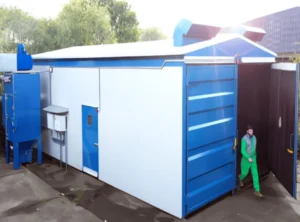
Define Blast Room Size from Workpiece and Safety Requirements
Room dimensions must provide sufficient clearance for the largest workpiece, operator movement, blasting hoses, lighting, ventilation paths, maintenance access, and safe loading operations. A room that is technically large enough for the workpiece may still fail operational or safety review if operators cannot move safely or if airflow is obstructed by fixtures and suspended components.
Key sizing factors for procurement review
- Record the maximum workpiece length, width, height, weight, and loading orientation.
- Add clearance for operator access, hose movement, protective equipment, and safe retreat.
- Reserve space for doors, lighting, ventilation openings, ducting, and maintenance work.
- Determine whether the room will support manual blasting, manipulator operation, or automation.
- Confirm floor loading, foundation conditions, lifting equipment, and material-handling routes.
- Check that the proposed arrangement does not block emergency exits or inspection points.
Oversizing is not always the safest solution. An unnecessarily large room can increase ventilation demand, dust-collection capacity, heating or make-up-air costs, and construction expense. A Customizable design should match the actual workpiece envelope and production method while preserving legally required clearances and safe access.
Use Airflow and Negative Pressure to Control Exposure
Airflow design should prevent contaminated air from escaping into the workshop and should move dust toward the collection system without creating unstable turbulence. Negative pressure safety requirements must be confirmed through engineering calculations and commissioning tests rather than assumed from fan capacity alone.
Airflow design checks
- Maintain controlled negative pressure relative to adjacent workshop areas.
- Provide a planned path from make-up air inlets toward exhaust and filtration points.
- Avoid dead zones where abrasive dust or hazardous residues can accumulate.
- Prevent excessive velocity that could disturb settled dust or reduce blasting visibility.
- Use interlocks to coordinate room access, blasting operation, fan status, and dust collection.
- Install pressure monitoring with alarms for abnormal pressure or ventilation failure.
- Ensure doors, seals, ducts, and penetrations are suitable for the required pressure differential.
The Supplier should provide airflow calculations, fan curves, pressure readings, duct layouts, and test procedures. Final acceptance should verify that the room remains under the required negative pressure during normal operation, door movement, filter loading, and planned maintenance conditions.
Design Dust Collection for Emissions and Explosion Prevention
Dust collection must be selected according to dust type, abrasive consumption, coating residues, room volume, airflow, filtration method, and environmental emission limits. A general-purpose collector may be unsuitable where combustible dust, toxic residues, or high particulate loading is present.
| Design area | Buyer should verify | Acceptance evidence |
| Dust classification | Abrasive and coating residue characteristics | Material assessment and hazard review |
| Collector capacity | Required airflow, pressure, and filtration margin | Calculation sheet and test report |
| Emissions | Applicable discharge limit and monitoring method | Emission or filtration-performance records |
| Explosion protection | Venting, isolation, grounding, and ignition control | Safety documentation and inspection results |
| Maintenance | Safe filter access and dust disposal procedure | Maintenance manual and operating training |
Dust explosion prevention measures
- Assess whether collected dust or coating residue is combustible or chemically reactive.
- Control ignition sources, static electricity, hot surfaces, sparks, and unsuitable electrical equipment.
- Provide grounding and bonding for rooms, ducts, collectors, hoses, and related equipment.
- Evaluate explosion venting, suppression, isolation, or other approved protective measures where required.
- Prevent dust accumulation on ledges, ducts, structural surfaces, and inaccessible equipment areas.
- Use suitable inspection, cleaning, filter replacement, and waste-disposal procedures.
Explosion protection must be determined by a qualified safety assessment and local requirements. Buyers should not accept unsupported claims that a dust collector is explosion-proof or environmentally compliant. The contract should identify the applicable design standard, test responsibility, certification documents, and corrective-action process.
Prepare for Environmental Impact Assessment and Final Acceptance
Environmental impact assessment acceptance criteria commonly require consistent information about process capacity, abrasive consumption, dust sources, exhaust volume, filtration efficiency, emission points, noise, waste disposal, and emergency controls. The Blast Room, dust collector, exhaust stack, and workshop layout must be presented as one integrated system.
- Confirm local emission, noise, fire, and occupational safety requirements.
- Prepare process-flow diagrams and identify every dust-generating operation.
- Calculate room airflow, exhaust volume, collector capacity, and expected emissions.
- Document dust classification, explosion-control measures, and waste-disposal methods.
- Submit equipment drawings and compliance documents for authority or consultant review.
- Conduct installation, pressure, airflow, noise, and emission tests before final acceptance.
- Retain operating records, inspection reports, training documents, and maintenance logs.
Conclusion
Make compliance the first Blast Room design rule. Contact our Manufacturer team for a site-specific review of dimensions, airflow, negative pressure, dust explosion prevention, and environmental acceptance requirements. We can develop a Customizable OEM or ODM proposal that supports safer procurement and smoother project approval.
 English
  Russian
  Spanish
  Portuguese
  French
  Indonesian
  Thai
Thai