
Are Hidden Environmental Costs Eroding Your Shot Blasting ROI?
A low purchase price can conceal years of filter replacement, steel shot waste disposal, electricity, maintenance labor, and dust-remediation expenses. When leakage, poor abrasive recovery, or oversized dust collection systems are ignored, environmental management becomes a recurring production burden. Buyers who compare only quotations may select equipment that costs more throughout its operating life.
The best choice is a shot blasting machine with high abrasive recovery, reliable sealing, efficient dust collection, measurable emissions, and documented consumable usage. Our company provides Customizable OEM and ODM เครื่องระเบิดล้อ solutions, helping each customer compare total environmental and operating costs before selecting Wheelblast Equipment from the right Manufacturer or Supplier.
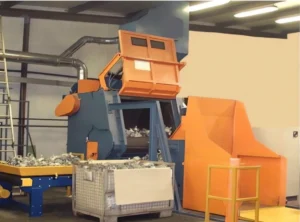
Look Beyond the Purchase Price
Purchasing departments often compare equipment by initial price, delivery time, and nominal capacity. However, environmental costs continue throughout the machine’s service life and can significantly affect total cost of ownership.
- Filter cartridge or filter-bag replacement
- Steel shot and abrasive replenishment
- Solid waste collection, storage, transportation, and disposal
- Dust collector electricity consumption
- Maintenance labor and spare parts
- Cleaning labor caused by leakage or poor recovery
- Environmental inspections, corrective actions, and possible remediation
- Production downtime caused by blocked filters, worn seals, or unstable extraction
A lower-priced machine may appear attractive during quotation review but create higher recurring expenses if its recovery system, seals, dust collector, or maintenance access are poorly designed. Procurement teams should therefore evaluate the five-year or ten-year operating burden instead of treating environmental control as an optional accessory.
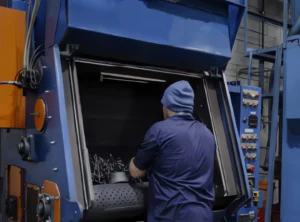
How Abrasive Recovery Rates Affect Waste Disposal
Steel shot recovery directly influences both consumable usage and solid waste generation. A well-designed recovery system separates reusable abrasive from broken media, dust, scale, and other contaminants. When recovery is inefficient, more usable shot leaves the system with waste, increasing replenishment and disposal requirements.
Key recovery points to evaluate
- Confirm whether abrasive falls directly into a collection hopper or accumulates in low points.
- Review the design of screw conveyors, elevators, separators, and return channels.
- Ask how the system handles broken shot, casting sand, scale, and oversized debris.
- Check whether the separator can maintain stable performance as contamination increases.
- Request actual abrasive consumption data from comparable installations.
- Verify whether recovery performance changes with different workpiece sizes and loading methods.
| Equipment condition | Effect on abrasive use | Environmental and procurement implication |
| High recovery efficiency | More reusable shot returns to circulation | Lower media purchasing and solid waste disposal demand |
| Frequent abrasive loss | Higher replenishment frequency | Increased material cost, waste volume, and handling labor |
| Poor separation | Contaminants remain in the abrasive circuit | Unstable blasting quality, accelerated wear, and more waste |
| Blocked or poorly arranged recovery lines | Manual cleaning and irregular return flow | Higher downtime, housekeeping pressure, and maintenance cost |
Do not accept general claims such as low abrasive consumption without supporting records. A professional Supplier should explain the test conditions, workpiece type, abrasive specification, production hours, and measurement method behind its figures.
Sealing Design Determines Filter Replacement Frequency
Dust leakage is often treated as a minor maintenance problem, but it can increase filter loading, reduce extraction performance, contaminate the workshop, and shorten filter service life. Leakage commonly occurs around chamber doors, loading openings, transfer points, inspection panels, conveyor interfaces, and worn curtains.
Sealing features worth checking
- Replaceable door and access-panel seals
- Overlapping rubber or steel curtains at workpiece entry and exit points
- Enclosed transfer chutes and protected abrasive return channels
- Accessible inspection points for seal wear
- Negative-pressure control inside the blasting chamber
- Pressure monitoring across the dust collector
- Simple adjustment and replacement procedures
A machine with a simple and serviceable sealing structure may deliver lower long-term cost than a more complicated design that requires frequent adjustment. Buyers should request filter replacement intervals from operating references rather than relying only on theoretical specifications.
Ask the Manufacturer to provide actual data covering filter life, pressure-drop trends, cleaning frequency, dust emissions, and seal replacement cycles. The data should be connected to comparable production conditions, not isolated laboratory tests.
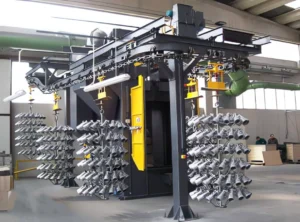
Analyze Dust Collection Energy Consumption
Dust collection systems can become one of the largest continuous energy users in a การพ่นวัสดุ workshop. Excessive airflow, oversized fans, poor duct layout, clogged filters, and uncontrolled leakage all increase electricity consumption.
- Define the required airflow for the chamber, loading points, transfer areas, and collector.
- Check whether the fan capacity matches the actual pressure loss of the complete system.
- Review duct length, bends, diameter changes, and avoidable resistance.
- Confirm whether variable-frequency control is suitable for the operating pattern.
- Monitor filter differential pressure and establish cleaning or replacement limits.
- Compare annual energy consumption under actual production hours.
| Design characteristic | Short-term appearance | Long-term cost effect |
| Oversized fan and collector | Strong extraction capacity | Higher electricity cost and possible abrasive loss |
| Efficient airflow and sealed chamber | More precise engineering required | Lower energy demand and reduced dust leakage |
| High-resistance duct layout | May function during initial testing | Rising fan load, unstable extraction, and higher power use |
| Automatic pressure monitoring | Additional control components | Earlier fault detection and more predictable filter maintenance |
When comparing quotations, require electricity estimates for the blast wheel, conveyor, elevator, separator, fan, and control system. The comparison should use the same operating hours, utility prices, production volume, and duty cycle.
Select Equipment That Reduces Leakage and Waste
Environmental performance depends on the entire equipment configuration, not only the dust collector. A เครื่องระเบิดล้อ should coordinate abrasive projection, chamber containment, recovery, separation, extraction, and waste discharge.
- Select a chamber size that matches the workpiece envelope without excessive unused volume.
- Use suitable liners and curtains to control wear and prevent openings from enlarging.
- Specify recovery conveyors that minimize dead zones and abrasive accumulation.
- Use a separator designed for the actual mixture of shot, dust, sand, and scale.
- Provide sealed waste discharge containers or controlled collection points.
- Require differential-pressure, airflow, temperature, and motor overload monitoring.
- Ensure maintenance access does not require unnecessary entry into contaminated areas.
Simple designs can be advantageous when they provide fewer leakage points, easier inspection, and faster maintenance. However, simplicity should not mean the removal of necessary safety, filtration, or monitoring functions. The best solution balances reliable containment, efficient recovery, safe operation, and maintainability.
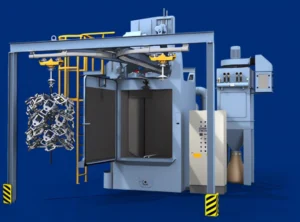
Optimize Workshop Layout Before Ordering
Workshop layout directly affects environmental management pressure. Poor positioning of the machine, collector, waste containers, and material flow can increase duct resistance, handling distances, dust exposure, and housekeeping requirements.
Layout considerations for procurement teams
- Place the dust collector as close as practical to the blasting machine to limit duct length and resistance.
- Separate clean and contaminated material routes.
- Provide adequate clearance for filter replacement, separator inspection, and waste-container removal.
- Prevent forklift traffic from damaging ducts, seals, cables, or collector components.
- Locate abrasive and waste storage in clearly identified, manageable areas.
- Plan ventilation, make-up air, access doors, and emergency routes together.
- Reserve space for future maintenance and possible production expansion.
Request a layout drawing, airflow calculation, utility schedule, maintenance-clearance plan, and waste-handling proposal before approval. A capable Supplier should evaluate the complete workshop rather than offering an isolated machine that later requires costly ducting or civil modifications.
Compare Models by Total Environmental and Operating Cost
Before selecting a Manufacturer, normalize each quotation into the same scope. Compare purchase price, installation, energy, abrasive consumption, filters, waste handling, labor, spare parts, downtime, and expected remediation. Include documented assumptions so management can verify the decision.
- Request actual emission and consumable usage data from reference installations.
- Ask for annual filter replacement quantities and estimated service intervals.
- Confirm expected steel shot recovery performance under similar workpieces.
- Compare fan power, operating hours, and control method.
- Review leakage-control design and seal replacement procedures.
- Include waste disposal and environmental inspection costs in the TCO model.
- Define performance testing, acceptance criteria, and data submission in the contract.
Reduce Environmental Costs Before They Become Operating Costs
Compare shot recovery, sealing, dust collection energy, filter life, waste handling, layout, and verified operating data before approving a machine. Contact our team for a Customizable OEM or ODM Wheelblast Equipment proposal that reduces environmental burden, operating cost, and long-term procurement risk.
 Thai
 English
 Russian
 Spanish
 Portuguese
 French
 Indonesian