
Is an Unclear Машина для дробеструйной обработки Budget Creating Procurement Risk?
When purchasing teams compare Shot Blasting Machine solutions, the equipment quotation is only part of the financial decision. Installation, workpiece handling, dust collection, utilities, abrasive media, maintenance, and production downtime can significantly change the final investment. Without identifying these cost drivers early, a low initial quotation may become an expensive long-term commitment.
The best selection budget evaluates the complete installed investment and expected running cost, including capacity, automation, blast wheel configuration, energy use, abrasive consumption, maintenance, and technical support. Our Manufacturer and Supplier provides Customizable OEM and ODM Оборудование для колёсного выброса with transparent technical scope for reliable quotation comparison.
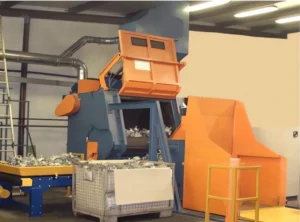
Factors Affecting Машина для дробеструйной обработки Costs
The cost of a Shot Blasting Machine is mainly determined by the production task, workpiece characteristics, equipment configuration, and factory conditions. Purchasing professionals should define the application before requesting quotations so that different Suppliers calculate comparable solutions.
- Workpiece dimensions, weight, shape, and surface contamination
- Required cleaning intensity and surface quality
- Daily production volume and required cycle time
- Batch, hanger, tumble, roller conveyor, or continuous handling
- Number, power, and arrangement of blast wheels
- Manual, semi-automatic, or fully automatic operation
- Dust collection capacity and environmental requirements
- Special liners, fixtures, sensors, controls, or safety systems
- Integration with molding, machining, painting, or inspection lines
A standard machine may be suitable for stable, repetitive production, while a Customizable solution may be more economical when product sizes, loading methods, or downstream processes vary. A professional Manufacturer should explain which functions are essential and which options can be postponed, rather than adding unnecessary features to the investment budget.
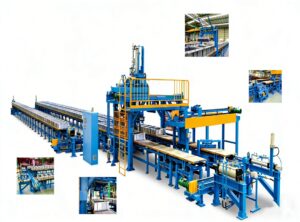
Initial Investment in пескоструйной обработке Machines
Initial investment includes more than the main machine body. A complete budget should cover all items required to place the equipment into safe and productive operation. Excluding these items can create approval gaps and unexpected site expenditure after the purchase order is released.
| Investment category | Variables to review | Potential savings approach |
| Machine configuration | Capacity, chamber size, blast wheels, liners, and controls | Match specifications to actual production requirements |
| Material handling | Loading method, fixtures, conveyors, and transfer distance | Reduce unnecessary manual handling and duplicated equipment |
| Dust collection | Airflow, filtration, ducting, discharge, and safety design | Use calculated capacity instead of excessive system sizing |
| Site preparation | Foundation, power supply, ventilation, and workshop layout | Confirm existing infrastructure before final design |
| Delivery and commissioning | Freight, installation, testing, training, and documentation | Define responsibilities clearly in the commercial proposal |
Prepare a complete capital expenditure checklist
- Shot blasting machine and blast wheel assembly
- Roller conveyors, elevators, separators, and abrasive recovery equipment
- Dust collector, ductwork, filters, and waste discharge system
- Electrical cabinet, control software, sensors, and safety interlocks
- Freight, insurance, customs clearance, and local transportation
- Installation, commissioning, operator training, and acceptance testing
- Initial abrasive media and critical replacement parts
For OEM and ODM projects, every design change should be recorded in the technical specification. Changes to workpiece dimensions, automation level, layout, or environmental standards may affect engineering time, delivery requirements, and installation resources.
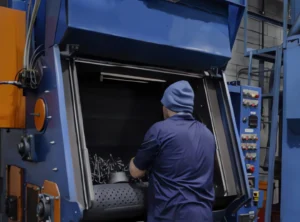
Operating Costs of пескоструйной обработке Machines
Running cost should be calculated according to annual production rather than only the machine purchase decision. The main expenses are energy, abrasive media, wear parts, labor, maintenance, dust disposal, and losses caused by downtime or inconsistent cleaning quality.
- Electricity for blast wheels, conveyors, elevators, separators, and dust collectors
- Steel shot, steel grit, or other approved abrasive media
- Blades, liners, seals, screens, filters, and conveyor wear components
- Routine inspection, lubrication, cleaning, and service labor
- Operator labor, training, and process adjustment
- Dust disposal and environmental compliance activities
- Rework, quality claims, scrap, and lost production during downtime
Blast wheel efficiency and abrasive separation have a direct effect on operating cost. Excessive media loss, poor air washing, incorrect projection intensity, or unsuitable abrasive selection can increase consumption without improving surface quality. Procurement teams should request operating assumptions from each Supplier and compare them against actual production data.
Evaluate cost per treated workpiece
- Define annual production quantity and operating hours.
- Estimate energy use for the complete Wheelblast Equipment system.
- Calculate abrasive consumption and replenishment frequency.
- List planned maintenance and replacement intervals.
- Estimate labor, dust disposal, and inspection costs.
- Assign a financial value to production downtime and rework.
- Compare total annual cost across shortlisted solutions.
| Running cost driver | Questions for procurement teams |
| Энергия | Does the estimate include blast wheels, dust collection, and conveyors? |
| Abrasive media | What consumption rate and recovery efficiency are expected? |
| Изнашиваемые части | Which components require regular replacement and how quickly can they be supplied? |
| Техническое обслуживание | Can routine service be completed by trained factory personnel? |
| Время простоя | What support response and spare parts plan protect production continuity? |
Build a Practical Budget for Shot Blasting Machine Selection
A reliable budget should include three scenarios: expected production, lower utilization, and higher utilization. This prevents the selected system from being judged only under ideal conditions.
- Define workpiece data, production targets, and required surface standards.
- Separate equipment investment from installation and infrastructure costs.
- Estimate annual energy, abrasive, labor, maintenance, and downtime costs.
- Identify optional functions that can be added during future expansion.
- Compare suppliers using total ownership cost and expected availability.
- Confirm warranty, training, spare parts, acceptance testing, and service obligations.
Request a line-by-line technical and commercial proposal. The comparison should show what is included, excluded, optional, or dependent on site conditions. This approach helps purchasing professionals identify genuine savings without sacrificing safety, quality, maintainability, or production capacity.
Make the Investment Easier to Verify
Do not compare Shot Blasting Machine quotations by purchase price alone. Contact our team for a production-based assessment, transparent budget structure, and Customizable OEM or ODM Wheelblast Equipment proposal designed to reduce both initial investment risk and long-term operating cost.
 Russian
  English
  Spanish
  Portuguese
  French
  Indonesian
  Thai
Thai