
Confusion about shot blasting machine working principles leads to wrong choices. This guide compares core types for clear decision-making.
This guide compares the working principles of tumblast, track-type, hook-type, and through-type shot blasting machines, highlighting key differences in operation and application.
Explore below how each type operates—uncover their unique working mechanisms and contrasts.
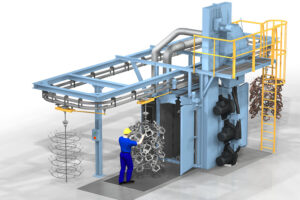
How does a Tumblast Shot Blasting Machine work?
The tumblast shot blasting machine’s working principle revolves around “rotational tumbling + all-angle abrasive impact” for small bulk workpieces. Its core component is a hexagonal/octagonal rotating drum driven by a gear motor (5-15 RPM). When workpieces (screws, gears, small castings) are loaded, internal lifting bars elevate them as the drum rotates, then gravity causes free fall—creating continuous tumbling. Simultaneously, 1-2 blast wheels (2000-3000 RPM) accelerate abrasive media (steel shot, glass beads) to 60-80 m/s, spraying toward tumbling workpieces. The tumbling motion ensures every surface (including recesses) contacts the abrasive stream, stripping rust, scale, and burrs. After cleaning, media and contaminants fall through drum perforations into a separator, where reusable media is recycled to the blast wheel. This closed-loop principle balances efficiency and gentleness, avoiding workpiece damage while ensuring uniform cleaning—ideal for low-to-medium volume small parts production.
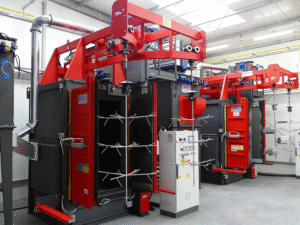
How does a Track-Type Shot Blasting Machine operate?
The track-type shot blasting machine’s working principle centers on “conveyor transport + targeted abrasive spraying” for medium-sized workpieces. It uses a rubber or steel track conveyor to continuously feed workpieces (castings, brake discs, auto components) into the blasting chamber. Unlike tumblast machines, workpieces remain stationary relative to the track, while multiple blast wheels (3-4 typically) are arranged at different angles (top, sides) to spray high-velocity abrasive media. The track’s steady movement ensures consistent exposure time, and adjustable conveyor speed (0.5-2 m/min) controls cleaning intensity. After processing, the track transports cleaned workpieces out of the chamber, and abrasive media is recycled via a separator and elevator. Its working principle prioritizes efficiency and versatility—handling batch production of medium-sized parts without manual tumbling, making it suitable for foundries and auto parts plants. The fixed workpiece position also reduces collision damage, ideal for parts with precise dimensions.
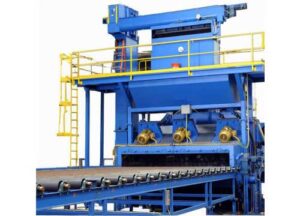
What is the working principle of a Hook-Type Shot Blasting Machine?
O máquina de jateamento do tipo gancho’s working principle relies on “suspended rotation + 360° abrasive coverage” for large heavy workpieces. A heavy-duty rotating hook (capable of lifting 500kg-50 tons) suspends workpieces (steel beams, engine blocks, hull segments) and moves them into the blasting chamber. Once positioned, the hook rotates (10-20 RPM) while multiple high-power blast wheels (4-6, 30-50 kW each) spray abrasive media from all directions. The combination of hook rotation and multi-angle blast wheels eliminates cleaning dead ends, even for complex-shaped workpieces. After cleaning, the hook moves the workpiece out for unloading, and media is recycled through a high-efficiency separator. Its working principle emphasizes power and flexibility—handling oversized, heavy parts that other types can’t accommodate. The suspended design avoids workpiece contact with conveyor surfaces, preventing scratches, and makes it indispensable in steel structure, shipbuilding, and heavy machinery industries.
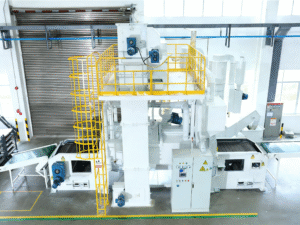
How does a Through-Type Shot Blasting Machine work?
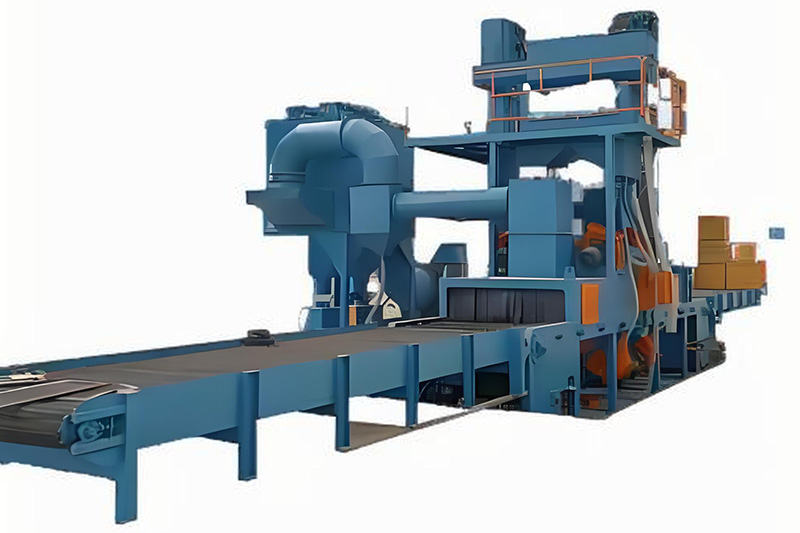
The through-type shot blasting machine’s working principle is “continuous linear transport + high-speed abrasive blasting” for long workpieces. It uses a roller conveyor or chain conveyor to feed long workpieces (profiles, plates, pipes) through the blasting chamber continuously. Blast wheels are arranged above and below the conveyor, spraying abrasive media at the workpiece surface as it moves linearly. The conveyor speed (1-5 m/min) is adjustable to match cleaning requirements, and the machine’s long chamber ensures sufficient blasting time. After processing, the conveyor transports the workpiece out, and media is recycled via a closed-loop system. Its working principle is optimized for high-volume, continuous production—integrating seamlessly with assembly lines. Unlike batch-type machines (tumblast, hook-type), it requires no loading/unloading downtime, making it ideal for construction steel, aerospace profiles, and pipe manufacturing. The linear transport principle also ensures uniform cleaning along the workpiece’s length, critical for long components needing consistent surface quality.
What are the key working principle differences across these shot blasting machines?
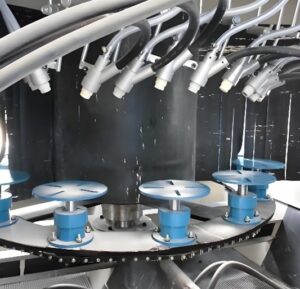
As principais diferenças nos princípios de funcionamento decorrem dos métodos de manuseio de peças e configurações de jateamento. As máquinas de tumbling utilizam uma rotação de tumbling (para pequenas peças a granel), to tipo de prateleira usa transporte por correia (peças de lote de tamanho médio), o tipo de gancho utiliza rotação suspensa (peças grandes e pesadas), e o tipo de passagem utiliza transporte linear contínuo (peças longas de alto volume). A intensidade do jateamento também varia: as máquinas do tipo gancho têm a maior potência (30-50 kW nas rodas de jateamento) para limpeza pesada, enquanto as máquinas de tumbling utilizam menor potência (7,5-15 kW) para evitar danos às peças. Os princípios de reciclagem de mídia são semelhantes (separador + elevador), mas escalonados para o tamanho da máquina - máquinas do tipo passagem e do tipo gancho têm funis e separadores maiores para alto rendimento de mídia. O alinhamento da aplicação é direto: tumbling para pequenos lotes, tipo trilho para lotes medianos, tipo gancho para peças grandes e pesadas, e tipo passagem para produção contínua longa. Compreender essas diferenças garante que você escolha uma máquina cujo princípio de funcionamento corresponda às suas peças e necessidades de produção.
Conclusão
Domine essas diferenças de princípios de funcionamento para selecionar a máquina de jateamento correta.
E-mail:[email protected]
 Portuguese
  English
  Russian
  Spanish
  French
  Indonesian
  Thai
Thai