
Can the Wrong Mesin Shot Blasting Disrupt Your Production Line?
Selecting equipment by price or catalogue capacity alone can create bottlenecks, excessive manual handling, unstable surface quality, and delivery delays. A machine that does not match workpiece flow, workshop conditions, or dust control requirements may perform well in demonstrations but fail on the shop floor. Production-focused selection prevents costly rework and installation changes.
The right Shot Blasting Machine matches workpiece size, production volume, surface standard, layout, environmental controls, and automation level. Our company provides Customizable OEM and ODM Wheelblast Equipment, supported by site surveys, process engineering, installation guidance, and after-sales service from an experienced Manufacturer and Supplier.
Match the Machine Model to the Production Scenario
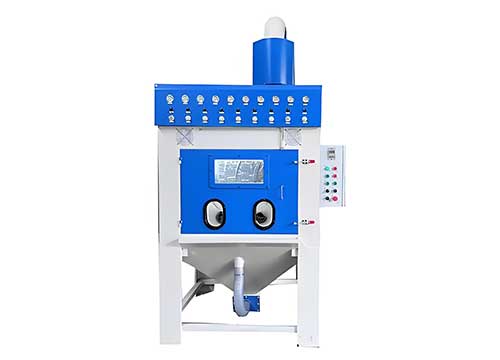
Different mesin blasting models are designed for different workpiece shapes, handling methods, and production volumes. Procurement should begin by classifying the workload rather than selecting a familiar machine model.
| Tipe mesin | Suitable applications | Key procurement consideration |
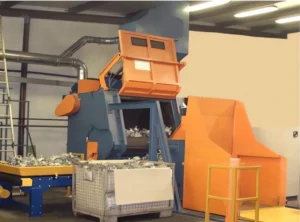
| Tumble belt machine | Small and medium castings, forgings, and bulk components | Confirm workpiece impact resistance, batch weight, and unloading method |
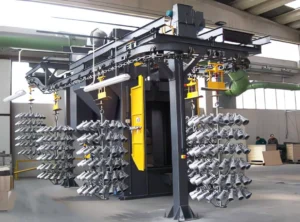
| Hanger type machine | Large, irregular, or fragile components requiring suspended treatment | Check hook load, workpiece dimensions, and loading cycle |
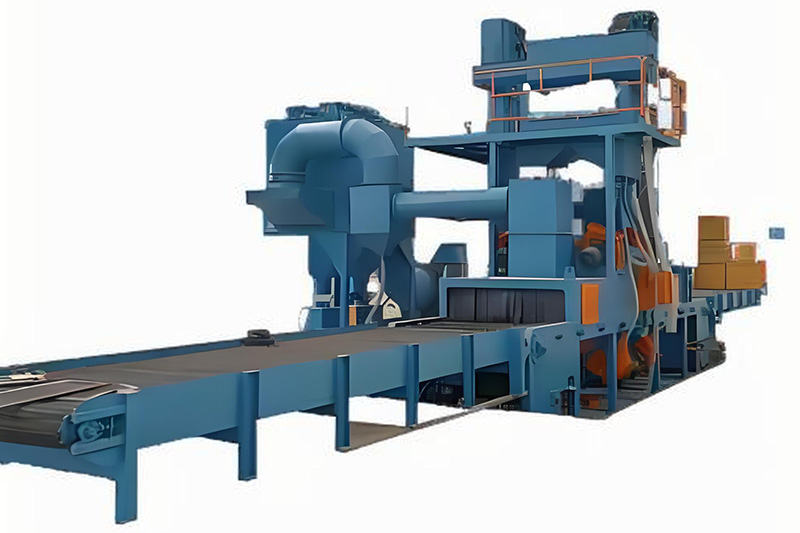
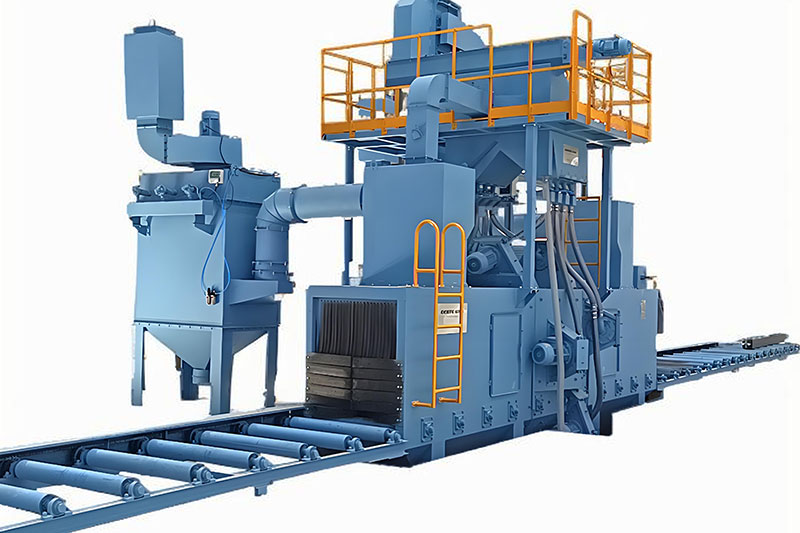
| Mesin konveyor rol | Steel plates, structural sections, beams, pipes, and fabricated parts | Match conveyor width, load capacity, line speed, and downstream flow |
| Mesh belt machine | Continuous treatment of smaller or heat-sensitive components | Verify belt loading, media recovery, and product separation |
| Continuous wire or special machine | Long products, coils, tubes, and specialized production lines | Confirm feeding accuracy, enclosure length, and process integration |
Production data to confirm
- Workpiece length, width, height, weight, and surface geometry
- Material type and allowable impact intensity
- Required cleanliness standard and surface profile
- Pieces per hour, batch size, and shift schedule
- Loading and unloading method
- Upstream forming, casting, forging, or fabrication process
- Downstream painting, coating, machining, inspection, or packaging process
- Expected production growth and product variation
For high-volume and continuous production, Peralatan Wheelblast should be evaluated as part of the complete line. The blasting cycle must match upstream delivery and downstream acceptance capacity. Otherwise, the machine may become a bottleneck even when its individual technical specifications appear sufficient.
Confirm Workshop Layout and Installation Conditions
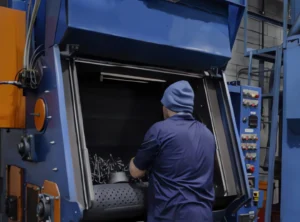
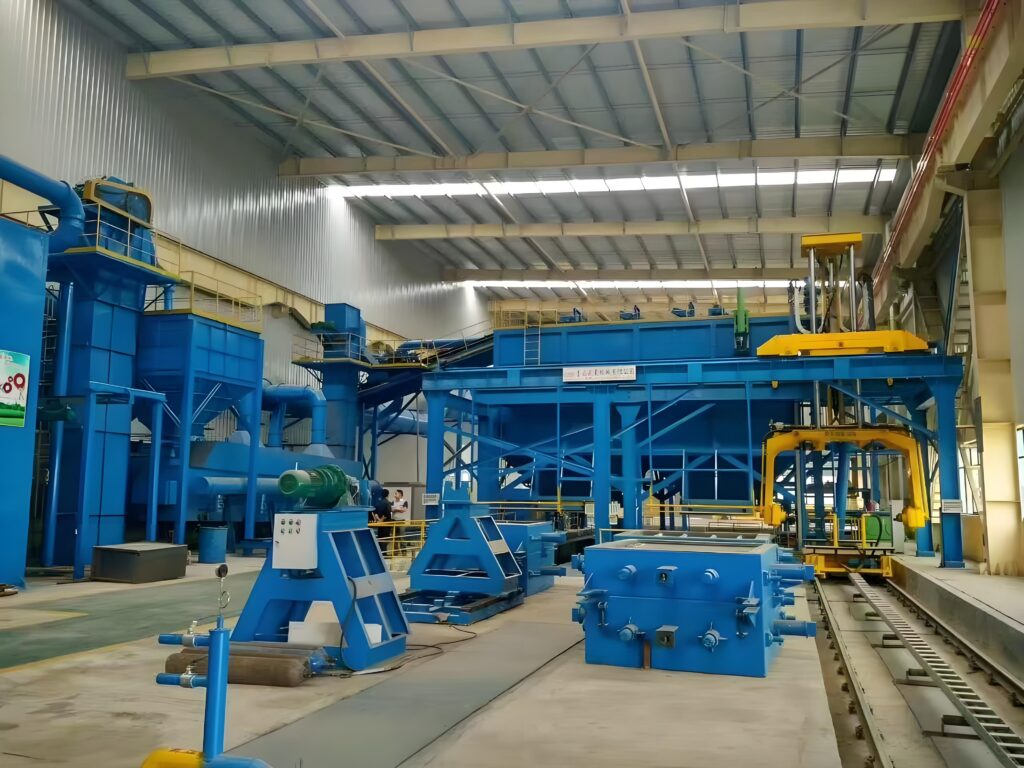
A Shot Mesin Blasting requires more space than its external dimensions suggest. Procurement must reserve room for loading, unloading, maintenance, abrasive storage, dust collection, electrical cabinets, filter replacement, and safe operator movement.
Workshop conditions to verify before ordering
- Measure available length, width, height, doors, columns, and transport routes.
- Confirm foundation type, floor load, vibration limits, anchor positions, and drainage.
- Check crane capacity and lifting clearance for installation and future repairs.
- Reserve space for dust collectors, ducts, abrasive separators, and waste containers.
- Verify power supply, cable routes, compressed air, lighting, and control room access.
- Map the material flow from incoming workpieces to finished product dispatch.
- Provide safe access platforms, guarding, emergency exits, and maintenance zones.
Before contract approval, request a general arrangement drawing and an installation condition checklist from the Supplier. The drawing should show machine orientation, maintenance clearance, duct routing, utility connections, and material transfer points. A qualified Manufacturer should identify site limitations before manufacturing begins.
Meet Environmental and Dust Removal Requirements
Blasting generates dust, spent abrasive, noise, and contaminants removed from the workpiece. Environmental compliance must therefore be included in the initial equipment specification, not added after installation. An undersized or poorly routed dust collection system can cause workplace exposure, filter overload, housekeeping problems, and regulatory risk.
Environmental requirements to include in the quotation
- Required dust capture points and total airflow
- Dust collector type, filter area, fan capacity, and discharge method
- Duct length, bends, access doors, and cleaning provisions
- Dust emission limits and local environmental requirements
- Spent abrasive collection, separation, storage, and disposal method
- Noise control and operator exposure limits
- Fire prevention, explosion protection, grounding, and static control
- Filter replacement access and ongoing maintenance requirements
The Supplier should state which environmental systems are included in the base offer and which are excluded. Procurement teams should compare total installed scope, including ducts, fans, filters, platforms, electrical controls, commissioning, and compliance testing. This prevents an attractive equipment price from becoming an incomplete project cost.
Select the Appropriate Automation Level
Automation should be selected according to production pressure, labor availability, product variety, and required traceability. The most advanced configuration is not always the most economical. The correct level reduces handling and quality variation while preserving practical changeover and maintenance access.
| Automation level | Suitable operating condition | Typical functions |
| Manual or semi-automatic | Low volume, high variety, or irregular product mix | Manual loading, adjustable cycle settings, operator inspection |
| Assisted automation | Medium volume with repeatable workpieces | Powered loading, automatic cycle control, media recovery, alarms |
| Integrated automation | High volume and synchronized production lines | Automatic loading, conveyors, recipe control, tracking, and data reporting |
Automation selection checklist
- Can the automation handle the full range of workpiece dimensions?
- Will changeover time affect delivery performance?
- Are operators available to manage alarms and routine adjustments?
- Can the controls communicate with upstream and downstream systems?
- Are safety interlocks, sensors, and emergency stops clearly documented?
- Can maintenance personnel access automated components safely?
- Does the investment produce measurable labor, quality, or throughput benefits?
Customizable OEM and ODM Peralatan Wheelblast can combine standard machine structures with application-specific handling, controls, abrasive recovery, inspection, and line interfaces. The procurement team should require a clear description of standard components, optional functions, software responsibilities, spare parts, and future upgrade capability.
Validate the Proposal Before Purchase
Use a structured technical review before comparing commercial terms. Confirm the Supplier has demonstrated similar applications and can support installation, commissioning, training, and spare parts supply.
- Submit representative workpieces and required production data.
- Request a process proposal with machine model, cycle time, and capacity assumptions.
- Review layout, utilities, dust removal, safety, and maintenance requirements.
- Ask for media consumption, energy estimates, wear part schedules, and labor needs.
- Define factory testing and site acceptance criteria.
- Confirm warranty scope, response time, documentation, and training obligations.
- Bandingkan total biaya kepemilikan, bukan hanya harga belinya saja.
Choose Equipment That Supports Production Delivery
Select a Shot Blasting Machine by evaluating the complete production environment, not isolated specifications. Contact our team for a site-based assessment, Customizable OEM or ODM proposal, and Wheelblast Equipment configuration aligned with your layout, compliance needs, automation level, and delivery targets.
 Indonesian
  English
  Russian
  Spanish
  Portuguese
  French
  Thai
Thai