
Is Workshop Noise Undermining Productivity and Worker Safety?
Shot blasting delivers essential cleaning performance, but high-impact abrasive projection, rotating equipment, vibration, and dust extraction can create excessive noise. Reducing operating speed alone may protect hearing while damaging production targets. The practical solution is to control noise at its source through equipment structure, vibration isolation, workshop layout, and disciplined monitoring.
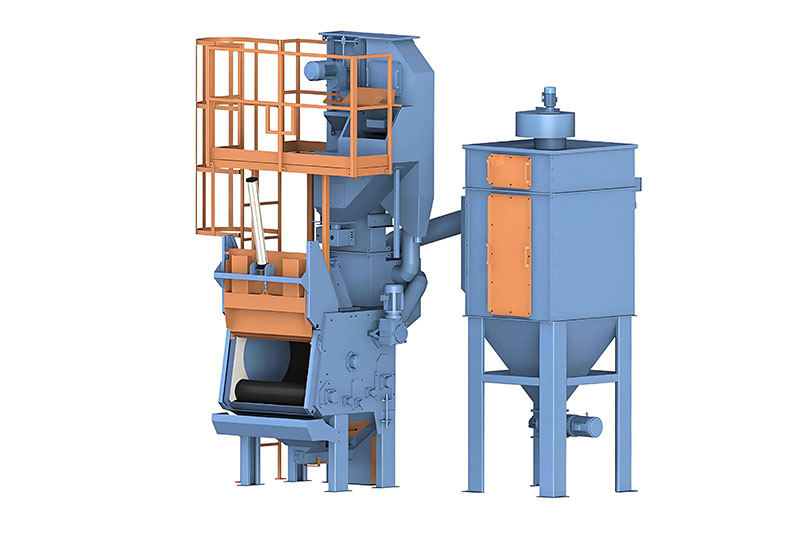
The best solution combines a properly enclosed Shot Blasting Machine, vibration-damping foundations, efficient abrasive selection, isolated workstations, and documented noise testing. Our company provides Customizable OEM and ODM Peralatan Wheelblast, helping each Manufacturer and Supplier balance cleaning capacity, occupational safety, workshop comfort, and noise-compliance requirements.
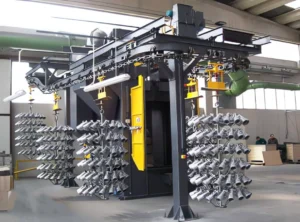
Identify the Main Sources of Peledakan Tembakan Noise
Noise control begins with identifying the equipment components and operating conditions that generate or transmit sound. Purchasing teams should request a noise-risk assessment as part of the technical quotation rather than treating noise as an installation-stage issue.
- Abrasive particles striking the workpiece, chamber liners, and internal surfaces
- Blast wheel rotation, motor operation, and imbalance
- Vibration from conveyors, tracks, turntables, bearings, and structural frames
- Impact between steel shot, castings, hooks, or fixtures during loading and tumbling
- Dust collector fans, motors, airflow turbulence, and duct vibration
- Air leakage through doors, access panels, transfer openings, or damaged seals
- Loose liners, worn bearings, unbalanced wheels, and poorly secured covers
Noise can increase gradually as wear parts deteriorate. A machine that meets the initial acceptance requirement may become significantly louder if liners loosen, blast wheels become unbalanced, bearings degrade, or filters become blocked. The purchase specification should therefore include both initial noise performance and maintenance controls for preserving that performance.
Compare Enclosures With Vibration-Damping Foundations
Soundproofing and vibration control solve related but different problems. A soundproof enclosure limits airborne noise, while a vibration-damping base reduces the transfer of mechanical energy into the floor, building structure, and adjacent workstations. Effective noise reduction often requires both measures.
| Metode kontrol | Primary function | Best application | Procurement consideration |
| Soundproof enclosure | Contains airborne noise from the chamber and equipment | High-impact blasting areas near occupied workstations | Check acoustic materials, access doors, ventilation, lighting, and maintenance access |
| Vibration-damping base | Reduces structure-borne vibration and floor transmission | Heavy machines, elevated platforms, and sensitive neighboring areas | Verify foundation loading, isolation materials, settlement risk, and alignment requirements |
| Acoustic duct treatment | Reduces fan and airflow noise | Long extraction ducts or collector systems near offices and production lines | Review pressure loss, inspection access, fire safety, and filter maintenance |
| Internal liners | Absorb or reduce impact energy inside the chamber | Workpieces and abrasive with severe impact loads | Specify wear resistance, replacement method, thickness, and fastening security |
Soundproof enclosure design points
- Use robust panels with suitable acoustic absorption and impact resistance.
- Seal doors, inspection windows, cable penetrations, and maintenance openings.
- Provide safe internal lighting and viewing arrangements without creating leakage paths.
- Design ventilation and dust extraction so acoustic treatment does not restrict airflow.
- Ensure operators can access filters, liners, bearings, and controls without removing the complete enclosure.
Vibration-damping design points
- Confirm the machine mass, dynamic loads, operating speed, and foundation condition.
- Specify suitable isolators, pads, or spring systems based on the equipment configuration.
- Check that vibration isolation will not affect conveyor alignment, door operation, or abrasive recovery.
- Measure vibration after installation and again after the machine reaches normal production conditions.
- Include periodic inspection of isolators, anchor points, and structural connections.
Match Noise Controls to the Machine Type
Berbeda Mesin Shot Blasting configurations produce different noise patterns. No universal baseline should be assumed. The actual result depends on workpiece material, abrasive size, loading method, chamber construction, blast wheel speed, motor condition, and dust collector location.
| Tipe mesin | Typical noise characteristics | Primary control priorities |
| Track-type machine | Impact noise from tumbling parts, track movement, and repeated workpiece contact | Internal liners, controlled loading, enclosure sealing, and vibration isolation |
| Turntable-type machine | Blast impact concentrated around the rotating table, with drive and indexing noise | Table balancing, drive maintenance, chamber enclosure, and access-door sealing |
| Roller-conveyor-type machine | Blast wheel, roller rotation, workpiece movement, and transfer-point noise | Roller alignment, acoustic chamber panels, conveyor isolation, and duct treatment |
When comparing models, require the same test conditions: identical workpiece type, abrasive specification, production cycle, machine loading, extraction status, and measurement distance. A Supplier should clearly distinguish sound-power data from operator-position sound-pressure data.
Evaluate Abrasive Specifications and Workshop Soundproofing ROI
Steel shot specification affects impact noise. Larger or harder abrasive can create stronger impact sound, while excessive abrasive flow can increase both noise and chamber wear. However, selecting smaller media solely to reduce noise may compromise cleaning quality, cycle time, or surface preparation.
- Match shot diameter to workpiece geometry and required cleaning intensity.
- Avoid excessive abrasive flow that creates unnecessary impact energy.
- Maintain separator performance so broken media does not increase unstable impact.
- Kontrol roda ledakan speed according to the required cleaning result.
- Inspect liners and seals before noise levels become an operational problem.
Workshop soundproofing should be evaluated through total cost of ownership. The investment may include acoustic panels, enclosure upgrades, vibration isolators, duct silencers, monitoring instruments, and installation work. The return can include reduced hearing-protection risk, fewer complaints, improved audit readiness, lower absenteeism, and fewer production interruptions.
Use a practical investment review
- Measure current noise levels at operator, aisle, boundary, and adjacent-workstation locations.
- Identify whether airborne noise, structure-borne vibration, or auxiliary equipment is dominant.
- Estimate the cost of engineering controls and compare it with potential corrective-action costs.
- Confirm that acoustic modifications will not reduce extraction, access, cooling, or production capacity.
- Verify performance during a production trial rather than an empty-machine test alone.
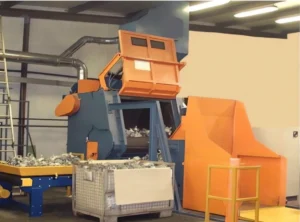
Control Noise Through Layout, Scheduling, and Monitoring
Equipment design should be supported by workshop-level controls. A well-planned layout can separate high-noise operations from offices, inspection stations, maintenance areas, and frequently occupied walkways.
- Place the Mesin Shot Blasting away from offices, meeting rooms, and permanent workstations.
- Locate the dust collector and fan where maintenance is accessible but worker exposure is minimized.
- Use physical barriers or acoustic partitions around operator positions.
- Separate loading, inspection, and manual finishing areas from the blasting zone.
- Schedule the noisiest production cycles when fewer employees are present, where legally permitted.
- Rotate personnel only when the risk assessment confirms that rotation does not replace engineering controls.
- Provide hearing protection zones with clear signs, training, storage, and enforcement.
Noise monitoring and self-testing
Noise monitoring points should include the normal operator position, nearby workstations, access aisles, maintenance areas, workshop boundaries, and locations near offices or neighboring production lines. Measurements should represent normal production, including blast wheels, conveyors, dust collectors, abrasive recovery, and typical workpiece loading.
- Calibrate the sound-level meter before and after each measurement session.
- Record machine configuration, workpiece, abrasive, production cycle, and operating status.
- Measure at consistent heights and positions representing employee exposure.
- Take repeated readings during stable operation rather than relying on a single observation.
- Record peak or impulse events where repeated impacts create short-duration hazards.
- Compare results with applicable occupational exposure and environmental requirements.
- Document corrective actions, responsible personnel, deadlines, and verification results.
A professional Manufacturer should provide noise-test records, recommended measurement conditions, equipment maintenance requirements, and guidance for acceptance testing. These documents help companies demonstrate due diligence during occupational health audits and environmental inspections.
Protect Cleaning Output While Reducing Noise
Noise compliance should not depend on reducing production capacity. Specify the required cleaning standard, cycle time, workpiece mix, abrasive consumption, and acceptable noise limits together. Contact our team for a Customizable OEM or ODM Wheelblast Equipment proposal that integrates acoustic enclosures, vibration control, efficient abrasive settings, safe layout planning, and audit-ready monitoring.
 Indonesian
 English
 Russian
 Spanish
 Portuguese
 French
 Thai