
Bisakah Orang Miskin Peledakan Tembakan Design Increase Your EHS Workload?
Passing an EHS inspection is only one part of equipment ownership. Daily dust checks, leakage inspections, fault reports, corrective actions, and consumables records can consume hours every week. When a Shot Blasting Machine is difficult to monitor or maintain, safety personnel spend more time managing paperwork than preventing risk, increasing hidden internal costs.
A well-designed shot blasting system should combine online dust monitoring, sealed structures, accessible maintenance modules, integrated data records, and a coordinated dust collector. Our company supplies Customizable OEM and ODM Peralatan Wheelblast that helps Manufacturers reduce false alarms, simplify EHS documentation, and control lifecycle management costs.
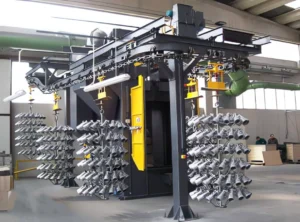
Build EHS Management Into the Peledakan Tembakan System
EHS workload is strongly affected by equipment design. A machine with poor sealing, scattered control points, and limited data collection may require repeated manual inspections. A properly engineered system gives safety teams clearer information and faster access to maintenance evidence.
- Online monitoring identifies abnormal dust conditions earlier.
- Sealed chambers reduce abrasive and dust leakage.
- Modular components make maintenance more controlled.
- Integrated controls provide clearer operating status.
- Digital records reduce repeated manual entries.
- Standardized alarms make corrective actions easier to verify.
These features do not replace inspection procedures. They make inspections more focused and more reliable. Procurement teams should evaluate how the Supplier supports daily EHS activities, not only how the machine performs during a short production test.
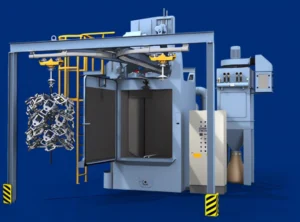
Use Online Dust Monitoring to Reduce Manual Checks
Dust monitoring equipment can provide continuous information about dust collector operation, differential pressure, filter condition, fan status, and abnormal emission risk. Without online monitoring, safety personnel may need to rely on periodic visual checks or manual readings that can miss short-duration problems.
Practical monitoring functions
- Dust concentration or emission trend monitoring
- Filter differential pressure monitoring
- Fan and motor operating status
- Dust collector fault alarms
- Overload and abnormal temperature warnings
- Operating-hour records for filters and wear components
Monitoring data should be connected to the machine control system where practical. This allows safety personnel to distinguish between a genuine emission risk, a planned maintenance condition, and a temporary process alarm. Clear alarm logic can reduce false alarms and prevent unnecessary investigations.
| EHS task | Manual management risk | Integrated system advantage |
| Dust inspection | Missed short-term abnormal conditions | Continuous status and trend information |
| Filter management | Replacement based only on calendar time | Maintenance based on operating data |
| Fault reporting | Repeated handwritten records | Automatic alarm and event history |
| Corrective actions | Unclear evidence of completion | Traceable fault, action, and verification records |
Reduce Daily Inspections Through Better Sealing
Leakage creates both an environmental concern and an administrative burden. Dust escaping from chamber doors, inspection openings, conveyor interfaces, duct connections, or abrasive recovery points can trigger repeated cleaning, additional inspections, and corrective-action reports.
A sealed Peralatan Wheelblast design should include suitable door seals, abrasive curtains, protected transfer points, sealed duct connections, and accessible inspection locations. The objective is not to eliminate all inspection work. It is to reduce the number of leakage points that require constant attention.
Sealing points to review before purchase
- Blasting chamber doors and access covers
- Workpiece entry and exit openings
- Roller conveyor and transfer interfaces
- Abrasive elevator and recovery connections
- Dust duct joints and collector inlet connections
- Inspection windows, cleanout ports, and service panels
Ask the Manufacturer to show these points on the equipment drawings. The quotation should also identify seal materials, replacement intervals, inspection methods, and the spare parts included in the delivery scope.
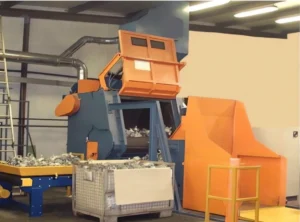
Use Modular Maintenance to Control Dust Dispersion
Maintenance can create a temporary increase in dust exposure when filters, duct sections, abrasive recovery parts, or chamber liners are removed. A modular design helps isolate the work area and reduces the amount of equipment that must be opened at one time.
- Use removable service modules for filters, liners, roda ledakan components, and recovery sections.
- Provide local isolation points for electrical, pneumatic, and abrasive systems.
- Include cleanout access that does not require opening the entire chamber.
- Use service doors positioned outside the main abrasive impact zone where possible.
- Provide lifting points and maintenance platforms to avoid unsafe manual handling.
- Define a clear lockout, cleaning, inspection, and restart sequence.
Modular design also improves documentation. Each module can have its own inspection checklist, maintenance interval, replacement history, and responsible person. This makes it easier to demonstrate control during internal reviews or third-party audits.
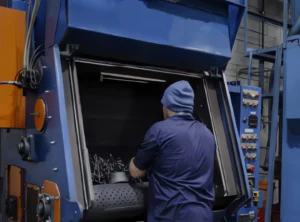
Connect Operating Data With EHS Records
EHS teams often maintain separate records for production, maintenance, dust collection, filter replacement, alarms, and corrective actions. Disconnected records increase duplication and make it difficult to determine whether a problem was isolated or recurring.
A coordinated control system can provide information that is directly useful for EHS records. Examples include operating hours, alarm history, emergency stops, dust collector status, filter pressure, maintenance completion, and abnormal shutdowns.
Recommended O&M record fields
- Machine identification and operating location
- Date, time, and duration of operation
- Dust collector status and differential pressure
- Alarm type, cause, and response
- Filter, seal, liner, and abrasive replacement records
- Inspection result and corrective action
- Technician, supervisor, and verification details
- Supporting photographs or test documents when required
Digital O&M records should remain easy to export. A Supplier should explain whether the system can generate reports in commonly used formats and whether records can be retained after software updates or control-system changes. This supports audits without requiring safety personnel to reconstruct information from multiple notebooks and spreadsheets.
Compare Integrated and Split-Type Dust Collection Systems
Dust collection configuration directly affects management complexity. An integrated system is designed together with the Shot Blasting Machine, while a split-type system may combine equipment from different Suppliers. A split arrangement can work, but it requires clearer responsibility for signals, alarms, airflow balance, spare parts, and corrective actions.
| Management factor | Integrated system | Split-type system |
| Alarm responsibility | Usually coordinated through one control logic | May require communication between multiple parties |
| Airflow verification | Designed as one process system | Requires additional balancing and interface checks |
| Maintenance records | Can be consolidated in one O&M structure | May be divided among separate suppliers |
| Spare parts control | More centralized | More item numbers and ownership boundaries |
| Audit preparation | Fewer documentation interfaces | More certificates, drawings, and test records to coordinate |
Procurement teams should not assume that an integrated system is always the least expensive option. The correct comparison includes installation coordination, commissioning, staff training, fault diagnosis, spare parts, documentation, and audit preparation throughout the equipment lifecycle.
Calculate the Hidden EHS Cost Across the Lifecycle
The purchase price does not show the full EHS management cost. A low-priced machine may require more inspections, more cleaning, frequent filter changes, manual record-keeping, and repeated corrective actions. These costs accumulate over years and may exceed the initial price difference.
- Estimate weekly hours spent on inspections, cleaning, and records.
- Calculate the internal labor cost of EHS and maintenance personnel.
- Review filter, seal, liner, and dust collector replacement requirements.
- Estimate production losses caused by leakage, alarms, and maintenance access.
- Include training, audit preparation, and external testing expenses.
- Evaluate the cost of future control-system upgrades and data migration.
- Compare total lifecycle costs instead of comparing machine prices alone.
A professional Manufacturer should provide a clear technical scope, maintenance schedule, monitoring configuration, spare parts list, and commissioning plan. These documents help the buyer verify whether the proposed system can reduce daily administrative work instead of transferring that work to the customer after installation.
Reduce EHS Administration With Smarter Procurement
Select a Shot Blasting Machine that combines low leakage, online monitoring, modular maintenance, integrated records, and coordinated dust collection. Contact our team for a Customizable OEM or ODM solution that reduces EHS workload, supports third-party audits, and controls hidden lifecycle costs.
 Indonesian
 English
 Russian
 Spanish
 Portuguese
 French
 Thai