
Why Shot Blasting Systems Fail EHS Audits
Many factories pass production checks yet fail customer inspections or official EHS audits because their shot blasting systems were configured around purchase price rather than compliance. Repeated findings involving dust leakage, unsafe access, noise, and missing records create costly remediation delays. The problem often begins during equipment selection, when the Shot Blasting Machine, dust collector, and safety controls are not designed as one system.
The most reliable audit-ready solution combines a properly enclosed Shot Blasting Machine, correctly sized dust collection, verified emissions control, interlocked safety devices, compliant electrical components, and complete operating documentation. Our company, an experienced Manufacturer and Supplier, provides Customizable OEM and ODM Wheelblast Equipment configured for site conditions, production needs, and customer or regulatory EHS audit requirements.
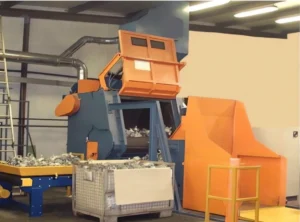
What EHS Auditors Inspect at a Shot Blasting Station
Auditors normally evaluate the complete risk-control chain rather than the machine nameplate alone. A visually clean workshop may still receive findings if engineering controls, maintenance records, or emergency procedures are incomplete.
- Dust containment:Enclosures, doors, seals, transfer points, and abrasive recovery areas should prevent visible or fugitive dust release.
- Dust collection performance:The collector should provide stable airflow, suitable filtration, safe discharge, and documented maintenance.
- Emission control:Exhaust outlets, ductwork, filtration stages, and monitoring arrangements should match applicable site and customer requirements.
- Machine guarding:Rotating equipment, conveyors, elevators, blast wheels, access doors, and pinch points require effective guarding.
- Interlocks and emergency controls:Doors and access panels should stop hazardous motion where required. Emergency stops must be accessible, labeled, and tested.
- Noise and vibration:The factory should assess worker exposure and provide engineering controls or personal protective equipment where necessary.
- Electrical and fire safety:Control panels, grounding, cable protection, lighting, combustible dust risks, and fire response equipment may be reviewed.
- Operational discipline:Auditors may request risk assessments, training records, inspection logs, maintenance evidence, and corrective-action closure reports.
Why Basic Dust Collection Often Fails Compliance Reviews
A basic dust collector may remove visible dust while failing to maintain the airflow, filtration efficiency, or sealing performance needed for consistent compliance. The difference is usually found in engineering calculations, component selection, installation quality, and ongoing maintenance.
| Evaluation area | Basic configuration risk | Audit-ready configuration |
| Airflow | Fan selected by nominal machine size without verifying pressure loss | Air volume and static pressure matched to the machine, ductwork, filters, and operating condition |
| Filtration | Generic filter elements with limited dust compatibility | Filter media selected for abrasive dust characteristics, temperature, humidity, and replacement access |
| Sealing | Leaking doors, ducts, flanges, or inspection covers | Sealed interfaces with planned inspection and replacement of wear components |
| Discharge | Uncontrolled dust removal or poorly managed collection containers | Safe discharge arrangement with housekeeping, disposal, and exposure controls |
| Verification | No baseline readings or maintenance history | Commissioning records, differential-pressure checks, airflow verification, and periodic inspection logs |
Procurement teams should therefore avoid comparing dust collectors only by fan power or filter quantity. A compliant design must consider the complete airflow path, including the Shot Blasting Machine enclosure, abrasive separator, recovery system, duct elbows, collector, fan, exhaust stack, and replacement-filter condition.
Common Non-Compliance Issues in Shot Blasting Safety Audits
Repeated findings are often caused by design omissions rather than operator negligence. The following issues should be addressed before equipment acceptance:
- Dust leakage around loading doors, inspection covers, or worn seals.
- Insufficient extraction at loading, unloading, or abrasive transfer points.
- Dust collector capacity that declines rapidly as filters become loaded.
- Missing or ineffective door interlocks and emergency-stop devices.
- Unprotected rotating parts, conveyor sections, elevators, or maintenance access points.
- Unsafe access platforms, ladders, handrails, or lighting around elevated components.
- Unlabeled electrical panels, incomplete grounding, or exposed cables.
- Inadequate housekeeping around accumulated abrasive and dust.
- No documented inspection schedule for filters, ductwork, blast wheels, and safety devices.
- Incomplete training records, risk assessments, lockout procedures, or corrective-action evidence.
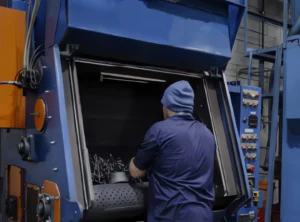
How to Match the Machine, Collector, and Safety Components
A Shot Blasting Machine should be purchased as a complete EHS system, not as an isolated production asset. The Manufacturer or Supplier should confirm the relationship between throughput, workpiece dimensions, abrasive type, blast intensity, enclosure volume, extraction points, and local workshop conditions.
Recommended engineering sequence
- Define the process:Confirm workpiece material, maximum dimensions, loading method, cycle time, abrasive media, surface standard, and operating hours.
- Map the installation site:Record available floor space, ceiling height, utility capacity, ventilation constraints, access routes, fire controls, and exhaust-routing limitations.
- Calculate extraction demand:Match airflow and pressure requirements to every connected point, allowing for duct resistance, filter loading, and future operating conditions.
- Select safety hardware:Specify guarding, interlocks, emergency stops, access platforms, warning signs, electrical protection, and lockout provisions.
- Verify interfaces:Confirm that the machine controls, dust collector, fan, filter monitoring, alarms, and emergency circuits communicate correctly.
- Document acceptance criteria:Define tests for airflow, leakage, noise, emergency stops, interlocks, emissions, housekeeping, and operator training before final handover.
For specialized production, Customizable OEM and ODM Wheelblast Equipment can be adapted to existing layouts and customer standards. However, customization should be based on documented requirements rather than informal modifications after delivery. A professional Supplier should identify exclusions, utility responsibilities, civil work, installation boundaries, and compliance assumptions in the quotation.
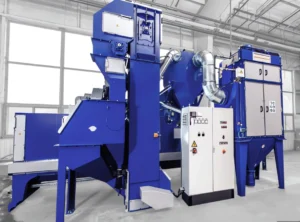
Documents Required for Customer and Official Audits
Documentation demonstrates that the system was designed, installed, operated, and maintained under controlled conditions. Procurement teams should require a document package before project closure.
- Equipment specifications, general arrangement drawings, and foundation requirements
- Dust collection calculations, airflow design data, filter specifications, and duct layouts
- Electrical schematics, grounding information, control-panel documentation, and component certificates
- Risk assessment, guarding details, interlock logic, emergency-stop layout, and lockout guidance
- Operating, cleaning, maintenance, and filter-replacement manuals
- Commissioning test records and measured performance results
- Recommended spare-parts list and preventive-maintenance schedule
- Operator training records, attendance sheets, and competency evaluations
- Inspection checklists for daily, weekly, and monthly EHS verification
- Corrective-action records, service reports, and evidence of completed improvements
Build a Daily EHS Inspection SOP
Daily inspections should be short, repeatable, and assigned to named personnel. The objective is to identify deteriorating conditions before they become audit findings or production interruptions.
- Check the surrounding area for visible dust, abrasive accumulation, leaks, blocked access, and damaged guards.
- Verify that doors, covers, interlocks, emergency stops, warning lights, and alarms operate correctly.
- Confirm that the dust collector is running, differential pressure is within the approved range, and collection containers are safely positioned.
- Inspect duct connections, flexible joints, seals, filter-access covers, and exhaust points for leakage or abnormal vibration.
- Review unusual noise, vibration, temperature, abrasive discharge, or machine alarms.
- Record findings, isolate unsafe equipment when necessary, assign corrective actions, and verify closure.
The SOP should identify who may restart equipment after a safety stop, how dust is removed, which protective equipment is mandatory, and when a qualified technician must be called. Records should be retained in a form that operators and auditors can easily review.
Case Study: Replacing Equipment to Reduce Audit and Remediation Risk
A metal-component factory experienced repeated findings for dust leakage, incomplete interlocks, unstable extraction, and missing maintenance records on an aging blasting line. Temporary sealing and filter replacement reduced symptoms but did not provide reliable control, and customer approval was repeatedly delayed.
The replacement project began with a site survey and an audit-gap review. The selected Manufacturer supplied a Customizable Wheelblast Equipment package containing a sealed blasting chamber, integrated abrasive recovery, correctly matched dust collection, guarded access points, interlocked doors, emergency controls, and documented commissioning tests.
| Project stage | Risk-control action |
| Preliminary review | Compared audit findings with machine condition, workshop layout, utilities, and customer requirements |
| System design | Matched enclosure, ductwork, collector, fan, filters, controls, and safety devices as one package |
| Installation | Verified foundations, grounding, access platforms, sealing, exhaust routing, and control interfaces |
| Acceptance | Completed airflow, interlock, emergency-stop, leakage, noise, training, and documentation checks |
| Operation | Implemented daily inspection, preventive maintenance, filter monitoring, and corrective-action records |
This approach reduced dependence on repeated temporary repairs and gave the factory objective evidence for customer and EHS reviews. The central lesson is that audit performance should be designed into the Shot Blasting Machine package from the beginning.
Take Action Before the Next Audit
Do not wait for an audit failure to expose configuration gaps. Ask an experienced Manufacturer and Supplier to review your process, workshop, dust collection, safety controls, and documentation. Contact our team for a site-based assessment and a Customizable OEM or ODM Wheelblast Equipment proposal built for dependable EHS compliance.
 English
 Russian
 Spanish
 Portuguese
 French
 Indonesian
 Thai