Manual sandblasting of small precision parts is inefficient and uneven; rotary table automatic sand blasting machine offers solutions.
This guide defines rotary table automatic sand blasting machine, explains its core structure and working principle, helping you fully understand this professional sand blasting equipment.
Read on to explore key details of rotary table automatic sand blasting machine.
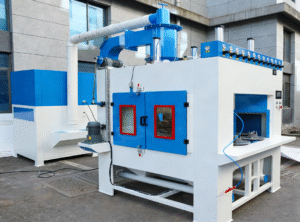
What Is the Core Structure of Rotary Table Automatic Sand Blasting Machine?
A rotary table automatic sand blasting machine is a professional sand blasting equipment integrating automation and precision, with a scientific and compact core structure. Its main components include a rotary worktable, sand blasting system, enclosed chamber, dust removal system and automatic control system. The rotary worktable is the core part, driven by a servo motor to realize stable and adjustable rotation (speed range: 5-30 rpm), ensuring 360° uniform sandblasting on workpiece surfaces without dead angles. The sand blasting system consists of high-pressure nozzles (usually 2-4 nozzles), an air compressor and an abrasive storage tank, which provides stable abrasive supply and adjustable sandblasting intensity. The enclosed chamber is made of wear-resistant steel plates to prevent abrasive splashing and dust leakage, ensuring operational safety. The built-in dust removal system is essential for environmental protection, collecting over 99% of sand dust and waste residues to meet emission standards. The automatic control system (PLC) enables pre-set parameters such as rotation speed and sandblasting time, realizing unmanned operation. Compared with traditional sand blasting machine, its integrated structure enhances stability and processing efficiency significantly.
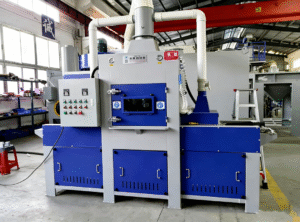
How Does a Rotary Table Automatic Sand Blasting Machine Work?
The working principle of rotary table automatic sand blasting machine is based on automated coordination of multiple systems, realizing efficient and precise sandblasting. First, operators place workpieces on the rotary table and fix them with fixtures (to avoid displacement during rotation). Then, set parameters such as rotation speed, sandblasting time and abrasive flow rate through the control panel, and start the machine. The enclosed chamber door closes automatically to ensure airtightness. Next, the air compressor generates high-pressure air, which drives abrasives from the storage tank to the nozzles. Simultaneously, the rotary table starts rotating, and the nozzles spray abrasives onto the rotating workpiece surfaces at high speed to complete sandblasting (rust removal, deburring, surface roughening). During the process, the dust removal system runs synchronously to collect dust and waste. After the preset time is reached, the machine stops automatically, the chamber door opens, and the rotary table stops rotating. Finally, operators take out the processed workpieces. This automated working process not only improves efficiency but also avoids human error, ensuring consistent sandblasting effect. Unlike manual or semi-automatic sand blasting machine, it is especially suitable for batch processing of small precision parts.
Conclusion
Rotary table automatic sand blasting machine is efficient, precise and automated sandblasting equipment.