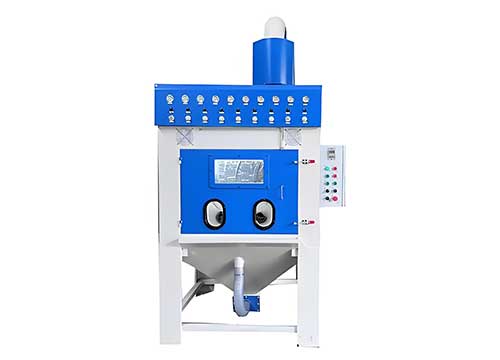
Automatic sandblasting has high costs and poor flexibility; Manual sandblasting machine suits small-batch sandblasting needs well.
This guide outlines key advantages of Manual sandblasting machine, covering cost, flexibility and applicability for sandblasting operations
Read on to explore why Manual sandblasting machine fits specific sandblasting scenarios.
What Cost and Flexibility Advantages Does Manual Sandblasting Machine Offer for Sandblasting?
Manual sandblasting machine holds obvious advantages in cost control and operational flexibility compared to automatic sandblasting equipment. In terms of cost, Manual sandblasting machine features a much lower initial investment—usually 1/3 to 1/5 of automatic models, which is more friendly for small and medium-sized enterprises (SMEs) and individual workshops. It also has lower maintenance costs due to its simple structure with fewer electronic components, reducing repair frequency and expenses. In terms of flexibility, operators can adjust sandblasting intensity, angle and speed of Manual sandblasting machine in real time according to the workpiece’s actual condition. This is crucial for irregularly shaped workpieces or those needing localized sandblasting (such as small precision parts’ burr removal). Unlike automatic equipment that requires complex programming for parameter adjustments, Manual sandblasting machine can quickly switch between different sandblasting tasks, adapting to small-batch, multi-variety sandblasting needs efficiently.
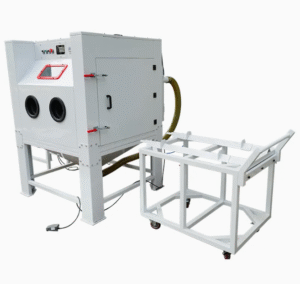
What Applicability and Operational Convenience Advantages Do Manual Sandblasting Machine Have?
Manual sandblasting machine excels in applicability and operational convenience for specific sandblasting scenarios. In terms of applicability, it is ideal for small-batch production, prototype processing and maintenance sandblasting tasks. For example, auto repair shops use Manual sandblasting machine to clean rust on auto parts, while hardware workshops rely on it for surface treatment of small batches of custom parts. It is also suitable for workpieces with strict surface quality requirements that need manual fine-tuning. In terms of operational convenience, Manual sandblasting machine has a simple structure, requiring no professional programming skills—operators can master sandblasting operations after simple training. Its compact size saves workshop space, making it suitable for small-scale production sites. Additionally, Manual sandblasting machine can use various abrasives (such as glass beads, aluminum oxide) to achieve different sandblasting effects, further expanding its applicability.
Conclusion
Manual sandblasting machine is cost-effective and flexible for targeted sandblasting needs.